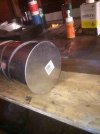
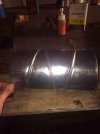
Made my homemade forge today!

Joined
Dec 29, 2008
Messages
697
So today I finally put together my forge. Was very easy but didn't come out as nice as I hoped. I hope this design works for the materials I had I think it should be ok. Let me know what you guys think.
The housing is a piece of circular 6" heater duct with an end cap. Drilled hole in the side for the torch head. And filled the thing up with refractory cement . To keep the 3.5 inch hole in the center I used 2 monster cans then once the cement was packed in I removed them. During removal kinda elongated my nice hole a little but still seems ok. I could not find that fire proof wool material so I hope this design works.
Still needs to be painted and brackets made . Just for now I'm running the torch to let the cement harden. ImageUploadedByTapatalk1385256389.115867.jpgImageUploadedByTapatalk1385256402.230587.jpgImageUploadedByTapatalk1385256409.713778.jpgImageUploadedByTapatalk1385256415.550268.jpg
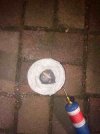
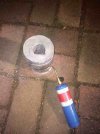
Let me know your guys opinions please.
 
Well, It is a start, but probably won't work well ...if at all. The whole shell of refractory cement will need to come up to the chamber temp to work. Refractory wool is an insulator, and only the 1/4" of refractory on the wool gets heated up.
Also, the torch shown does not look sufficient to heat a forge. It take a lot of BTUs, and a simple plumbers propane torch has not nearly enough.

Your use of things available is good, but the things you used are not suitable.
 
Probably the most critical point I see that has not been addressed is the fact that that is galvanized pipe. Which could be very very bad. Bad as in killing you if the pipe gets too hot and releases zinc vapours
 
Well, It is a start, but probably won't work well ...if at all. The whole shell of refractory cement will need to come up to the chamber temp to work. Refractory wool is an insulator, and only the 1/4" of refractory on the wool gets heated up.
Also, the torch shown does not look sufficient to heat a forge. It take a lot of BTUs, and a simple plumbers propane torch has not nearly enough.

Your use of things available is good, but the things you used are not suitable.

Wow good thing I showed everyone this before I tried to actually work with it.

This wool insulator can you find this at a local Home Depot or is it something that needs to be ordered? If so what type would be sufficient for me? I mostly work with 1084 and 1095 steel.
Sending things out to get heat treated has just become a pain and costly.

Now for the torch what type of torch should I use? Would mapp gas be a better approach?

Kinda bummed I just made a giant paper weight lol.
Thank you guys very much for the help.
 
Probably the most critical point I see that has not been addressed is the fact that that is galvanized pipe. Which could be very very bad. Bad as in killing you if the pipe gets too hot and releases zinc vapours

Wow thank you! I had no idea. That could of been bad . Good thing it didn't get to hot and it was outside.
 
I built my first forge today also.

You need to spend some money at hightemptools!
 
The proper materials are all available from High Temp Tools and Refractory, www.hightemptools.com They also have lots of forge building info.
Many pottery supply shops, and well as places that sell boiler supplies carry it as well as the refractory coating. The two refractory blanket/matting most commonly used are called Kaowool and Inswool, and the common refractory coating is called satanite. There is lots of info in the stickies on forge building and the materials needed.
There are a lot of knifemakers in your area, maybe one will have some scraps of Kaowool he can give you.

As to the galvanized piping, the fumes can make you feel sick...if it gets to 800°F and above, but a forge shell should not get that hot. Also, people constantly confuse zinc poisoning with metal fume sickness/fever...which is what you get from breathing the fumes off of galvanized metal that is heated with a torch or other high heat. The zinc combines with the air and makes zinc oxide , which comes off as a white smoke. Breathing it can make you dizzy and nauseous, and even give you a fever, but it is not fatal. The treatment is getting fresh air and a good nights sleep. Some old welders recommend drinking a glass of milk. What that does is wash down the zinc oxide from your throat's mucous membranes and also settles your stomach.
Zinc poisoning is a very rare problem with humans, but is very bad for animals, especially birds and dogs. It is from absorbing elemental zinc, not the stable form of zinc oxide. My standard statement on zinc in the form of zinc oxide being poisonous is, "Why aren't all the lifeguards in California dropping dead?"

That said, avoiding this situation is practicing good safety.

For a forge body, use any steel cylinder. Avoiding galvanized metal where flames will be is always a good idea. An old CO2 or oxygen tank, , propane/Freon/helium tanks, a piece of 6-8"pipe from the junk yard, #10 coffee can, etc
 
Here is a good text copy from an OSHA advice forum:

In the arc welding or torch welding of galvanized steel,
provision must be made for control of welding fumes when
planning procedures. Due to the relatively low melting point of zinc a proportion of the coating is volatilized and given off as a white zinc oxide fume. The presence of any fume evolved is obvious and this permits simple observation of the efficiency of the ventilation or extraction system.
When welding is carried out in accordance with normal
industrial practice with provision for adequate ventilation and air circulation, the non-toxic zinc fumes will cause no inconvenience. If adequate ventilation is not available supplementary ventilation using air extraction equipment or forced air circulating equipment should be provided.
Although welding fumes from galvanized steel are not toxic,
operators welding in a confined space should always be
provided with suitable respirators to minimize possible
discomfort. Fume development and consequent coating
damage may often be minimized with certain joint designs in
flat sheet by the use of copper chill bars. The chill bars are used as a backing strip or clamped on the weld side of the joint to absorb some of the heat generated during welding.

When zinc vapor mixes with the oxygen in the air, it reacts instantly to become zinc oxide. This is the same white powder that you see on some noses at the beach and the slopes. Zinc oxide is non-toxic and non carcinogenic. Extensive research into the effects of zinc oxide fumes has been done, and although breathing those fumes will cause welders to think that they have the flu in a bad way, there are no long-term health effects. Zinc oxide that is inhaled is simply absorbed and eliminated by the body without complications or chronic effects. Current research on zinc oxide fumes is concentrated in establishing the mechanism by which zinc oxide causes "metal fume fever," how its effects are self-limiting and why zinc oxide fume effects ameliorate after the first day of exposure even though the welder may continue to be exposed to zinc during subsequent days ("Monday-morning fever"). Other research is being done using zinc oxide fumes together with various drugs which results in a synergetic effect for treatment of cancer and AIDS. Another area of research is use of zinc compounds as the active ingredients in throat lozenges that are recognized as significantly effective in reducing the duration and intensity of the common cold.
Typical “metal fume fever” begins about 4 hours after exposure, and full recovery occurs within 48 hours. The symptoms include fever, chills, thirst, headache and nausea. All of these symptoms, pain and suffering, as well as lost work (and play) time, can be avoided entirely by simply not inhaling the zinc oxide fumes. This can easily be done using any of the methods described later.
Unlike other heavy metals, such as copper, lead and mercury, zinc is an essential micro nutrient. Zinc is essential to the proper growth of plants and animals. Zinc forms part of the enzyme system that regulates biological processes throughout the body. As shown on any multi-vitamin/mineral bottle, the recommended minimum adult intake is 15 mg/day.
 
The proper materials are all available from High Temp Tools and Refractory, www.hightemptools.com They also have lots of forge building info.
Many pottery supply shops, and well as places that sell boiler supplies carry it as well as the refractory coating. The two refractory blanket/matting most commonly used are called Kaowool and Inswool, and the common refractory coating is called satanite. There is lots of info in the stickies on forge building and the materials needed.
There are a lot of knifemakers in your area, maybe one will have some scraps of Kaowool he can give you.

As to the galvanized piping, the fumes can make you feel sick...if it gets to 800°F and above, but a forge shell should not get that hot. Also, people constantly confuse zinc poisoning with metal fume sickness/fever...which is what you get from breathing the fumes off of galvanized metal that is heated with a torch or other high heat. The zinc combines with the air and makes zinc oxide , which comes off as a white smoke. Breathing it can make you dizzy and nauseous, and even give you a fever, but it is not fatal. The treatment is getting fresh air and a good nights sleep. Some old welders recommend drinking a glass of milk. What that does is wash down the zinc oxide from your throat's mucous membranes and also settles your stomach.
Zinc poisoning is a very rare problem with humans, but is very bad for animals, especially birds and dogs. It is from absorbing elemental zinc, not the stable form of zinc oxide. My standard statement on zinc in the form of zinc oxide being poisonous is, "Why aren't all the lifeguards in California dropping dead?"

That said, avoiding this situation is practicing good safety.

For a forge body, use any steel cylinder. Avoiding galvanized metal where flames will be is always a good idea. An old CO2 or oxygen tank, , propane/Freon/helium tanks, a piece of 6-8"pipe from the junk yard, #10 coffee can, etc

Thanks for all that information. Now I can go ahead and make a decent forge . Oh we'll now I can paint it black and have a fancy umbrella stand!
I was wondering why no one used just cement alone in the stickies or how to videos .
Thanks for the link and do you know of any makers in CT that use this forum?
 
New England is full of them There is the New England Bladesmiths guild, and another guild or two up there, and a knife making school called the New England School of Metalworking.
http://www.newenglandschoolofmetalwork.com/

Off the top of my head, in CT there is Kevin Cross, rocketman, Chris Myers,.... and lots more I can't recall the names of. MA is also full of makers.
 
My first little forge I made from a paint can, I looked around locally for kaowool or insuwool and could not find it, how ever I did find Mineral Wool that was rated at 2300[SUP]o[/SUP]f. I wrapped 2 inches of that inside and then coated with refractory cement (several layers). It worked fine, outside of the can I could place my hand on it, was very warm but would not burn me.

HOWEVER I do not think this is the best way to do it, and it is why I only used it twice, I just started out so I just simply posted what I did and I recommend buying one that is made properly. I just put an order in on a Atlas mini forge, it is $240 and I can feel comfortable knowing it's made by people much more knowledgeable, and smarter than me. In the meantime I am just using a fire brick forge.
 
Back
Top