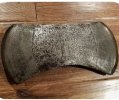
Maine or Worn Western?

Joined
Mar 31, 2016
Messages
1,936
Ive been hanging on to this guy for a good few years but i havent done anything with it because i always thought it was a particularly worn out western.

ive only just weighed it and discovered it actually weighs about 3 1/4lbs (stamped 3lbs) and has a LOT of bit left, it doesnt seem very worn at all.

However, it seems to me to have a fair bit more beard than the typical Maine.

And on the other hand, the toes are dead flat all the way across, and its a very stubby thing.

what say you, western or big maine?


another thing i noticed, i believe these ward's master qualities to be forge welded given the two temper lines. In the 2nd picture you can very plainly see a transition from the body to the bit, and a separated temper line. if these were mono-steel heads, i believe there would only be one line.
qd5g3Xr.jpg

UDVLLtz.jpg
 
If a double bit doesn't have a diamond-shaped eye I generally don't consider it a Maine.
 
Wisconsin pattern maybe?
i think youre onto something, i did go and look through the montgomery ward catalogs that i could find, however they never mention making anything other than a connie, dayon, and michigan.

this is despite the fact that theyve made axes outside of these patterns, as evidenced by this puget sound: https://www.worthpoint.com/worthopedia/vintage-lb-oz-wards-master-quality-2062825135

I think youre right, it may be a pennsylvania or wisconsin pattern.

After grinding it, i can very plainly say this axe was not only 3 pounds and is actually missing quite a bit of its bit judging by the sheer amount of material ive had to remove from the bit
 
Warren made some lakeside axes no reason to think they didn't make the premium ones as well wards master quality want junk on anything I have come across
 
I believe it to be a western with worn toes.
Whatever though it is a high-quality axe that would be worth the file work to be put back into shape.
 
I believe it to be a western with worn toes.
Whatever though it is a high-quality axe that would be worth the file work to be put back into shape.
no file, but the belt grinder took a VERY long time to get through the steel here.

these inserted bit axes are always incredibly hard, whether its a no-name, spiller, or apparently a Ward's. I see why hand forged axes stuck around well into the mono-steel era

Hr4lFVy.jpg
 
I believe it to be a western with worn toes.
Whatever though it is a high-quality axe that would be worth the file work to be put back into shape.
Yeah.
And I wouldn't really expect anything but a common pattern on a house brand axe like this.
It's not unheard of but typically it's Dayton Michigan jersey and Western patterns for house brand axes, probably because a national chain store would want to avoid region specific products for their house brands.
 
no file, but the belt grinder took a VERY long time to get through the steel here.

these inserted bit axes are always incredibly hard, whether its a no-name, spiller, or apparently a Ward's. I see why hand forged axes stuck around well into the mono-steel era

Hr4lFVy.jpg
That looks great.
It will be an overlaid bit, they do run out of steel before the forge line is reached.
Axe is done before that will ever happen though.
 
I believe that when we get two lines visible on an axe one is the hardened steel bit and the other line above it is the quench.
I don't believe that we get that on wrought bodied axes so it would be a softer steel body and not iron.

Is this correct?
 
I believe that when we get two lines visible on an axe one is the hardened steel bit and the other line above it is the quench.
I don't believe that we get that on wrought bodied axes so it would be a softer steel body and not iron.

Is this correct?
It's more likely that the lines would be the other way 'round, as you'll see a quench line on steel and then see the steel-to-iron transition. In the case of an overlaid bit there's no point in quenching deeper than where the edge steel goes, thus the extensions of the cheeks scarfs would be unquenched.
 
It's more likely that the lines would be the other way 'round, as you'll see a quench line on steel and then see the steel-to-iron transition. In the case of an overlaid bit there's no point in quenching deeper than where the edge steel goes, thus the extensions of the cheeks scarfs would be unquenched.
qd5g3Xr.jpg
 
I believe that when we get two lines visible on an axe one is the hardened steel bit and the other line above it is the quench.
I don't believe that we get that on wrought bodied axes so it would be a softer steel body and not iron.

Is this correct?
Most of the time, yes. But sometimes one can find a monosteel Plumb with two lines.
pOoRl5V.jpeg
 
Come to think of it I have noticed that tempering quench on other Plumbs.

I'm not sure when Plumb first advertised solid steel axes, but I did a deep dive into it at one time and the results are buried in this forum some place.
Plumb was the earliest solid steel I could find and maybe it was just because they are so well documented. It seems like it was between 1908-1912 range so quite early.

So, calling a solid steel Plumb modern is very subjective.
 
Plumb is definitely the first company doing whole-steel construction I've seen incidentally when scouring period documents for scythe-related info. In all the old publications I've seen Plumb in I see them using whole steel quite a ways back.
 
Plumb is definitely the first company doing whole-steel construction I've seen incidentally when scouring period documents for scythe-related info. In all the old publications I've seen Plumb in I see them using whole steel quite a ways back.
I believe when it comes to one piece construction full size axe heads, Plumb was a pioneer. However, I think monosteel hammers and hatchets came much earlier. It would be worth to examine history and products of George Selsor and Germantown Tool Works: I have just not seen many hatchets with inlaid bit from those two.
 
Back
Top