Makin' Band Saw Blades

Stacy E. Apelt - Bladesmith

ilmarinen - MODERATOR
Moderator
Knifemaker / Craftsman / Service Provider
Joined
Aug 20, 2004
Messages
38,498
Recently I bought a couple hundred feet of band saw blade stock. Lenox, Norton, etc.
Though I'd show you how the old school folks make up blades.

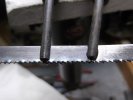
First, you cut the piece 3/4" longer than the blade size.
Then you scarf both ends.
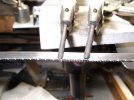
Then you hold in place with a piece of hard silver solder sheet ( 1200F) between the ends.
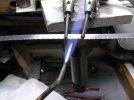
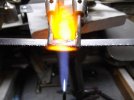
Flux and braze together with a torch.
Temper the joint.
Grind clean.
Put on saw and cut away.
 

Attachments
  • band saw blade weld 002.jpg
    band saw blade weld 002.jpg
    46.5 KB · Views: 146
  • band saw blade weld 004.jpg
    band saw blade weld 004.jpg
    43.4 KB · Views: 147
  • band saw blade weld 005.jpg
    band saw blade weld 005.jpg
    47.1 KB · Views: 144
  • band saw blade weld 007.jpg
    band saw blade weld 007.jpg
    40.5 KB · Views: 152
Last edited:
The process seems pretty straight forward, but I never quite figured out how you're supposed to anneal the joint. Any details ?
 
The one being joined in the photo is Lenox Diemaster2 bladestock. It comes in a 100 foot roll.

I mis-typed "anneal" when I meant to type "Temper". You just re-heat the joint to a dull red after clean-up.
 
Not that I intend on making my own blades Stacy but I have to ask some questions about the process!

In the first pic where you lapped the ends of the blade to be. The teeth do not appear to be lined up in the second pic they appear to be aligned, is that because you realigned them or did you file them in.

Next is there a double thickness at the splice? That looks problematic!

How long did it take for you to learn to get this process right? Cause for the average Joe I see a big learning curve here!
 
Cool stuff. I made a steel clamping jig with a cutout for the splice area, it helps to braze the blade together in a straight line. It's easy to get it to look nice, then put on the saw and it wobbles with a slightly crooked splice.
 
I've done this many times thru 35 years of knifemaking, still have it available locally and still
in a pinch try it occasionally. I've made a lot of jigs to hold things straight and true and now
and then get one to not bump too bad but for the most part I do much better buying them
already welded.
Ken.
 
I'll bet I'm the only one here (dumb enough) who TIGs them.
 
Nathan, After you tig them do you anneal or temper and how? Thanks Jess
 
The teeth don't have to line up, but I usually do it anyway. They loose much of their hardness in the brazing, and don't really cut. All photos are the same blade, and the difference in alignment appearance is caused by camera angle. The thickness in the photo is mainly caused by the sheet of hard solder between the blade ends. Once the joint is made it is much tighter, then the sides are ground until the thickness is even with the blade size. Sometimes I feel a little bump in cutting and need to take off a high spot, but these blades usually work pretty good.
 
ive got two im going go tig how the best way of doing it nathan

I use .020 stainless filler rod I have on hand, it seems to crack less. I have a little metal fixture I made that is nothing more than a shallow angle that the spine rests against to keep things straight with a little clearance cut for the teeth. I grind the ends square and chamfer them. I clamp one end in the fixture with a little c clamp, then the other with the loop of the blade going down and sit the mess on the corner of my welding table.

Nick would cringe if he saw the way I weld this. I drip a bead of filler rod in the middle half of the joint. I then come back and pulse it from the center to the edges. You have to be real careful not to over do it towards the edges or you'll blow it because the material is only about 30 thou, so at the edge I just barely use enough power to maintain the arc with real quick pulses of heat. With it welded I then draw it back with a propane torch, flip it and do it over again with the loop up and just clamp it flat to the corner of my weld table. Draw it back with a propane torch again and grind the weld flush (I use a little 3" angle grinder I keep over by the welder). It about takes more time to describe it than it does to actually do it. I don't have a perfect success rate, every once in a while they'll crack, but they usually don't give me any trouble.


edit: I understand that some people braze them using TIG as the heat source, but I've never tried it.
 
Last edited:
Back
Top