Making a bush craft blade

Joined
May 8, 2014
Messages
45
Would anyone care to define what the profile of the blade looks like ... i.e. angle of grinde? Will a 5/32 blade do good?

 
There are all kinds of shapes and sizes of "bush craft" knives, go with what you think looks nice. :thumbup:
 
Have you ever used a knife for bushcraft? If yes, then you should have an idea of what works. If no, then it doesn't matter....you don't know what works and you need to start some where . 5/32 will be just as good as anything. Why not.
 
Typical 'bushcraft' looks like a drop point or semi-spear, like these ...
esee-4p-od-thumb.jpg
esee-ls-p-thumb.jpg


Scandi or Sabre or Full Flat are popular grinds, each has its pros-n-cons and fans. ;)

5/32" will work but 3/16" would probably be better if you intend it to do a lot of batoning.
 
Typical 'bushcraft' looks like a drop point or semi-spear, like these ...
esee-4p-od-thumb.jpg
esee-ls-p-thumb.jpg


Scandi or Sabre or Full Flat are popular grinds, each has its pros-n-cons and fans. ;)

5/32" will work but 3/16" would probably be better if you intend it to do a lot of batoning.

agreed "if" batonning is going to be your primary goal then lean toward thicker... if cutting is your goal go thinner. When I decided that I was going to make a specific bushcraft blade I searched a lot of popular models and had a look at their dimentions. most are smaller than I would have thought or what I had been using, so I refined one of my designs to accommodate. typical sizes are about 8.5 - 9.5 OAL with a blade of between 3.5 and 4.5 at about 1/8 to 3/16 thick... with 5/32 right dead in the middle I would have to say you likely have a good starting point.
 
Typical 'bushcraft' looks like a drop point or semi-spear, like these ...
esee-4p-od-thumb.jpg
esee-ls-p-thumb.jpg


Scandi or Sabre or Full Flat are popular grinds, each has its pros-n-cons and fans. ;)

5/32" will work but 3/16" would probably be better if you intend it to do a lot of batoning.
These aren't bushcraft knives. They'll work but they're really not suited for a lot of carving. Maybe if you thin the edge out...a lot. IME all of the survival type knives like the ones above have been absolute crud when doing any kind of carving. You can start a fire and build a "shelter" with these but they're typically too thick in the edge, have so so handles and are just plain cumbersome for bushcraft. If you're looking for a true bushcraft knife opt for something thin bladed, thin stocked, about 3-5 inches in blade length and with a comfy hand filling handle. I've tried esee, becker, swamp rat, scrapyard, kabar, survive, and a few others of the most recommended brands. And I mean a few of the top models from each brand. I've also tried several customs. I always come back to a mora.
 
This is one of my favorite knives. Fiddleback Forge (version of the) Kephart.

HVWdXCO.jpg


5/32"

High convex grind

O1

4" blade, around 5" handle

Tapered tang

It's just a stellar knife. To me, when I think "dog" I think black lab or golden retriever. Folding knife= Buck 110. Fixed blade= FF Kephart.
 
I guess it depends on what your definition of a bushcraft knife is. A bushcraft knife too me is is like a survival/camping knife. It should be able to perform multiple task like skinning/cleaning animals or fish, light batonning, making fire and shelter...Most production knives have a thicker edge than custom knives. I think a drop point with a 4-5" blade works well for lots of stuff. 1/8"-5/16" thick is fine. Like I said, when I think bushcraft knife I think things like camping/backpacking/hunting.... things done in the bush!
These aren't bushcraft knives. They'll work but they're really not suited for a lot of carving. Maybe if you thin the edge out...a lot. IME all of the survival type knives like the ones above have been absolute crud when doing any kind of carving. You can start a fire and build a "shelter" with these but they're typically too thick in the edge, have so so handles and are just plain cumbersome for bushcraft. If you're looking for a true bushcraft knife opt for something thin bladed, thin stocked, about 3-5 inches in blade length and with a comfy hand filling handle. I've tried esee, becker, swamp rat, scrapyard, kabar, survive, and a few others of the most recommended brands. And I mean a few of the top models from each brand. I've also tried several customs. I always come back to a mora.
 
Last edited:
ST9EMB.jpg


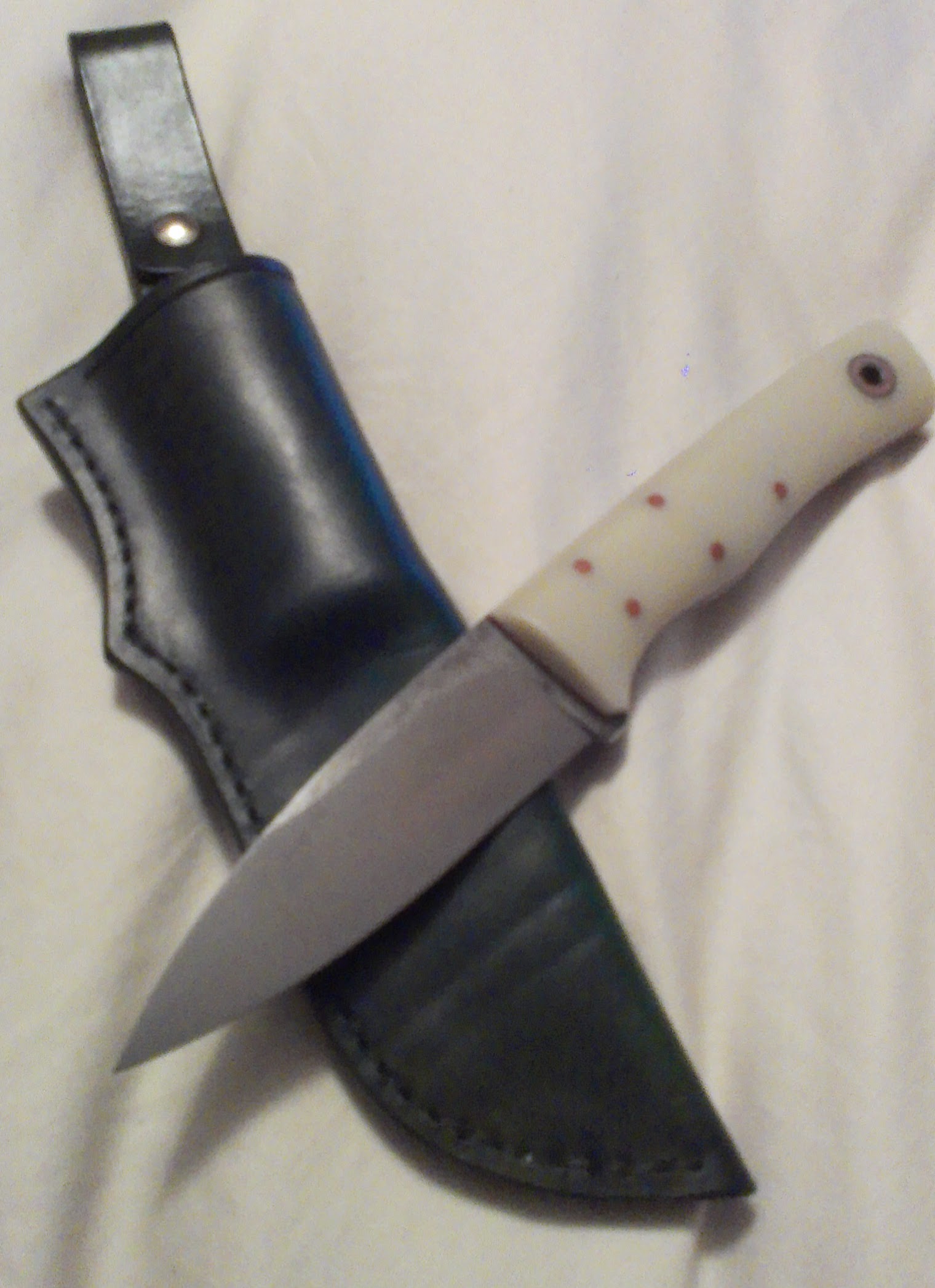
This is one I made out of a Simmonds file. It was my first attempt at a scandi grind and I was very impressed with the ease it cut oak and maple boards. This sold right away so I'm sure I'll be making another one very soon.
 
Why all the emphasis on thick blades? Look at knives traditionally carried in the woods/wilderness by guys that actually depended on their knives to survive, i.e. "mountain men," "long hunters," etc. Lots of French style chef knife looking knives in fairly thin steel.
 
Lots of people want a knife to be an axe. When I go backpacking, I carry a small hatchet for chopping and use my knife for knife stuff. It's surprising what an 1/8" thick knife will do.
Why all the emphasis on thick blades? Look at knives traditionally carried in the woods/wilderness by guys that actually depended on their knives to survive, i.e. "mountain men," "long hunters," etc. Lots of French style chef knife looking knives in fairly thin steel.
 
Lots of people want a knife to be an axe. When I go backpacking, I carry a small hatchet for chopping and use my knife for knife stuff. It's surprising what an 1/8" thick knife will do.

Well said. I never understood the thick blade concept. I'll take an 1/8" all day long.
 
Well said. I never understood the thick blade concept. I'll take an 1/8" all day long.

+2 for that. most of my stock starts at 3/16 unfinished down to 1/8 and i only do 1/4 on BIG knives if someone requests it. If you can't get what you need out of a well made knife of thinner stock you're probably not using a knife properly IMHO
 
The ones I choose to carry are 1/8" thick steel with a tapered tang. 4" blade. No choil.
 
Back
Top