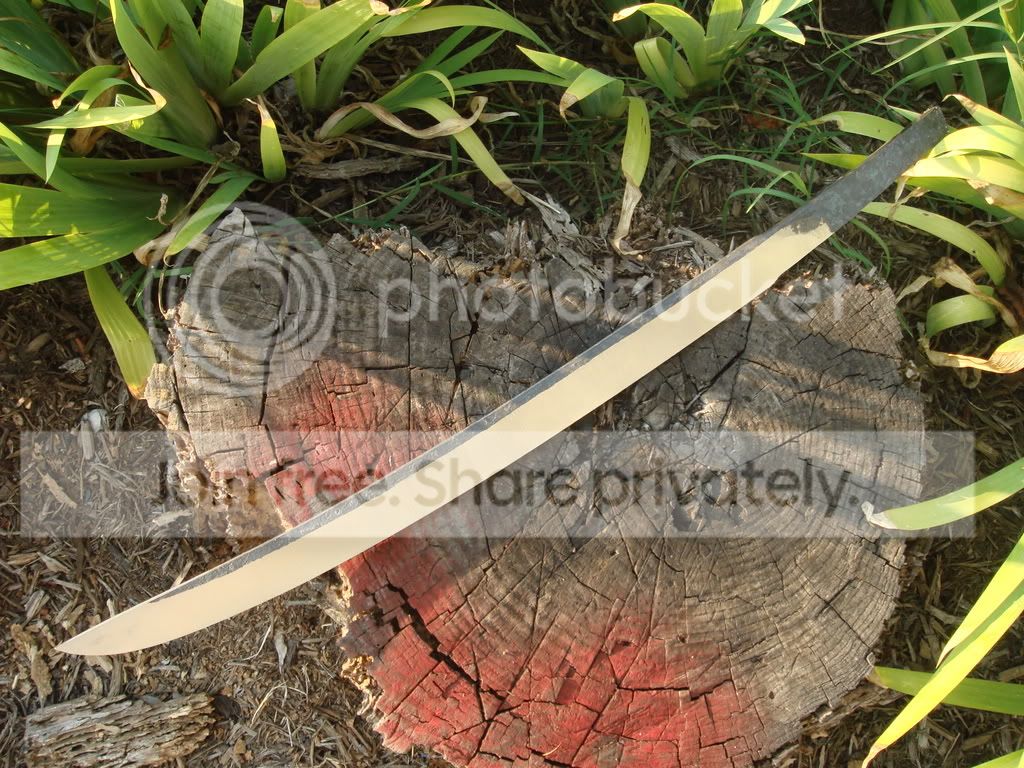
making a new Wak, comments? (pic)

Joined
Jan 2, 2006
Messages
1,073
hey everybody...
relativly recently i tried out swrodmaking.. and broke the Wak in the process. well.. i am back again. i am using W1 steel, and i froged the sword to shape.. i put some sori in there before hand as i am going to be quenching with Parks #50. as i am still relativly early in the process, comments or advise would be greatly appreciated.
thanks!
~Chris
DSC01800.jpg
 
Lookin' good, Chris - can't wait to see this one after heat treat!
 
That looks awesome! 20 bucks says its not going to crack 50 bucks says its going to look awesome. do you plan on wrapping the handle?
 
Nice!! Go for the oil Chris,I have to give you a pat on the back for trying water in the first place.You are a braver man than me:D
I might have missed it but how did the hamon come out on the last one? the clay looked great :thumbup:
 
You should be a world better off with the oil quench.
Clay coat it just the same as last time. Quench straight in and pull it out in about five-six seconds. It should be well past the nose by then (beware !!! It will ignite in a flaming ball, and/or smoke like hell). Give it a fast wipe with a dry rag (which may ignite,too) and check for warp and twist. If there is a warp, put it on the anvil and whack it straight with a wooden mallet (or just use a flat 2-3# hammer). If it has a twist, stick it in a straightening board and give it the necessary tweak. The board is a piece of 2X6 with a 2X1/4" slot in it. Clamp the board in the vise. You can also make a straightening hardy for your hardy hole by welding two pieces of 1/2 round stock on two adjacent sides of a piece of square stock to fit your hardy hole. The gap between the rounds should be 1/4-3/8".
You have about ten to twenty safe seconds to do the straightening, so don't waste time.
Once the twist/warp is QUICKLY straightened, stick it back in the oil to cool for 2-3 minutes. CAUTION - Once the blade is below 400F, don't straighten anymore or it will break. If the twist warp is too severe - anneal, straighten, normalize, and re-do the HT.

The flare up problems can be dealt with a couple of ways.
1) Planning - Have a metal trash can available to drop flaming rags in.
Wear heavy gloves,preferably foundry or smelting gloves.
Have a good fire extinguisher handy. A hose is good,too. But that is
a last ditch effort if things get totally out of control.
Make fire resistant/proof rags. Soak the rags in a saturated solution of
twenty mule team borax for an hour. Hang on the line to dry. Shake off
any loose powder. The rags will not burn readily.
HAVE A TIGHT LID FOR YOUR QUENCH TANK !
Have everything right at hand before starting the HT. Pliers, tongs, vise,
straightening jig, everything.
2) Control - Remove one of the ingredients of combustion. Since heat is not removable
you can exclude oxygen by putting some CO2 or Nitrogen in the top of
the quench tank (Have the rim about 5-6" higher than the oil) .You can
stop the sword from being a torch by wiping all the oil off it with
one fast swipe with a fire retardant rag (remove the fuel). The rag will
carry the burning oil with it, so drop it in the can.
3) Location - Unless you are in a warehouse size shop,with good ventilation and fire
control, do this type of quenching outside. Stay away from buildings,
flammable debris, and have plenty of overhead clearance (15-20 feet).

Be safe, Have fun, Show pictures (preferably of your girlfriend, but sword photos are good ,too.)
Plan this out in your head several times. Plan for every possibility. Do a dry run with the blade cold (or a bar of steel) before you clay coat and heat it up. Get the FEEL of how you are going to move, especially the straightening steps.

Good luck !!!

Stacy

 
Chris,

Blade looks great! I have done W1 blades that thick and wide, judging from the picture, but never nearly that long. I've had good results using and irrupted quench as well. I will add to Stacy's great post that for me I have found that I crack fewer W1 blades if I have the temper heat ready and RUN not walk to get the blade into the sandbox or oven before it gets below 130 or so. It may be just blind dumb luck, but it works for me. Some of the realy smart guys on TBF might explain why.

chiger
 
thanks everybody!
the blade is just over 18" and the oal is just under 24"
wow... thanks for the post Stacy, that is gonna be alot of help. i am gonna try a different way of heating this time as my HT forge is too small. gonna tr the traditional small fire big sword thing and "stoke" it in and out, you know? i already tried it ou when i was normalizing the blade... gonna try the HT forge (to see if it will fit) to see wich one works best.
yep.... i am planning on doing a traditional wraped sheath. gona try horn fittings this time.. i like how that looks.

question here... how hot does the oil need to be before quench?
also, since i have a curved blade... i cant to a perfect edge quench and will have to "roll" the blade. put the tip in first? or the main part of the blade?

wow.. with all this help i dont think i have any excuse to break the blade.
thanks so much and i will keep you posted... gonna hopefully file it down this afternoon or tommorow.
thanks
~Chris
 
I would advise against trying an edge quench on an 18 inch blade of W-1. Also the stroke method of heating to critical is iffy. Sometimes it works, sometimes it doesn't.
Stacy
 
I forgot to mentiton, in repsonse to the question on the hamon... i partially etched it... didnt polish it up real fine to see it in detail.. but the hamon was way far up on the blade.. almost past midpoint. no wonder it cracked. so i guess what would mean that i got it too hot? also i think they clay didnt cover enough of the edge for a good Choji hamon like i was shooting for.
thanks!
~Chris
 
so if i dont edge quench how do i do it?
(i dont know if the sword will fit in my HT forge becasue of the curve)
what would be the best way to do it then?
thanks
~Chris
 
Chris,

Again, I would agree with Stacy. Edge quench can be risky. W1 is extremely predictable if you control the variables. Possible outcomes that increase with length. Point quench = warp and crack. Edge quench = more curve and crack. Spine first quench = take out your curve. All possible or not depending on control of variables.

Oil Temp 130 is pretty common. Make sure you have plenty of volume so the oil has more effect on the steel than the other way round.

If the blade will not fit in completely you can us a torch on the remainder. I suggest the end near the hand since you will not want to over harden the spine and handle too hard anyway. W1 will get brittle.

Here is some good general reference info.
http://www.key-to-steel.com/Articles/Art12.htm

chiger,
 
so... if i dont ut the blade in edge first, and i cant put it in spine first, and i am not able to put it in tip first.. how the heck am i supposed to do it? i have an old wallpaper trough that i put my oil in. so it is long and about the right size for small swords..
thanks
~Chris
 
I think I was misunderstanding your term "edge quench". If you mean a full edge in quench, then that is a good choice. I would use a full edge first quench or a straight in point first quench.
The procedure that I am not a fan of is trying to quench the edge only and not quench the spine at all. Rocking the blade back and forth in 1/4" of oil is just not a suitable quenching method ,IMHO.
Stacy
 
i full clay my blades... i just put the edge in the oil first. that 1/4" of oil isnt a method of mine... i just dont havea way to point quench it.
thanks
~Chris
 
Back
Top