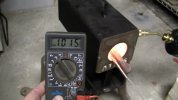
Making a thermocouple probe for heat treatment. PID or Mulitmeter?

Joined
Jan 16, 2013
Messages
3
Long time reader, first time poster..
I've been reading the great info on thermocouples and their usage on this forum, but im having a hard time deciphering whether i should get the PID, which i have zero experience with or to get a multimeter which seems more straightforward. Any problems getting the right connections from a thermocouple to a multimeter? Im using the probe to make sure my 1095 is at proper temp before hardening. Any help would be appreciated, thanks
Chase Dowler
 
If you are just checking your forges temperature adjustment, get a TM902C off ebay. It only reads in degC, so you'll probably need to convert your target temperature if you think in Fahrenheit, but for around 5 bucks delivered, it's a bargain. Accuracy is good and you won't be too upset when you drop it, melt it or stand on it at that price. It takes a type K thermocouple with a miniature (flat-pin) plug.

Thermocouple connectors come in 2 types; "standard", with round pins, and "miniature" with flat pins. Almost every handheld instrument I've ever come across uses the miniature flat pin connectors.

The PID is more versatile, in that it can use different thermocouple types, but it needs mains power and takes much more setting up than a simple handheld display. The thermocouple (or extension/compensating cable) wires directly to the terminals, so you don't need to worry so much about the connectors.

The other thermocouple types that you might possibly want to use in a knifemaking context could be N, R, S or perhaps B.

N is a nice stable base-metal (i.e. reasonably cheap) thermocouple, developed to be "better" than type K at temperatures above about 1000 degC/1832 degF, where it suffers less "drift" than the type K. I use type N in my HT ovens/kilns, but type K would be fine.

R, S and B are Platinum-based and cost silly money. I have a couple of salvaged type S thermocouples, which I use for measuring the higher forge-welding temperatures, but I couldn't afford to replace them if they broke. If you luck into one of these, it's worth spending on a display that will let you use it.
 
I would get a PID. As a matter of fact, I was in your same situation asking the same question, and decided to get the PID. Basically, you can hook the pid up and turn it on and it will do the same thing that you want the multimeter to do. Just being on, it will display temperature, then when your ready, you can make it to so much more. If you look on ebay you can get a basic PID pretty cheap.


-Adam
 
Just for information, the TM902Cs that I've had have all been good to 1365 degC (2489 degF) when I tested them, even though some have been marked for 750 degC and others for 1300 degC.
 
Just to make sure I understand, if I get a TM902C off ebay, do I still need to buy a thermocouple probe? It looks like it comes with a wire but no probe? Or is the wire all that is needed? The ones I've seen had a probe looking thermocoupler and not just a wire so Im not sure.

ETA it looks like the thermocoupler they come with is only good to 250 C.
 
Last edited:
The thermocouple itself is the expensive bit and you'll need to buy that seperately to suit the task.

The one that comes with the TM902C is a glass-braid-insulated thing with an exposed junction. The glass braid is good to 350 degC (662 degF) or so. It's useful for checking tempering temperatures (it is flexible enough to go through the door in a domestic oven and allow it to close normally, for example), but no good for Austenitizing temperatures.
 
The thermocouple itself is the expensive bit and you'll need to buy that seperately to suit the task.

The one that comes with the TM902C is a glass-braid-insulated thing with an exposed junction. The glass braid is good to 350 degC (662 degF) or so. It's useful for checking tempering temperatures (it is flexible enough to go through the door in a domestic oven and allow it to close normally, for example), but no good for Austenitizing temperatures.

Thanks, but where can I find a Thermocouple rated for forge temps? I have been looking for an hour and google fails me.

Nevermind I think I found one at Thermo works.
 
Last edited:
Check OMEGA.com.

One of the facilities that I run oxidized a pyrophoric metal and I use a couple of different thermocouples. Like they said earlier, K type minimum and N if it isn't too costly for you. The nice thing is you mount the thermocouple to you "oven" and then just hook up your display device (handheld or mounted display unit) and start heating it up. Send me a PM when you get a chance and I may be able to help you more.
 
Back
Top