Making Makome

Joined
Feb 17, 2007
Messages
3,375
I have been trying to learn to make makome. Had a thread going earlier and was advised to use a temp of 1900. I ended up with a puddle of yellow brass and some partially eaten up copper.

I tried again today. Here is how I tried. I took 6 2"x2" pieces of 1/8" thick copper and 5 pieces of 2"x2" of 1/8" yellow brass. All sides were sanded clean and then stacked and enclosed in a ss foil envelope with a small piece of brown paper. I then used a clamp I made. Two 1/2" plates of inconel 800 with 5/8 inch holes in all 4 corners and 4 1/2" 304 ss bolts. I clamped the package as tight as I could get it between the plates and hammered it a couple times on the anvil then retighted. I then placed the assembly in my kiln and set the pid to 1450 as advised by a member at Blade West. After about a 1/2 hour I shut the kiln off and after an hour or so removed the package and let cool. When I disassembled and opened the foil the copper and brass were stuck together, but sitting on edge a few taps with a hammer caused them to come apart. Inspection showed the copper plates had a light coloring of brass, but that was it.

I resanded the plates and refoiled, then clamped tight again. Set the pid on kiln to 1500 and went again. This time after a period at 1500 I opened the door and fished out the assembly, set it on the anvil and popped it a couple fair rapps with my 4# hammer. Let cool. and upon opening I found the plates in the condition as the 1450 soak.

Here is my question. Is my temp just to low or am I doing something else wrong? Should I just keep jacking it up 50f at a time? Should I hang a piece of the brass in the kiln and keep watching it and see what temp it melts at? Then just back off a bit from that? Any help appreciated thanks.
 
I will be giving you a call. Your jewelery is great. Thanks I really want to learn how to do this. Might not be till Fri because of time differnce and all. Jim
 
hI IB2V4U,

I think that it was me that you talked to at blade west. Like I told you at the show you need to know what alloy of brass you are using. but a safe way is to soak for a very long time at a lower temperature. If you are going to use 1450 -1550 then soak for at least four hours and up to six or seven. if you want to use the higher temp (not easy in a kiln) then it is only a ten to fifteen minute soak (or until the brass just starts to sweat) and then a slight squeeze in a press or a few light taps with a hammer. If you get 260 alloy or cartridge brass and pure copper then raise the temp in your kiln to 1750 and soak for about four hours it will bond.

Discclaimer: The above temps and time are the proceedure that I use in my shop with my equipment and will differ slightly from result that others are using. any attempt to duplicate my work will take some experimenting and moving about of the variables of this method to get consistent and acceptible results.
 
I agree that you need to know the alloy . What is properly called "yellow brass " is Cu60Zn40. Cartridge brass is Cu70Zn30. Avoid leaded brasses.You are actually diffusion bonding, that is forming an alloy by diffusing. You'll have to play with the times and temperatures.
 
I think I will hang a piece of the brass on a wire and check it every 25 degrees and shee when it falls off, Then I will bach up a bit and do a 4 hour soak,. Why will it be hard in a kiln as I have wired it with a pid and it should hold ewmp well. Real oven coming soon though. Thanks for all the information and help. Burke if you are talking about the big guy with all the questions on Mokume Yup it way me, Thanks everyone Jim
 
Hi Jim,

After finding out the temp where the brass falls off the wire back down about fifty degrees and doing the four hour soak should work fine. I was refering to the high temp in the kiln when I said it would be hard to do, the reason being that you have to be able to see what is going on with the stack so that you know when to pull and squeeze/hit it before it melts and in a kiln/oven every time you open the door to look you lose heat and introduce O2 into the kiln making it very hard to judge just the right time to pull out the stack after it has bonded and before it melts there is only about thirty seconds between the two. hope that is clear as mud.

Bill
 
I got it. Was clear enough. I also missed calling Delbert Friday as my brother came from Montana and We got to visiting and messing around and I forgot. My bad. Will get with you soon Delbert. Right now I got my kiln torn to pieces and have built a new smaller steel box and am creating a electric oven with a 6"x6" x 20" chamber. The interior has a layer of soft brink that is surrounded by an inch of koa wool. I just have to make a decent door and connect the pid I had on the kiln and I should have a lot better heat treat and makome oven.
One of my first chores with it will be to find out at what temp the brass melts, then try again. Thanks all Jim
 
There are many ways to get a completed billet of mokume.Once you have a good over with accurate temperature control things will get much easier. With an accurate oven temperature and known fusing temperatures,you can place the billet into the oven and pretty much forget about it for several hours. If you want a quick billet you can hard silver solder the sheets of material together,and then go on to thickness reduction and pattern work.
 
I have a bunch of the hard silver solder that melts way hot (near red). You mean I can fuse the copper and brass plates with that stuff and go to hammering. Neat. I may try that too, but I am going to do the oven method also. A good well controlled oven will improve my HT ability also so is well worth the time and effort. With the kiln I could hold within 5 degrees but it was so slow. I think this thing is going to be able to get to 1500 fast and should go to 2000 within a reasonable time. I hope to get close to finished this weekend. Jim
 
Well, my oven is done and works well. I took a piece of my brass and cut and bent it so a piece stuck up. Set it on a piece of stainless in the oven and kept jacking the temp up 50 f and waiting 15 minutes then checking. Finally at 1700 it was laying flat and when I pulled the stainless from the kiln the brass poured off and puddled on the floor. I then tried the makome again. I had made up my stack with 5 1/8" thick pieces of 2"x2" copper and 4 of brass. Wrapped well in stainless foil and a small piece of paper and clamped tight in my inconel clamp. I place that in the oven at 1650 and waited 4 hours. The oven worked great and cycled from 1649 to 1651. When I removed the assembly and it had cooled, I took apart the clamp and worked off the stainless and you could see some melting had occurred. On two sides you could still see the sides of the copper layers before working it, but upon grinding and polishing I was left with it all looking like brass. I cut a slice off the one side and ground then sanded to 320 and buffed well and it just looked like shiny brass. I guess I will have to take another shot at 1600. Tried to call Delbert Friday but, missed him.
 
Did you give it a quick etch? After grinding the two will look very similar when shiny. An etch will bring out the banding.
 
Ok I will hit it with some ferric cloride. I do think I was to hot though as the stack had lost a lot. I am going to back off 50 on the next shot. I am going to get a stack ready and cook it while I grind out the knife I see in my head.
 
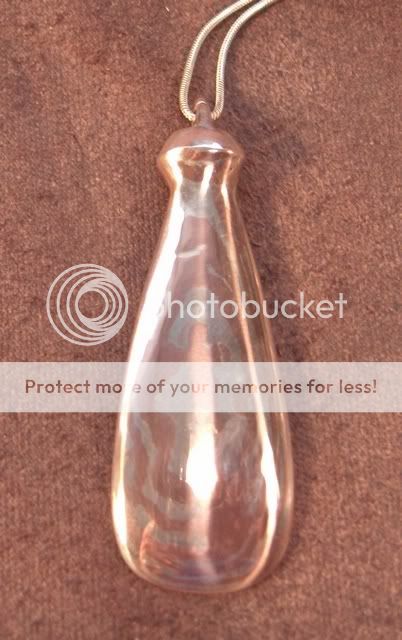
I made this pendant from from fine silver and pure copper and after polishing there was no pattern except when the light hit it just right. You would think copper and silver would have high contrast but not until etching.

mokumecloseup-web.jpg
 
Copper and silver mokume does have good contrast. You just need to oxidize the copper,or hit it with a fine scotch brite pad.All polished metals reflect a lot of light and a satin finish will hilite the contrast.
 
I don't understand. I dunked it in ferric chloride for about 10 minutes and couldn"t
t tell the diffence. Buffed it again. no effect. rubbed it with a scotch brite pad and it still all looks like brass. Even on the edges where I can still see the layers. I even drilled a hole in it and it looks like brass inside.
 
Sounds like the billet was too hot and you made a new alloy out of the brass and copper.the billet should be approximately the same thickness when it comes out of the oven as you started with.if you have any thin nickle silver sheet around,place the nickle silver between the copper and brass sheets and lower the temperature.
 
Jim, in case you don't know: don't use the same tank of ferric chloride for steel after you've etched copper, unless you intentionally want copper plating on your blade.
 
I dropped the temp by 50f and am taking another run at it. Fitzo, thanks for the tip, I've already made that discovery lol.
 
Back
Top