Making my first knife!!!

Joined
Aug 12, 2007
Messages
701
okay, so im making a boot knife out of an old steel file i found at the work (we go through hundreds a year) and had a few questions about the whole process. my grandfather used to make knifes as a hobbie and he has helped me alot but i still have a few questions that i need answered and he only gives me the "old ways" answers...

okay well, first off he told me that to anneal the file i should just stick it in the wood stove and let the fire burn all through the night then pick the blade out of the ashes in the morning. will this ruin the blade? or is that pretty much how everyone does it? i read that you should only anneal a blade till its non magnetic... please help me so i don't blow my first knife:jerkit:

thanks alot
 
well that's a sort of random and haphazard way of doing it it's the heating and slow cool that the anneal. If you put it in the coals until it's nonmagnetic, then bury it in wood ashes you will probably anneal it, how'bout reading the stickied threads that are called "newbies good info here" there really is a lot of relevant info there. Also fill out your profile, you may be living right next to a mastersmith who doesn't mind teaching new folks, but noone will ever know if you don't filll out the where you live part. The old ways have some good aspects, also a whole lot of smoke and hooey. The file is not a blade till you make it a blade. you will undoubtably ruin it as a file as soon as you heat it over 300, but it isn't a blade until you have shaped it and heat treated it (the opposite of annealing it)

Good luck, welcome to blade Forums

-Page
 
I'm not a knife maker yet and dont know much about it but this guy makes knives out in the woods and anneal's his files in a camp fire so I would assume the wood burning stove would work. Check out these videos, there are 4 at the bottom of the page.

http://www.greenpete.co.uk/?page_id=503
 
did not want to go through the tomes of knowledge (newbie tutorial sticky) without the search function for such a small question...

maybe i should upgrade to a paid membership (getting th search button back would make it worth my while a hundred times over)

and i guess i worded the question wrong. i should have asked if prolonged heat will destroy or affect the carbon in the blade (or anything for that matter). i have heard of carbon scaring and i was wondering if keeping it in the fire till the fire goes out then leting it sit in the pile of ashes all night would ruin it.

thanks and sorry for not wanting to scroll through 100 pages of useful knowledge with no relevance to my question...
 
Go through the old posts. It can be very helpful; and make the difference between a knife like object and a quality piece.

You can search the site by adding "site:bladeforums.com" to a google search
 
This is the bladeforums/Google site :
http://www.google.com/coop/cse?cx=011197018607028182644:qfobr3dlcra

In my opinion, placing the file in a woodstove/campfire overnite to anneal steel will probably ruin it. I know folks have done it, but people have make knives out of lawn mower blades and many other bad steels. A torch and a box full of wood ashes would be a better idea.Heat the file to non-magnetic and keep it there for at least one minute. Immediately bury the file in a box of wood ashes. Leave there for 10-12 hours. It should be fully annealed.It may not make a good knife anyway, as many files are case hardened now days.
Stacy
 
Okay i decided to post some progress on my first knife, tit has been slow coming due to the fact that i just brought my baby boy into the world kicking and screaming, well i didn't bring him... but you get the picture.

without further adue here are the pictures of the progress. the knife is days from being completed.

the file after i annealed it and grinded the threads off

th_101_0026.jpg


My wife holding the knife blank
(and a few pictures)
th_101_0042.jpg

101_0095.jpg

101_0098.jpg

th_101_0101.jpg


cut my finger sharpening it.

th_100_9943.jpg


didin't take a picture of the quench due to the fact that im only one man. here is the blade in my toaster oven tempering (i think thats the proper term)

th_100_9944.jpg


and more pictures after this weekend as i plan to finish it tommorow
 
Looks great to me!

With regard to annealing, I have read that you can heat the piece and then put it in an appropriately shaped box (rectangle) half-full of plaster of paris powder and then put more plaster powder on top and then close it up and leave it 12-24 hours or so until it is cool. Has anyone tried the plaster of paris method?
 
Looks great! Every blade I've ever made has a little blood, lot of sweat and more than one or two profane words directed at it :D

One design consideration for future knives (cause I'm sure you'll be making more since you done got the knife bug) the filework in the index finger groove is going to make a loooottttt of calluses for the user.

Great looking knife, much better than my first 1 or 20 or so. :D
 
Shape looks nice. looks like you have really done some work there.I know you will be proud of it when done.

There are some design errors on it that you want to deal with on the next knife.
The first is a biggie:
The hole directly above the finger notch is a bad idea. It will make a weak spot on the part of the knife that needs the most strength .
The file work in the finger notch will probably be less comfortable than a smooth curve. The grooves ( in the notch) could also start a stress riser toward the hole and really weaken the blade, causing it to break under use.

Has your box arrived yet? I know Canada Post is a bit slow when the sled dogs are worn out at the end of the winter.

Congratulations on your son, again.
Looking forward to seeing more knives soon.
Stacy
 
Stacy,

My ME perspective: I agree that the serrations in the finger notch are a bad idea due to stress risers, but I don't see any problems with the hole since it's (practically) on the neutral line and therefore contributes nothing significant to the strength (when properly finished on the inside). If he decides to remove the serrations the hole will in essence move towards the edge and then it becomes significant.

Cheers Rody
 
From a ME point of view,
the blade = X width
the finger notch appears to be about .375X deep
the hole appears to be .125X
Thus the notch plus the hole = approx 1/2 the blade width. That will put twice the stress on the neck than at the plunge line in a side flex - resulting in a failure . Even if this area is covered with the handle scales, it may still fail there. To add to that, the distance between the notch and the hole is quite small, and the probability of a riser there is high.
In design, I use the rule of no holes within 1" or the ricasso if avoidable. If they must be there for things like bolster pins, then they should be as small as possible, and have chamfered edges.
Final comment is that this is a knife from a file, and if 1095 is very prone to cracks and micro cracks. Any avoidance of stress areas is to be encouraged.

Gilles,
This is strictly an engineering discussion, and doesn't detract from the fact that you have made a nice knife. Just thoughts for future improvement, and cautions for use. I would suggest that you draw the temper with a torch at the neck to a lower Rc than the blade.
Stacy
 
<Hijack>

Stacy,

I take the notch as a given. In that scenario the hole would decrease strength in side-flex by about 30% (visual estimate of hole width vs. local blade "height", linear dependency acc. I=1/12*BH^3). This may or may not lead to failure, depending on use. I agree it is best not to have the hole for optimal strength in side-flex.
Upon closer examination of the pictures I would agree that the hole is closer to the notch than to the spine, moving it away from the neutral line in a "height-flex" situation and decreasing the remaining material height (I would say that the radius of the notch, when properly finished, is probably large enough to be of minor significance). In order to maintain optimal strength with the given geometry I would say: remove the file work and finish the inside of the hole and the radius of the notch as smoothly as possible to avoid crack initiation. Chamfering or radiusing the transition between inside radius (both hole and notch) and the flats is a good idea to avoid stress risers.

</hijack>

Gilles: Cool blade! Don't let us geeks discourage you!

Cheers Rody
 
well, i will take all of this into consideration for the next knife i build. but i think its too late to file of the grooves, cause the blade has been quenched and tempered and the handle is epoxed on... and i dont want to go through the trouble of filing hard steel. next time i will fix these problems.

and the box still has not arrived Stacy. Canada post's policy is that no employee should EVER set a record on mail delivery, that way they all can slack and no one looks bad.

well im off to go finish the blade and pictures should be up tonight or tomorrow sometimes.
 
Okay, finally finished the knife handle. after alot of set backs i finished the blade, still needs a bit of cleaning but the knife is done and i think it looks good.

as for the "Problem hole"
the wood piece that i used came up short and putting a pin hole would have ruined it so i opted to just fill it with epoxy. my wife will probably never use the knife past any light carving (i gave it to her as a gift) so we should be alright.


here are the pictures of the finished product

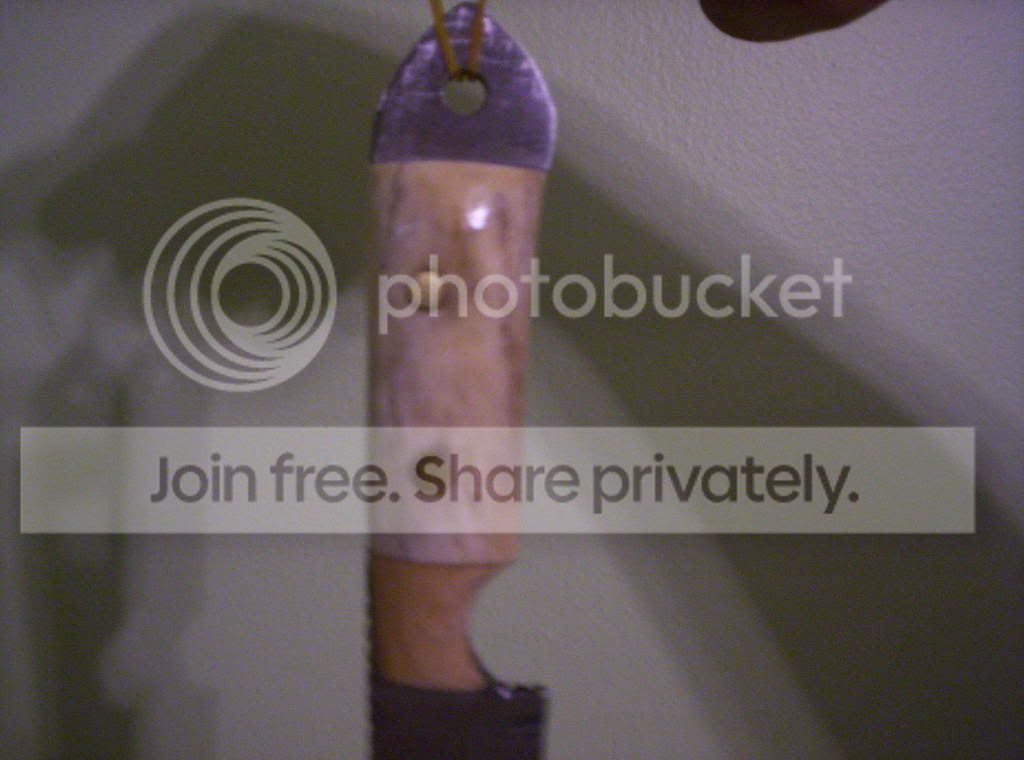
two part handle, i chose an old piece of antler that i had. it had been in the sun for a long time and developed many cracks, but it still had some resilience to it (the pitty core had not gone to dust, actually it held up quite well)
100_9953.jpg


Gluing the handle to the blade
100_9967.jpg


Finished product (quality sucks due to the fact that my camera sucks)
100_9981.jpg


handle up close with no flash, didn't turn out to good.
100_9985.jpg

100_9983.jpg


and the good news is that i have contracted my first customer, my father wants me to make him a 10" bowie, as he put it "something i can kill a grizzly with" so that should be fun. (So get ready for a flood of "how do i do this" questions hahaha)

I would like to thank everyone that helped me by answering my questions, if it was not for you guys this knife would not have turned out at all. I feel privileged to have so many experienced knifemakers to consult in time of dire need:D

Thanks
Gilles
 
looks good. Next time you photograph try to do it on the north side of the house outside on a bright day with some clouds with the house blocking direct sun. put a white piece of paper on the south side of the knife as a fill reflector. at that point the whole world is your lightbox (doesn't work well in a backyard with trees shading most of it, makes the light green)

-Page (former professional photographer)
 
Back
Top