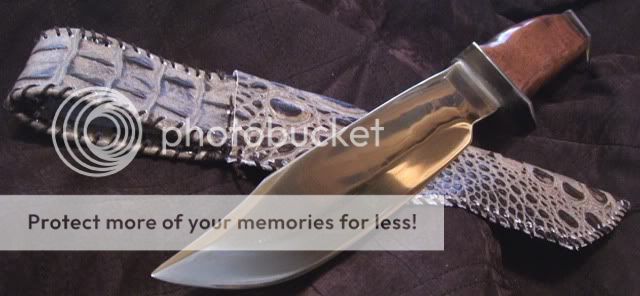
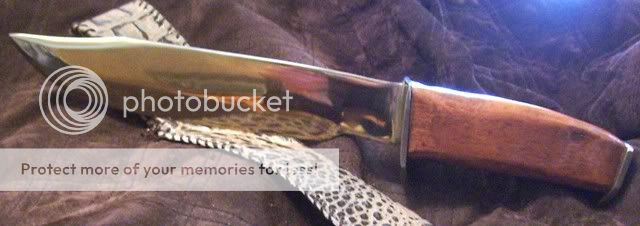
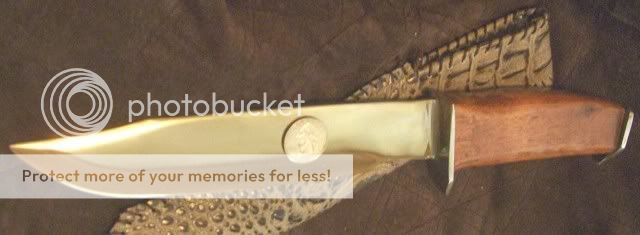
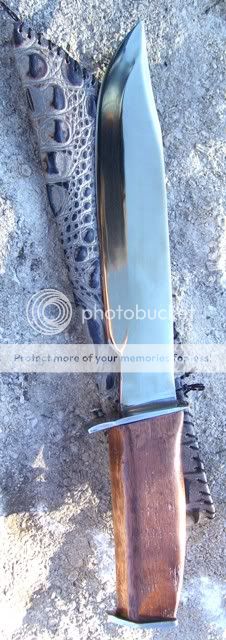
Making of “The Sabortooth” Bowie Knife

Archer Here

Knifemaker / Craftsman / Service Provider
Joined
Nov 2, 2008
Messages
1,323
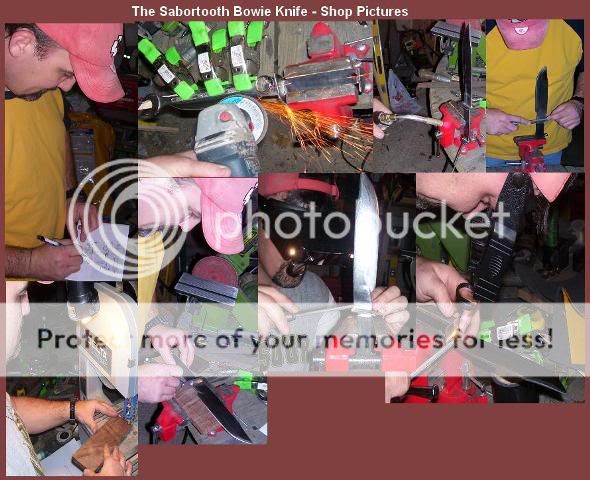
Shop Details:The steel I used on this knife is ½ ton Leaf Spring. I designed the knife style on paper, then cut the shape out. I heated in my forge to bright orange (around 1600 degrees Fahrenheit). I took a pen magnet and extended it out and reached inside and it was not magnetized. I let it go a little longer and then pulled it out and immediately dunked it in transmission fluid. I sanded and polished from 300to 600 to 1000 to 1200 to 1500 to 2000 grit. I tempered it at 400 degrees for 1 hour, letting it air cool, then putting it in 1 more hour at 400. I file tested the blade and it passed. Seems very hard.

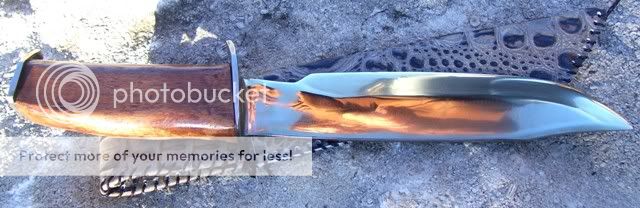
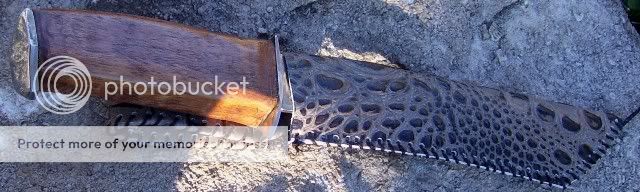
I made the handle out of Walnut and attached with epoxy. I hand stitched the sheath out of dark gator hide.

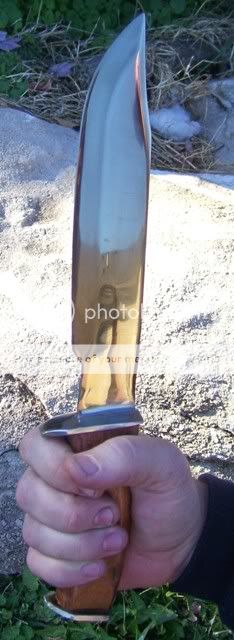
Measurements:Overall length is 13 ½ inches. Blade is 8 ½ inches long. Handle is 5 inches long. Blade width is 1 5/8 inches. Blade thickness is 5/16 inches. Handle thickness is 7/8 inches.

Below are shop pictures and pictures of the finished knife.
Thanks & See Ya in the Wild!

100_2236.jpg

100_2235.jpg

100_2240.jpg

100_2246.jpg

100_2250.jpg

100_2251.jpg

100_2254.jpg

100_2257.jpg

SabortoothBowieKnife.jpg
 
Last edited:
Looking very good. I hate to make suggestions because it doesn't always come accross on a typewritten page without sounding like criticism but I'll give it a try.

On your next one you might try to line up the edges of the handle so that they are the same width (cutting edge to back of knife) as the ricasso area in front of the guard. To me it makes the knife "flow" a little better. I prefer my handles a little more rounded, or even oval in shape.

Please don't take these suggestions in any other manner than friendly. Your stuff is looking better with every knife you post here.

SDS
 
nice!
One suggestion, though,use it (or a mockup of the knife with the handle, gaurd/pommel exactly as on the knife) hard, with bare hands. I think you'll find that you want to radius the transitions where your hand contacts them.

-Page
 
Hi - you've got a neat looking knife here. I'd like to make a couple suggestions about the knife, since you seem to be in the market to sell them, I hope you won't mind constructive criticism.

As was mentioned above, I feel that the handle looks a bit out of proportion and would flow nicer if it were slimmed down some. From the photos I've seen, you seem like a relatively large man and based on this, seeing that you can't close your hand around the handle gives me the impression it would be a bit bulky for many buyers.

I see that you like to do a scandi type grind on your knives. On a large knife like this, a higher grind will allow the knife to cut deeper with ease, it will also lighten the knife up considerably, making it more comfortable to use and carry. Lastly, having a deep, high grind will force the balance of a knife toward the handle. A large knife becomes much quicker in the hand if it balance to the rear. You may get more chopping force out of a forward balanced knife, but a bowie was a fighting knife where speed was just as important.

I see that you took your finish up to 2000 grit, but I'm wondering if you did so with the machine or by hand. I also wonder if the blade was buffed. In two pictures it looks like you may have deep scratches running perpendicular to the length of the blade along all of the flat. The way to get rid of these is to hand sand and don't even bother working above 800 on the grinder, 600 is probably better. Also, you won't want to go from 320 to 600 without using some 400 (and possibly 500) in between.

If you're buffing, then make sure you buff in several directions, if you only buff the blade at one angle, it will just highlight scratches instead of removing them. Unless you do a mirror polish, a blade will always have "scratches" showing, what we want is uniform and eye-friendly scratches. In your finishing grits, try to finish lengthwise down the blade so that the eye is drawn down the entire length instead of stopping at each scratch as it goes down.

Lastly I think you should examine the heat treating, I'm not going to say "you're doing it wrong" but 5160 is a little more complex than 10xx type steels. Depending on the lighting in your work area, bright orange may be well above 1600F. I would try to learn to watch for decalescence and shadows instead.

Hope that helps you in your quest.
 
Great knife. Taking on what others have said, I did some photoshop work and came up with my version. I think you have a great knife there if you do a bit to the handle.

Mods I made:
-Shaped hande
-Removed top guard
-Altered ricasso
-Added pin (too big, and just personal preference with this particular piece of wood)

Take no offense to this at all...its all good!

Before:
100_2236.jpg

After:
100_2236_mod.jpg
 
Thanks to all great makers and enthusiasts. Feedback is what I want. I’m not just doing this because I enjoy it. I’m also doing it to make some money for my family. At least for a while now, I’m going to be sending threads on all my knives I make, through this forum. All great info! I appreciate it. I will apply these tips to my next knife, which is coming soon! I just can’t stop!

One question, due to the fact that it was a real pain to me, I thought someone could give some advise: In the process of making my wood handled knife, I tempered it, then attached/glued the wood handle. This made it very difficult to shape and sand the wood and finish without marring the guards front and back on the inside. I would make it and put it on before hand and not finish it, and then temper it, but I’m afraid the heat would do something to the wood, like release the glue, etc.

And another question: Is it normal after tempering that your steel turns a sort of blond color, because it makes it hard to re-sand it to touch it up later… the silver comes back out. But I do like the blond/wheat color.
 
Mr Schott that is some kind of cool what you did with my picture I just noticed it . Ijust printed it thanks.
 
Tempering should be done before you attach anything to the blade, in my opinion. There's always a struggle between the previously finished parts and the new parts you want to put on. Short of screw construction, you just have to work around the finished bits after you attach the handle, in my experience. Every knife presents new finishing challenges for me.

Steel picks up oxide colors when you heat it. The oxide layer is a very thin one, so you won't be able to keep it unless you're completely finished with the blade when you temper. Even if you do, it will come off easily with use.
 
Back
Top