
Manufacturer's heat treat of a known steel

Yes of course it's why I qualified that with after several sharpening sometimes people can't get a blade sharp and blame the heat treat. I don't mean early 80s 440c either.

In general I'm more likely to believe that it's not the heat treat and more often user error that sometimes causes knife failures that are often blamed on the ht.

THAT IS with the exception of this knife that started it all for me. It was $3 shipped, a Frost Cutlery keychain knife. I innocently needed a knife one day. I had stopped carrying a knife about 7 years because prior to that all of my keychain classic Vic's covers would pop off and go missing.
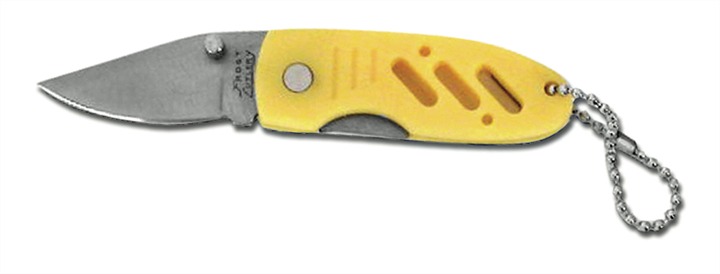
z_15-231Y.jpg


For the life of me I couldn't get the steel to sharpen. Then I found bladeforum, a few CRKT and very cheap Kershaw later, then 50 of the mixed CRKT, Benchmade, Spyderco, Kershaw etc... later and I was hooked. Lol. I spent a summer buying sub $100 budget knives off of Nutnfancy's list, my wife was getting mad and calling me crazy. Then what's crazier - 18 months later she bought me a Starbenza for Christmas.
 
Last edited:
Personally I don't really consider overheating the edge to be a "heat treat" problem. The heat treat itself was fine, but the edge was tempered back a bit too far. Usually a few good sharpenings takes care of that problem.

A heat treat problem in my mind is usually one of two things. 1) The blade is way, way too hard and brittle. It snaps/chips almost immediately after any sort of impact. 2) The blade is way, way too soft. The edge deforms (not chips) when it contacts anything. Its like the blade is made of string cheese or play-dough.

There are obviously ranges, but the ones that are just "slightly" hard or just "slightly" soft are less obvious, and take longer to discover.
 
Cobalt , a commercial HT company does not guess ! They have it all figured out.How far from the oven walls you can go etc.

.

What exactly makes you think that "they have it figured out"? I am sure that is an opinion that you cannot substantiate at all.

But I could be wrong, I would love to see peters provide data on their standards asm2750e and how they meet the standard aside from stating that their furnace was designed to that standard. How about testing. What class of furnace are they working with 1 through 6? if 6, which is +- 50 degrees, are they calibrating and testing every quarter? This is what DOD contracting Heat treaters have to do. What requirements do they fall under? Heavily loaded furnaces can have 4-5 times the temperature variation of a lightly loaded furnace.
 
Last edited:
Opinion ??? I am a metallurgist by profession. Lots of experience ,much with tool steels .Everything from developing new steels including HT recipies ,buying and operating equipment , etc, etc. My "opinions " are based on many years of experience never just blind guesses.
I've "figured it out " many times !
 
Opinion ??? I am a metallurgist by profession. Lots of experience ,much with tool steels .Everything from developing new steels including HT recipies ,buying and operating equipment , etc, etc. My "opinions " are based on many years of experience never just blind guesses.
I've "figured it out " many times !

Nice to know your profession. Tells me nothing about how you know how they(Peters, and others) have it figured out. Oh and if you figured it out many times then you haven't figured it out. Again, no hard facts about why they have it figured out.

I guess people like Bluntcut and Nathan the machinist should stop all their work on pushing HT limits. Some have it figured out better than others. But you will likely not see their videos on youtube for a reason.

You don't know what they have figured out. If you did you would have indicated testing standards they undergo. That is the biggest problem with an industry that caters to collecting. How many knives are used compared to collected? not a lot.
 
Last edited:
Back
Top