-
The BladeForums.com 2024 Traditional Knife is available! Price is $250 ea (shipped within CONUS).
Order here: https://www.bladeforums.com/help/2024-traditional/
You are using an out of date browser. It may not display this or other websites correctly.
You should upgrade or use an alternative browser.
You should upgrade or use an alternative browser.
Maple finishing suggestions
- Thread starter JMJones
- Start date

- Joined
- Apr 18, 2014
- Messages
- 244
Pretty much any top coating other than lacquer is going to yellow the maple color. If it is curly or bird's eye and you want the figure to pop, I always leaned towards boiled linseed oil followed by poly or Tru-oil.
BTW, you may need to de-oil the blackwood with solvent for any top coat to stick anyway, depending on how oily it is.
BTW, you may need to de-oil the blackwood with solvent for any top coat to stick anyway, depending on how oily it is.


- Joined
- Feb 4, 2016
- Messages
- 106
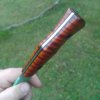
https://knifedogs.com/threads/finishing-curly-maple.46851/
I hope it's ok to post a link to another forum. If not feel free to delete the post.
I hope it's ok to post a link to another forum. If not feel free to delete the post.

Stacy E. Apelt - Bladesmith
ilmarinen - MODERATOR
Moderator
Knifemaker / Craftsman / Service Provider
- Joined
- Aug 20, 2004
- Messages
- 38,577
I second kuraki's method - Fiebing's water based dye and a tru-oil finish. You can experiment with several of the brown shades, but light brown works well for me

jdm61
itinerant metal pounder
- Joined
- Aug 12, 2005
- Messages
- 47,357
I took me like 4 or 5 years to remember what color of Fiebings I had used to get a color like Kuraki's example on a sample piece of maple early on and it turned out to be British tan. I typically went with light brown on most pieces, but now I want a lighter, more reddish orange color for wa handles because it looks more "Japanese" to my eye. I now have both British tan and the "regular" saddle tan for a little variety. One is darker than the other and I can't remember which off the top of my head. Remember also that repeated application of almost any of the colors will give you a darker finish.

- Joined
- Jul 31, 2015
- Messages
- 3,118
I use tru-oil for unstabilized maple. One tip, get the small bottle and just poke a small hole in the foil under the cap. It will last longer and be easier to dispense.
Stacy E. Apelt - Bladesmith
ilmarinen - MODERATOR
Moderator
Knifemaker / Craftsman / Service Provider
- Joined
- Aug 20, 2004
- Messages
- 38,577
I have tan, russet, brown, and light brown. They all leave a different look, and different pieces of maple don't look the same, so you may have to experiment. They can be mixed if needed. I often thin them down and make multiple applications.
Initially, it will look darker than you want, and sometimes have poor stripe contrast. Once rubbed in with a rag, wipe off all excess quickly. Then work it with steel wool a bit, followed by hand sanding with 400 grit to get the proper contrast. It is a very good idea to save some scraps and pieces of the same wood to test on before starting the handle.
TIP:
It is best to build up the dark stripe by applying the stain, rubbing in, then sanding off after it has dried a bit. Repeat as needed, and change the dye color to get the final look. It will look much less crisp ( even dull looking) until it dries fully, and gets the finish on it. When the finish is worked into the wood, it will deepen the color and make the 3-D look that we all love.
Initially, it will look darker than you want, and sometimes have poor stripe contrast. Once rubbed in with a rag, wipe off all excess quickly. Then work it with steel wool a bit, followed by hand sanding with 400 grit to get the proper contrast. It is a very good idea to save some scraps and pieces of the same wood to test on before starting the handle.
TIP:
It is best to build up the dark stripe by applying the stain, rubbing in, then sanding off after it has dried a bit. Repeat as needed, and change the dye color to get the final look. It will look much less crisp ( even dull looking) until it dries fully, and gets the finish on it. When the finish is worked into the wood, it will deepen the color and make the 3-D look that we all love.
jdm61
itinerant metal pounder
- Joined
- Aug 12, 2005
- Messages
- 47,357
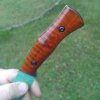
John, this is the color that I got out of red alkanet root oil with no Fiebings. The stuff is made for walnut gunstocks and has a bit of color to it. Even a little bit of pigment in your oil will cause the "darker" parts of the grain to "pop." With walnut, that oil tends to get rid of any "grayish" tinge and makes the figured stand out. I have never used TruOil, but I suspect it does something similar.