Marcus712's knifemaking journey

Joined
Mar 17, 2014
Messages
4
Just got into the knife-making addiction.

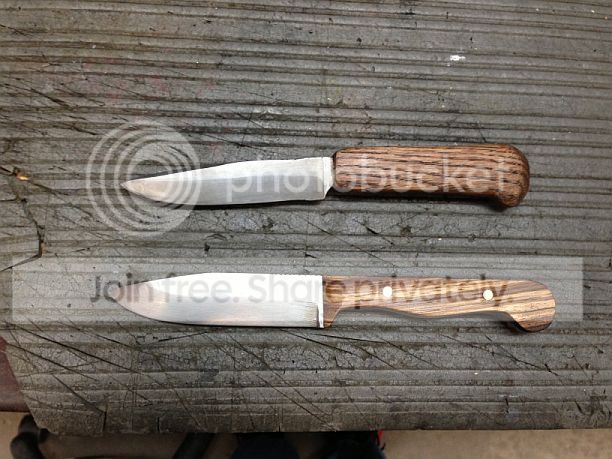
Here are some pics of my first two.

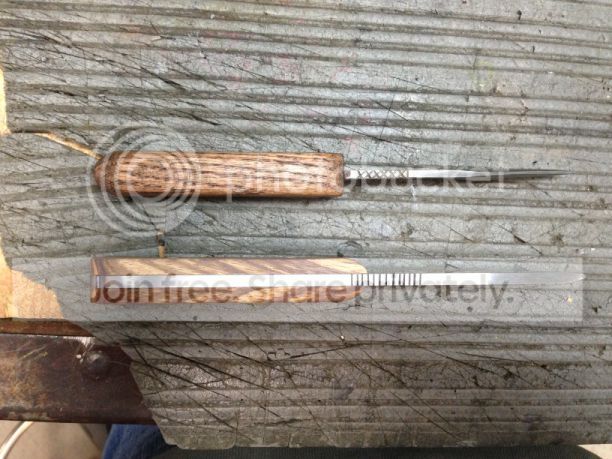
#1 on top is forged from crappy 1018 stock so it doesn't hold an edge to save its own life. Red Oak handle. Vinegar patina. 1/8" thick OAL 8" blade 4" handle 4"

#2 on bottom is stock removal o1 tool steel. Wanted to make it a hunter but ended up looking like a steak knife, so henceforth known as the "Steak Hunter". Zebrawood Handle. Light Vinegar Patina.3/16" thick 9" OAL, 4" blade, 5" handle.


Significant difference between the two in my eyes.


Any suggestions for improvement, or the next project?
 
Last edited:
Marcus, I'll agree there is significant improvement on the 2nd. I am relatively new to this myself and most of what I am going to say is subjective.

The most noticeable thing to me on both of them is the "blockiness" of the handles. You rounded the corners off but they are still essentially rectangular. The recommendations we hear most are to have an egg shaped handle when looking at it from the butt and coke bottle shaped when looking at it from the top. Also, we all seem to get the idea in the beginning of our journey that jimping or filework adds quality, but more often than not it really takes away. The only time any filework adds anything is when it goes with the flow of the knife and the spacing/technique is flawless. On the first knife, I think it would have helped it flow better to drop the top of the handle down even with the top of the spine. On the 2nd knife, on the front of the handle where the wood projects down likely would be prone to snapping of with use.

I can see the steak knife reference on the 2nd knife as well. I think if you would have added a slight curve to the top of the spine that went all the way from the butt to the tip it would have been better. Also, if you had given the handle a little more "depth" in its profile it also would have helped in avoiding the steak knife look.

I am also curious to know of your heat treat method/attempts and also how you ground the bevels. Did you use files or do you have a belt grinder?

Not too bad for the first 2. To improve you just need to make more. As for the next project that is up to you. Spend a little time looking at knives you like to get an idea what you want to do next. Then spend some time drawing your design and refining it a little. Feel free to post it here and get some feedback. Just remember to keep it simple.

Good luck,
Chris
 
I see you are trying out file work. I'd recommend you leave that off for now.

+1 on making rounder handles. The Steak Hunter is especially in need of some sexy curvatures.
 
I definitely agree with leaving out the file work in the future. It just sounds and looks so good in theory.

I have a small forge I built out of paint can, insuwool, satanite and itc that I can plug up the ends and it will keep the o1 just above magnetic for a nice soak. I then quench in 120 degree canola.

I use a small HF 1x30 belt sander for bulk removal then draw filing and sanding for the finishing on the blade and handle.

Thanks for the suggestions I really appreciate it.

Marcus
 
Didn't want to start another thread so Im reviving this one.

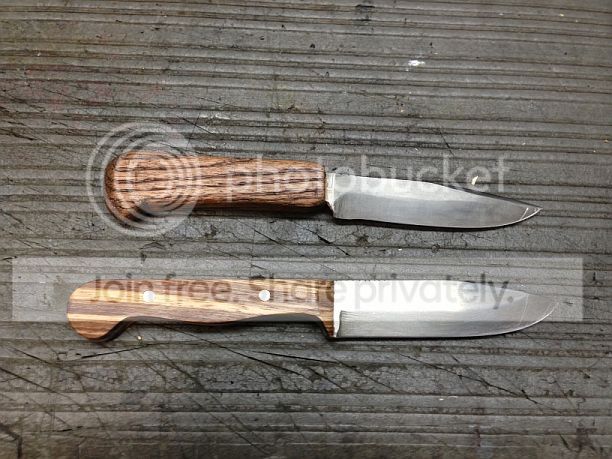
Knife #3
O1 tool steel 3/16"
Bolivian Rosewood Handle with Brass Pins
Flat grind
8" OAL, 3.5" Blade
Ferric Chloride Etch


I got in a little bit of a hurry and the index finger channel was left a little rough :(

Thoughts, Ideas, Suggestions?
 
Last edited:
Steak hunter....I've got to get me one of those ;0)

looks like you are making big improvements with each knife
 
#3 shows a really big improvement. The handle is much better and the blade bevels are much cleaner....good work!

For #4 try these changes:
1) Round the handle even a bit more...especially on the bottom part. The cross section should be slightly egg shaped. Avoid "points" where the finger groove is....smooth curves are better
2) Round the front of the handle instead of making it a bevel. Do this by temporarily taping the two scales together ( off the blade) with the pins stuck in place. Shape, round and polish the front to the look you want, then assemble the scales on the blade. That way the front is already shaped when you sand and shape the rest of the handle.
3) Use thinner stock. 3/16 is what you use for a 14" camp chopper, not a hand knife. 1/8" is more than thick enough for 90% of all knives. Many high quality hunting knives are barely over 1/16" thick.
4) Add some distal taper to the blade. This not only will greatly improve the look, but make the blade more functional.

Keep at it, your work shows lots of improvement.
 
Yea the only material I have right now is 3/16" I would prefer to be using 1/8" for sure.

Thanks for the suggestions
 
Back
Top