- Joined
- Dec 25, 2004
- Messages
- 1,363
I have been electro - etching, using a stencil before. But I like to mark them with my actual signature lately.
It is real easy and cheap method. Experimented with bees wax and a couple of different techniques, but I didn't like the results. 1 year ago I found an industrial painter and solved all my problems...
Here is how I do it:

This is the blade, 440C, it is going to be my first slipjoint folder. Sanded 400 grit...

This is the paint I'm using. It is drying real quick and it is resistant to acids and heat...

First I paint the place I will sign...

I double check full coverage...
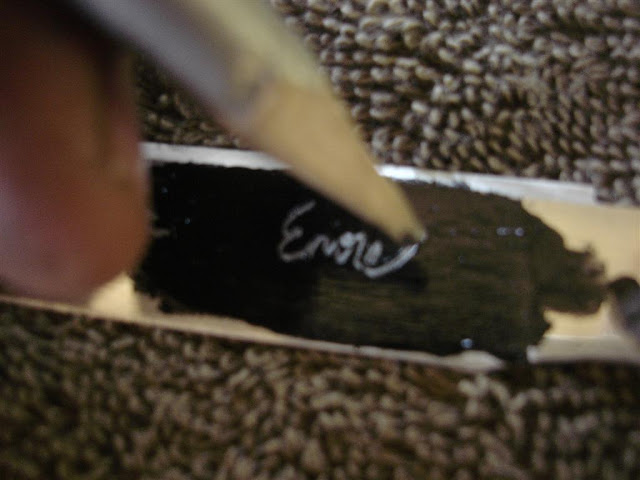
With a pencil I sign the blade. Pencil needs to be a bit dull if thick lines wanted. This step has to be done in 3 to 5 mins depending on the temperature. In winter it takes 10 mins to dry, in summer it takes only a couple of minutes. After it is dried to sign is impossible.
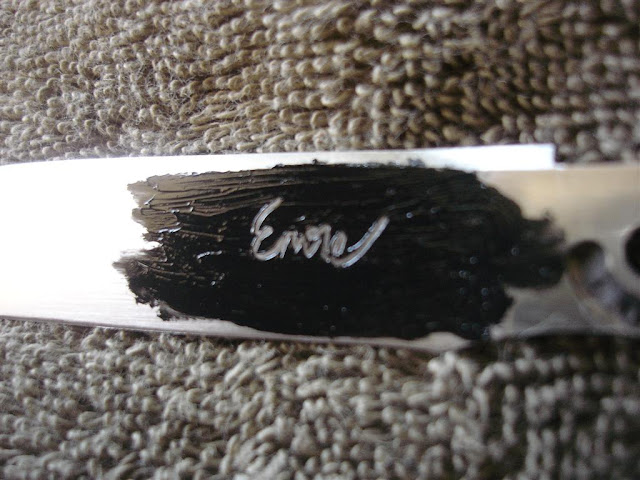
Now it is dried and ready to etch...

I use DC to etch and AC to darken the etched lines. Both power supplies are connected to a crocodile clip. Those pins are hollow and 1 pole attached to the end of the pin and on the other side filled with cotton.

The transformators are cheap things, I found at the scrapyard. One is 19 V 3 Amp AC, other one is 12 to 3 V, 1.2 Amp DC.

Electrolyte is brine. I put a coffee spoon of salt to water that is a half full of an espresso cup..

I attach the crocodile clip to the blade, dampen the DC pin end with the brine and switch on the DC supply. I use 12 V . I press the pin only 3 secs at a time and wait a couple of seconds to cool and repeat. After I etch all the signature repeat this step 10 more times.

After etched with DC, I turn off the DC supply and turn on the AC. Dampen the AC pin end and only 2 second etch, It is enough to make the etch black...

After the etch is done I wash the etched area with cold water to get rid of the salt.

With a cloth dampened with acetone, clean the paint.

Voilà ... The etch is really deep and lines are not fuzzy.
I hope this helps someone...
Emre...
It is real easy and cheap method. Experimented with bees wax and a couple of different techniques, but I didn't like the results. 1 year ago I found an industrial painter and solved all my problems...
Here is how I do it:
This is the blade, 440C, it is going to be my first slipjoint folder. Sanded 400 grit...
This is the paint I'm using. It is drying real quick and it is resistant to acids and heat...
First I paint the place I will sign...
I double check full coverage...
With a pencil I sign the blade. Pencil needs to be a bit dull if thick lines wanted. This step has to be done in 3 to 5 mins depending on the temperature. In winter it takes 10 mins to dry, in summer it takes only a couple of minutes. After it is dried to sign is impossible.
Now it is dried and ready to etch...
I use DC to etch and AC to darken the etched lines. Both power supplies are connected to a crocodile clip. Those pins are hollow and 1 pole attached to the end of the pin and on the other side filled with cotton.
The transformators are cheap things, I found at the scrapyard. One is 19 V 3 Amp AC, other one is 12 to 3 V, 1.2 Amp DC.
Electrolyte is brine. I put a coffee spoon of salt to water that is a half full of an espresso cup..
I attach the crocodile clip to the blade, dampen the DC pin end with the brine and switch on the DC supply. I use 12 V . I press the pin only 3 secs at a time and wait a couple of seconds to cool and repeat. After I etch all the signature repeat this step 10 more times.
After etched with DC, I turn off the DC supply and turn on the AC. Dampen the AC pin end and only 2 second etch, It is enough to make the etch black...
After the etch is done I wash the etched area with cold water to get rid of the salt.
With a cloth dampened with acetone, clean the paint.
Voilà ... The etch is really deep and lines are not fuzzy.
I hope this helps someone...
Emre...