
Martensizing, attempts and fails.

Joined
Feb 18, 2013
Messages
3
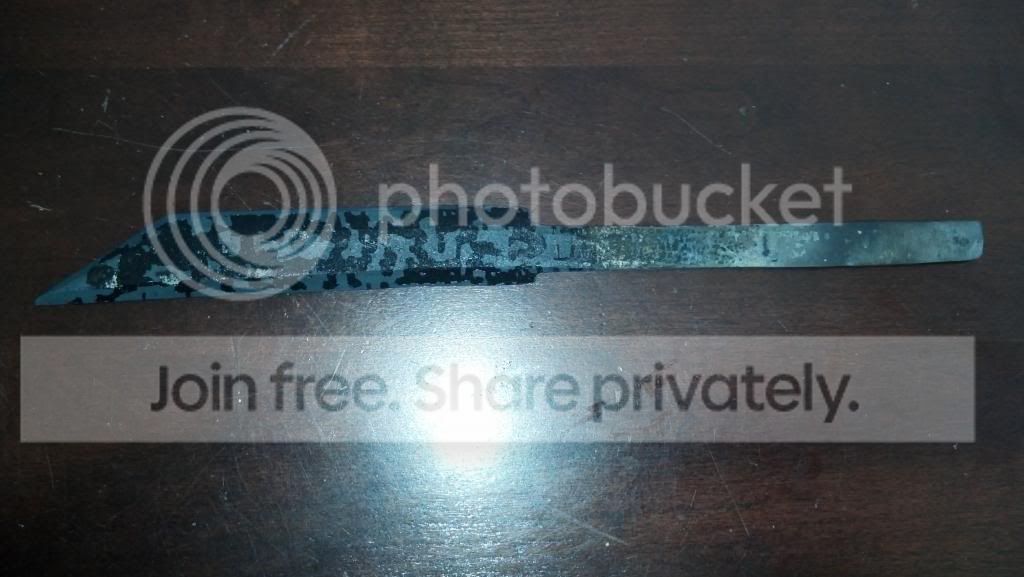
steelquench.jpg


So I've been trying to martensize steel.

I built a ceramic tile house inside my propane forge in order to protect the steel from open flame. Helps to heat the entire thing evenly and keep it at an even temperature.

So I tried to cook it right around critical temp. for about an hour. I'm not sure if the temperature was correct or not, I have a feeling it was just above it. Color was pretty much solid orange for most of the cooking. Then I pulled it out, let it cool in the air until it reached reddish, then quenched it in clean water.

Pretty sure I pearlized it.

Take a look at the photo. Pretty distinct carbon pattern. Wondering if it means something to someone.

Thanks a lot!
 
Welcome!

That looks like decarb (edit: scale) which has partially blown off in the quench. It's hard to tell in the picture.

So you were trying to harden the blade (create martensite...no such word as martensize that I know of). To do that, you austenitized the blade in your forge within a muffle. What steel and what temps were you shooting for? If you overshot your temp, you may have created a bit of grain growth which would result in a brittle blade; holding at temp for an hour is really long for any steels that are easily heat treated in a forge, and if you were over temp for a chunk of that time, your grain will be huge. From your description of the quenching process, you almost surely did create pearlite. You only have a finite window in which to cool the blade past a certain point to create martensite and prevent pearlite. By holding the blade out of quench until it dropped colors, you likely missed that window unless you were significantly over your target temp to begin with.

It's hard to know how you did based on your details. The steel makes a difference as does your method in determining or estimating steel temperature.

--Nathan
 
Last edited:
So you were trying to harden the blade (create martensite...no such word as martensize that I know of). To do that, you austenitized the blade in your forge within a muffle. What steel and what temps were you shooting for? If you overshot your temp, you may have created a bit of grain growth which would result in a brittle blade; holding at temp for an hour is really long for any steels that are easily heat treated in a forge, and if you were over temp for a chunk of that time, your grain will be huge. From your description of the quenching process, you almost surely did create pearlite. You only have a finite window in which to cool the blade past a certain point to create martensite and prevent pearlite. By holding the blade out of quench until it dropped colors, you likely missed that window unless you were significantly over your target temp to begin with.

It's hard to know how you did based on your details. The steel makes a difference as does your method in determining or estimating steel temperature.

--Nathan

+1 You nailed it with that response imho
 
Thanks a lot Silver Pilate.

I was using 1055 bar stock, and I was using the color of the steel in a mostly dark room to gauge temperature.

In general, how long should I let the steel 'soak'?
Previously I was bringing the steel up to temperature very quickly, and quenching in cold water very quickly. However, I was told that the steel needs to be 'soaked' for a much longer period of time.

So if my grain is very large, what process would bring the steel towards an even dispersion? (martensitic) Just the name of the process would be a help, no need to write a dissertation. If you give me some hints, I can track down the rest :)
 
For steels like 1084 that are eutectoid, there isn't really a need for any significant soak beyond what is necessary to get the steel at a uniform temperature throughout. For hyper-eutectoid steels and complex alloys and for hypo-eutectoid steels (1055) soak is variable depending on the steel used. 5-10 minutes is good for many steels like 1055 and 1095 while stainless steels may need 15-30 minute soaks at a precise temperature.

I can't say I'm very familiar with 1055, but I'd hazard that 5-10 minutes would be plenty of soak for something like a knife in 1055. In the case of excessive grain growth, that can be remedied with a normalization and a few thermal cycles to reset and refine the grain. Following that, redo your austenitization and quench. The steel will go non magnetic around 1414F, but you'll need to be around 50-100 degrees beyond that for your quench. Watch the steel closely and look for something called decalescence where you'll notice "shadows" in the steel and a sudden brightening of the color in a dark room. This will approximate the critical temperature. Because of the low carbon content, you'll need to hold that temp 5-10 minutes and then quench. Go straight from the forge to the quench and agitate up/down or tip/tang. Keep it in the quench until it's cool. Then you'll need to temper around 450 for 2 hours.

Here is a good thread with some information.

http://www.bladeforums.com/forums/s...ommended-tempering-and-heat-treating-for-1055

--Nathan
 
Last edited:
Thanks again Silver Pilate.

That's some of the best info I've received to date. I wish I could take a metallurgy class, but our time isn't our own usually. I will run this process this week and post my results next weekend probably!

Thanks again.
 
Back
Top