Mashed Kick?

Joined
Sep 13, 2012
Messages
18
Every once in a while someone will post that they've run across a knife with a mashed kick.

What is a mashed kick?

How does it happen?

What does it look like?

Would someone post a pict of a knife with a mashed kick?

Thanks
 
The kick on a folder is the part of the blade on the handle side of the plunge line that hangs lower than the edge. When the knife is closed, it is the part that contacts the backspring, preventing the edge from touching the spring. On knives with a fierce snap that are allowed to snap shut all the time, this part gets hammered by the back spring until it distorts. If it gets too mashed it'll start contacting the liners and give you problems with closing properly.
 
I never really thought about why that nub was there. So you're saying that if allowed to smack against the spring to many times, the kick will eventually "mushroom" and rub against the liners causing friction, and if distorted enough possibly let the knife edge make contact with the back of the spring.

Got it.

Thanks
 
I don't think you can mushroom a properly heat treated blade' kick by closing it, even by letting it hit the spring forcefully. There's just not enough velocity. I've never heard of this occurance nor do any of my old knives have it.
 
Nope, I've never heard of it either. Time to use my google-fu and see if I can find some pics of this phenomenon I guess; I am very intrigued.
 
I would say that the blade was too soft if that was occurring, which is a bigger issue.
 
I'd guess it would be more likely to occur on a crinked blade where they annealed the tang. That said, I've never noticed one on the hundreds of knife blades I own.
 
I have a few guillotine/ bear trap like folders. I have not seen it yet, but I have seen some small marks on the back spring on those.

I would think that if you tested the tang, it might be softer than it ought.
 
I also have never heard of a 'mashed' kick.....

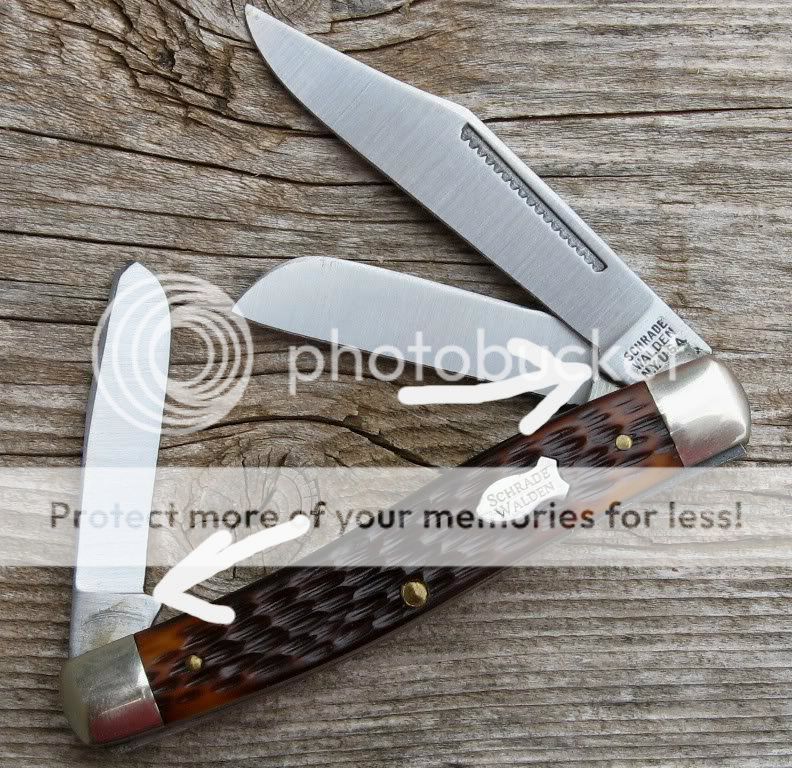
But for the poster that wanted to know what/where a kick is see photo below .....using one of Thawks good ole Schrades....300

The arrow points to the kick, this tang end holds the blade slightly off the bottom of the blade well to protect the edge, regulate the depth of the blade point into a safe carry level and to provide a very slight upward angle to slightly ease the opening of the blade. Very slight......
881_f-1.jpg
 
I'd guess it would be more likely to occur on a crinked blade where they annealed the tang. That said, I've never noticed one on the hundreds of knife blades I own.

Yes, I agree. The springs could not deform a fully hardened blade. However, the tangs of crinked blades have to be softened so they can be bent to fit together properly. I suppose that if you got one that was heated too long it might soften to the extent that the spring could deform it. I've not handled as many knives as Jack, but, like him, I've never seen the phenomenon in question.

Side note: I don't think the tangs of crinked are actually annealed. That would make them very soft indeed. According to Admiral Steel, Annealed 1095 has a Rockwell B hardness of 88, which equates to a Rockwell C hardness of only 7. Y'all bloody well know they ain't that soft. I have measured the tangs of crinked blades from several companies at the mid 40's HRC.

I believe tangs to be "softened" rather than "annealed", although everyone seems to use the term "annealed".
 
Last edited:
i mentioned my experience here twice. now i know why people are ignoring me. :D
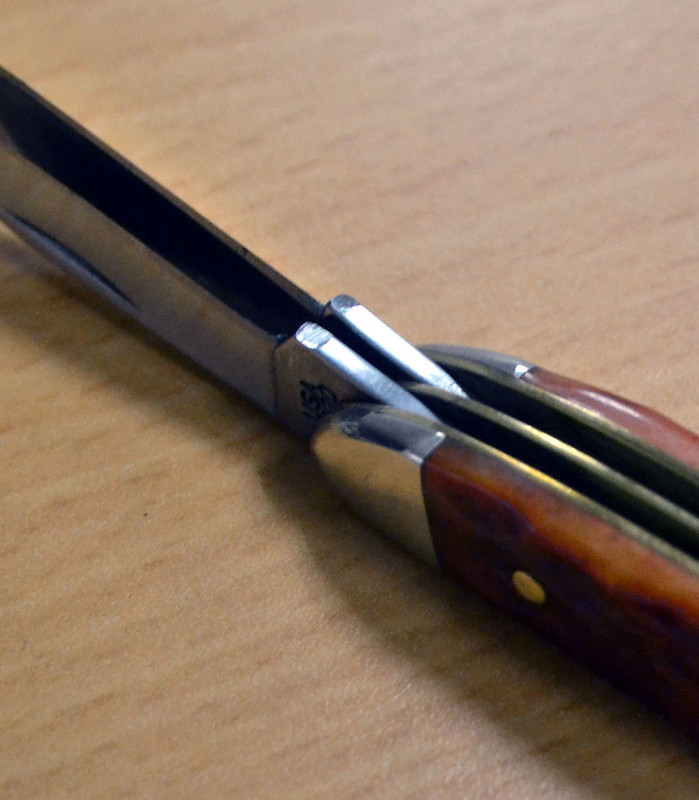
a chestnut bone peanut that i got 'NIB' from the bay.

http://farm9.staticflickr.com/8322/8031924217_833fb7921a_m.jpg
http://farm9.staticflickr.com/8029/8031922206_18cbc4271b_m.jpg
but to be fair, the mash hasn't really eaten away the kick and the edges are in no danger of hitting the spring. it's just disappointing for knife steel to get this way. and it's hell unsightly.

I can't see the problem. The pictures are a bit too small.

Ken
 
That almost certainly looks like the kicks were ground down and not mashed. Could be wrong...but my Peanut had similar grind marks, from what I assume is the factory adjusting the blade's depth in the well by taking a little off the kick. Maybe yours has a burr from the grind? Forgive me if I'm misinterpreting the picture.
 
That almost certainly looks like the kicks were ground down and not mashed. Could be wrong...but my Peanut had similar grind marks, from what I assume is the factory adjusting the blade's depth in the well by taking a little off the kick. Maybe yours has a burr from the grind? Forgive me if I'm misinterpreting the picture.
MAN YOU'RE A GENIUS! i'm holding it right now, looking at it with a lens. yup! they're transverse grind marks. if they were mashed, they'd have a roundish profile and a scaly texture. i thought they were mashed because there was mushrooming to one side but i realize it's just burrs from the grinding. i'll file those off.

well, that makes me a happy peanut owner. :D
 
MAN YOU'RE A GENIUS! i'm holding it right now, looking at it with a lens. yup! they're transverse grind marks. if they were mashed, they'd have a roundish profile and a scaly texture. i thought they were mashed because there was mushrooming to one side but i realize it's just burrs from the grinding. i'll file those off.

well, that makes me a happy peanut owner. :D

I love a happy ending!

Anything else we can help you with today? :)

~ P.
 
Yep, they look ground to me, also. I'm probably not alone in this, but on many older knives whose blades are sharpened away to the point that they peek above the handle, I've ground/filed/stoned the kicks to lower the blades. Even on some new ones... I had an 8OT whose sheepsfoot blade peeked from the factory, so I filed the kick to put it where it ought to be.
 
Thanks you explanation guys ... while reading this yesterday I had no idea what was ment by a "mashed kick" - I didn´t know the word and the whole term. The pics were clearing :)
 
Sometimes, the 'mushrooming' can happen on the other side of the blade too, opposite the kick. Here's a pic of a knife I have, a 1965 Case 6265 SAB Folding Hunter. The back of the blade tang, where it meets the spring in the open position, has been somewhat 'mashed' over time.
 
Last edited:
Back
Top