
- Joined
- Oct 4, 2011
- Messages
- 1,043
Hey everyone,
I have a school midterm project coming up in my Materials Processing Lab. I am required to find a heat treating process to maximize a balance of impact toughness as well as hardness. The steel sample will be 1095 with dimensions close to about 1cm x 3xm x 0.3cm.
I’ll have access to kilns, various quenches including salts. I think the toughness will be weighted more for points but hardness has to be a minimum of 35 HRC. They will be tested for hardness in Rockwell C, and then go through the impact testing. This is an assignment per group in the class, and each group will compete against each other to get the best results. I would like to learn a bunch, yield the best results, and maximize my group’s chances of winning. I think it's going to be an incredibly fun midterm project, and I am excited to really try out some stuff - I might be getting overly competitive...
While reading on the subject some, I came upon some questions that really got me thinking.
My former tests (which I can't find) with bainite yielded a lower than expected hardness, and it agrees with Kevin Cashen's study too - this is what concerns me going with this route.
I’m not sure what oil they have supplied – I’ll have to ask. I can choose between that, salt, water, brine, superquench, liquid nitrogen maybe, whatever else I can think of.
I’m sure I forgot something, but I’ll come back and ask later. I’m still going through a lot of readings, and I lost my old hardness and toughness results somehow.
Thanks so much!
-Don
I have a school midterm project coming up in my Materials Processing Lab. I am required to find a heat treating process to maximize a balance of impact toughness as well as hardness. The steel sample will be 1095 with dimensions close to about 1cm x 3xm x 0.3cm.
I’ll have access to kilns, various quenches including salts. I think the toughness will be weighted more for points but hardness has to be a minimum of 35 HRC. They will be tested for hardness in Rockwell C, and then go through the impact testing. This is an assignment per group in the class, and each group will compete against each other to get the best results. I would like to learn a bunch, yield the best results, and maximize my group’s chances of winning. I think it's going to be an incredibly fun midterm project, and I am excited to really try out some stuff - I might be getting overly competitive...
While reading on the subject some, I came upon some questions that really got me thinking.
- I was thinking of trying bainite (lower), but I’m not sure how well that would work. In the past I did a very similar experiment with 1095 and the HRC of the bainite samples yielded much lower than expected (although toughness was still very high). I also have read a couple of Kevin Cashen’s posts about heat treating 1095, and he stated that he doesn’t use salts or oils to do a martemper (from what I understand):
I have seen a few numbers mentioned in this thread, but all the curves I have seen (which also correspond to my experience) show 1095 as having around .5 second to get below the pearlite nose. 1095 lacks the manganese of many of the other 10XX steels so it is about the quickest that can still fully harden. Think about that- ½” a second from the time you go into the quench to get from 1500F to around 900F, you quench needs to be the best it can be for this stuff. I have tried and tried, with all of the methods described by others, to harden 10XX in salts and it just doesn’t work. I would be happy to share the images of choppy martensite laced with fine pearlite from those attempts. So needless to say I personally don’t use low temp salt on 10xx. Park’s #50 is simply the best for this steel in my shop, but if you were to heat it to 400F, it wouldn’t cool worth a darn and would most likely ruin good #50. They make special martempering oils that can do this but I don’t work with them and regular oils heated to 400F will give you that same pesky fine pearlite as well as singed hair.
My former tests (which I can't find) with bainite yielded a lower than expected hardness, and it agrees with Kevin Cashen's study too - this is what concerns me going with this route.
I also thought that bainite was the toughest microstructure for a given steel, but this source (http://hal.archives-ouvertes.fr/docs/00/25/56/55/PDF/ajp-jp4199707C558.pdf) says otherwise: “Because of the difference in the mechanism of transformation, bainitic steels have always been second- best when compared with tempered martensite. The lack of toughness can in principle be eliminated by using steels with a high silicon concentration (e.g. 1.5 wt%). Silicon has a negligible solubility in cementite and hence greatly retards its precipitation.”
I think in that source bainite was described to be brittle. Could someone shed some light on this? Reading other sources online bainite is supposedly tougher than other microstructures.
I think in that source bainite was described to be brittle. Could someone shed some light on this? Reading other sources online bainite is supposedly tougher than other microstructures.
Regardless, if it can be done, would bainite be a good contender? I understand that it would likely fair better in the Charpy test compared to just tempered martensite, but the lower hardness would be a pretty big factor.
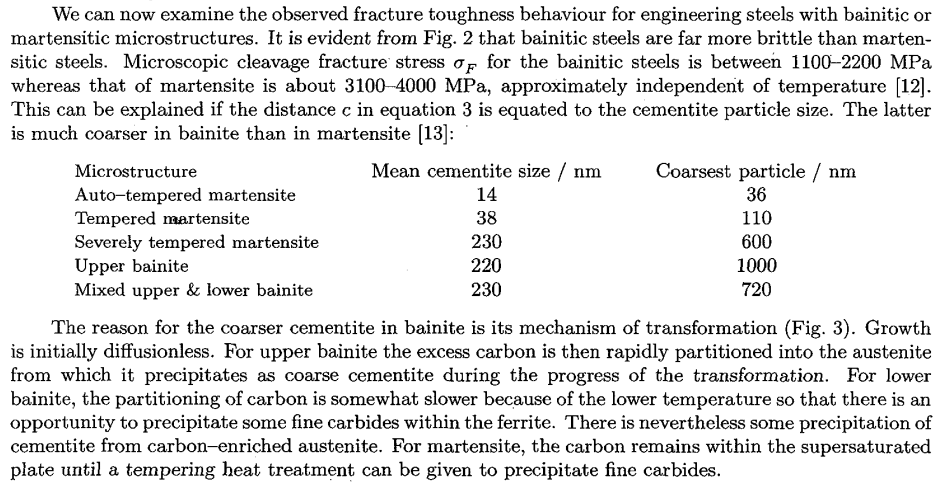
- I was also thinking about trying a martemper or interrupted quench. I remember reading about an auto-temper that takes place during which, reducing grain and cementite size, as well as increasing toughness (I remember someone saying twice as much). Is this truly the case? What is happening here? Again though, there would be a huge amount of human error with this method, or I would possibly be dealing with a sub-par quench speed with the salts/oils otherwise. Here’s a section of what I found (http://hal.archives-ouvertes.fr/docs/00/25/56/55/PDF/ajp-jp4199707C558.pdf):
- That brings me to one last little point: 1095 supposedly gets an additional point of HRC through cryo treatment from what I remember. Why does this happen? I thought that all of the martensitic transformation took place well above this temperature range.
I’m not sure what oil they have supplied – I’ll have to ask. I can choose between that, salt, water, brine, superquench, liquid nitrogen maybe, whatever else I can think of.
I’m sure I forgot something, but I’ll come back and ask later. I’m still going through a lot of readings, and I lost my old hardness and toughness results somehow.
Thanks so much!
-Don
Last edited:


