
Mill scale on tangs (edges clean) OK or finish cleaning off? (Pic)

Joined
Dec 15, 2009
Messages
1,008
This is a batch I've started (first grinds since last year), they're pretty rough and at 60 grit, gonna clean em up when my 120 etc belts come in. Any reason I need to clean the mill scale off the tangs if the edges are flat and clean? I'm wondering if I shouldn't use my 10" wheel to hollow the tang a bit if so, it would be faster than trying to flat grind lengthwise and get the scale off.. it takes forever.
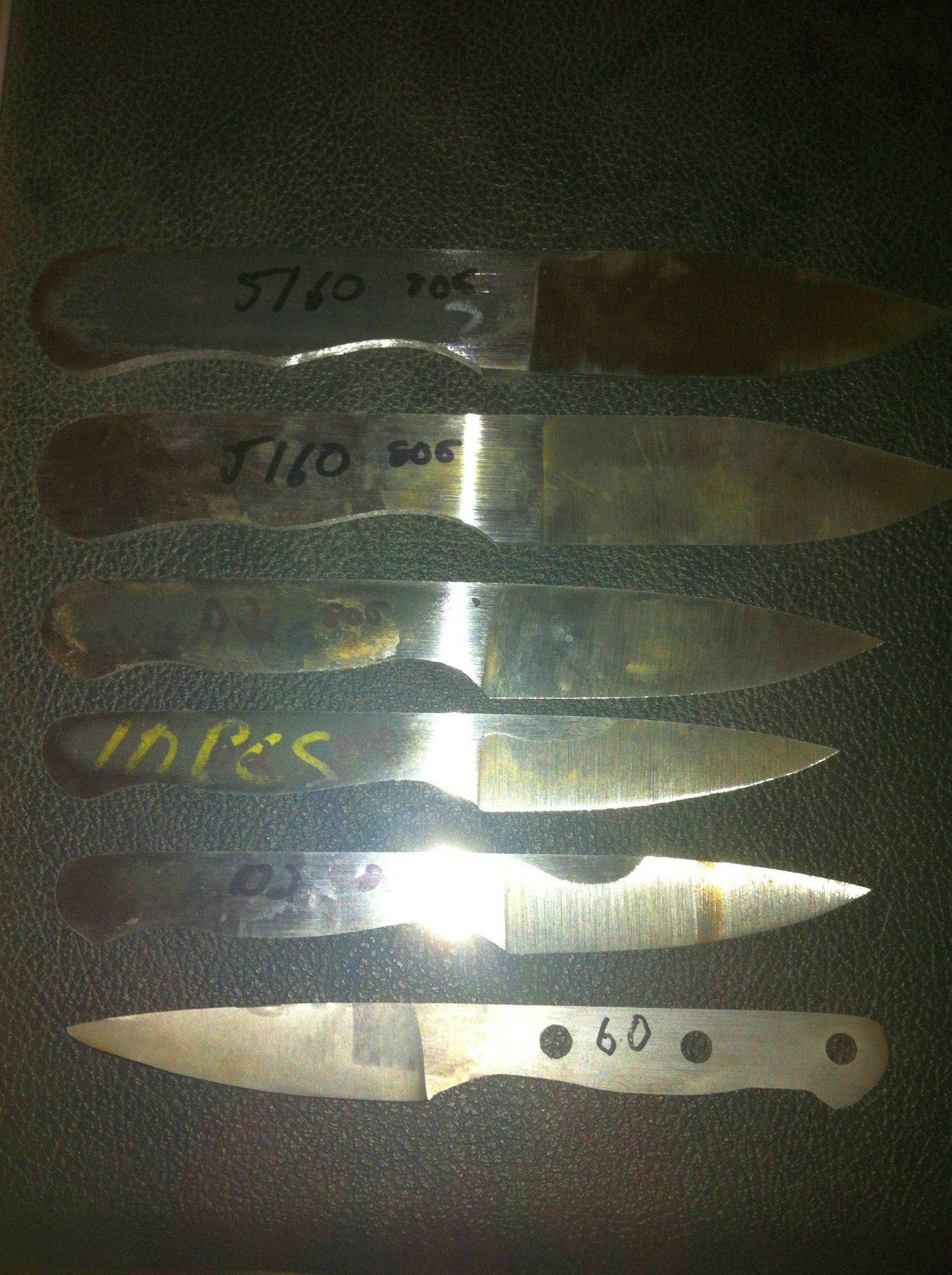
6qkyU.jpg
 
Last edited:
Yes. One way or another you want to clean that heat scale off the area the the handle scales will be sitting on. Frank
 
Thanks for taking the time to reply Frank. I was thinking there was a reason everyone does it, but nobody has outright explained it that I've seen. I suppose that even a couple thousandths height in the middle will prevent a good mating surface. Back to work!
 
If the tang is being epoxied with anything, I read that sandblasted surfaces stick to epoxy best.

My sandblaster makes short work of it anyway.

Do many people grind it off alone? Is this an issue with liner material?
 
I just experimented with this , mainly to test the strength of my acraglass. I made one knife and cleaned the tang good like I thought I should for a good glue joint and one knife I just glued the scales on without grinding the scale off. no pins to hold things together. I let the glue dry for a month. On the knife that I cleaned good I have hit the scales with a hammer more than 75 times and the scales are still attached fine. On the knife that I didnt clean one of the scales popped off on the first hit with the hammer.
The knife that has stood up to the hammer blows has natural walnut and the one that came loose had stabilized wood. Next I want to test how good the stabilized wood will hold when the surface is properly cleaned.
 
THat's a pretty convincing reason to just finish grinding the handles for me Spalted. I'm curious if it has to do with the natural wood being more porous and therefore having better adhesion than the very smooth stabilized wood. Looking forward to seeing your results with the stabilized slabs.. I have yet to use any of the stabilized woods I've purchased, just micarta and G10 so far..
 
You definitely have to sand the stabilized end. Best to sand it off be for you start ripping slabs.

I'm more concerned with the joint on the steel. You obviously have to remove the scale, but the question is how most guys do it. And what grit if you grind it?
 
Refusing to remove mill scale is a cheap and lazy move. It goes against everything that makes handmade knives worthwhile.
 
I'm more concerned with the joint on the steel. You obviously have to remove the scale, but the question is how most guys do it. And what grit if you grind it?

I finish my flats by using a magnet and laying the blade on my platen with the grinder off. Then I turn the grinder on. Doing this helps avoid screw ups from setting the blade unevenly onto the platen.
Most of my knives are done with way with a 120 grit 3m cubitron then the trizact cf's in a100, a45, and sometimes a30. Before gluing the scales I'll rough up the tang with some 60 or 80 grit paper making sure not to sand to the very edge of the tang
 
Refusing to remove mill scale is a cheap and lazy move. It goes against everything that makes handmade knives worthwhile.

I didn't mean to give the impression of a refusal or unwillingness, I was just curious if there was a good reason for getting them clean, whether the glue wouldn't stick as well or not etc. The replies have been pretty clear about it, for several good reasons, so I will simply finish cleaning them up. I always do, but I was staring at these ones while waiting on new belts and wondering at the necessity.
 
An addition to adhesion issues, if you don't take off all the mill scale then sometimes you'll end up with an ugly joint between the steel and handle scales because the cross section of the mill scale will be exposed.
 
Back
Top