
-
The BladeForums.com 2024 Traditional Knife is available! Price is $250 ea (shipped within CONUS).
Order here: https://www.bladeforums.com/help/2024-traditional/
You are using an out of date browser. It may not display this or other websites correctly.
You should upgrade or use an alternative browser.
You should upgrade or use an alternative browser.
Milling shoulders
- Thread starter alexmin
- Start date
- Joined
- Jan 16, 2006
- Messages
- 1,246
I always file them. By the time I get to squaring shoulders the potential for screwing them up by trying to mill them makes it too risky, at least in my book.

fitzo
Gold Member
- Joined
- Aug 14, 2001
- Messages
- 6,648
Alex, if you don't know squat about milling like I don't, then you may get some valuable information renting DVD's from this guy:
http://www.swarfrat.com/index.htm
The mini-mill basics Vol. 1, 2, & 6 will teach you a lot and give you ideas for how to figure this out. There is a rental section on there for about $9 each and they are very informative for the uninitiated. He uses the standard minimill to demonstrate, but the conepts in those 3 vids are useful in general setup.
If I told you how I set up to mill shoulders in, you'd laugh. If you watch the vids, you'll figure out a way quickly with the clamps and such you have on hand.
If you don't have "1-2-3" ( or 2-3-4 or 2-4-6) blocks and a good clamping kit, start looking for those. A good dial indicator and mag base is very helpful, as is a good set of squares. On that nice beast you bought, DRO is a desirable upgrade eventually. LittleMachineShop.com has decent inexpensive choices for some of this stuff. MSC Industrial has a nice catalog of monthly specials to quickly drain your pocketbook. The monthly fliers are available on the website or by calling in they'll put you on the paper mailing list. Delivery is very quick.
http://www.swarfrat.com/index.htm
The mini-mill basics Vol. 1, 2, & 6 will teach you a lot and give you ideas for how to figure this out. There is a rental section on there for about $9 each and they are very informative for the uninitiated. He uses the standard minimill to demonstrate, but the conepts in those 3 vids are useful in general setup.
If I told you how I set up to mill shoulders in, you'd laugh. If you watch the vids, you'll figure out a way quickly with the clamps and such you have on hand.
If you don't have "1-2-3" ( or 2-3-4 or 2-4-6) blocks and a good clamping kit, start looking for those. A good dial indicator and mag base is very helpful, as is a good set of squares. On that nice beast you bought, DRO is a desirable upgrade eventually. LittleMachineShop.com has decent inexpensive choices for some of this stuff. MSC Industrial has a nice catalog of monthly specials to quickly drain your pocketbook. The monthly fliers are available on the website or by calling in they'll put you on the paper mailing list. Delivery is very quick.

- Joined
- Jul 27, 2003
- Messages
- 5,689
You're going to need to create a table that clamps into your milling vise, and will hold the blade parallel to the axis of the table and hold it tightly laying flat.
Do most of the work with a file jig and file. Saves on end mills. Just get 'er close. Leave some extra meat.
If you cut one shoulder completely, leaving a small radius, (I use 1/8"), put your indicator on "0", raise the end mill, crank the blade to the other side of the end mill, lower it and cut that shoulder to "0" on the indicator, and the cuts are exactly in line.
There's no risk involved. Comes out perfect.
Do most of the work with a file jig and file. Saves on end mills. Just get 'er close. Leave some extra meat.
If you cut one shoulder completely, leaving a small radius, (I use 1/8"), put your indicator on "0", raise the end mill, crank the blade to the other side of the end mill, lower it and cut that shoulder to "0" on the indicator, and the cuts are exactly in line.
There's no risk involved. Comes out perfect.
- Joined
- Jan 24, 2001
- Messages
- 501
I have a large mill but still use my 2x72 to get close then finish the shoulders up with a file and a file guide. I can do it that way a lot faster than setting up the machine to do it.
- Joined
- Jul 27, 2003
- Messages
- 5,689
Good for you! I also use my 2X72 to remove the bulk, clean up with file and jig, but finish with the end mill. I have a mill and I'm gonna use it. Plus, the 1/8" end mill leaves me a radius at the ricasso which is best if you're going to harden that area. I cut both directions with the mill, so the first 1/2" or so of the tang is precisely 90 degrees to the guard shoulders.

fitzo
Gold Member
- Joined
- Aug 14, 2001
- Messages
- 6,648
Karl, I do essentially what you are describing.
What I would like to ask is what you do when you make one of your takedowns with the different "shoulder". Is that grinder and file and radius guage, or do you have some mill technique involved there?
Thanks.
What I would like to ask is what you do when you make one of your takedowns with the different "shoulder". Is that grinder and file and radius guage, or do you have some mill technique involved there?
Thanks.
- Joined
- Jul 27, 2003
- Messages
- 5,689
(Good to hear from you, Bill.)
Mike, I'm not sure what you mean on that question???
In reference to the guard shoulders, there is no difference at all whether the knife takes down or not? I haven't done many fixed assembly blades in a while, but the process is the same.
The only difference is the threaded tang.
Are you talking about the "shoulder" on the pommel nuts?
Help me out, Brother.
Mike, I'm not sure what you mean on that question???
In reference to the guard shoulders, there is no difference at all whether the knife takes down or not? I haven't done many fixed assembly blades in a while, but the process is the same.
The only difference is the threaded tang.
Are you talking about the "shoulder" on the pommel nuts?
Help me out, Brother.
fitzo
Gold Member
- Joined
- Aug 14, 2001
- Messages
- 6,648
The "shoulder" on the blade where the guard fits tight, Karl. The guard is slotted with a real nice "oval". The blade tang at the "shoulders" is radiused to match that guard and slide together tight. I'm thinking now I'm using the wrong term.
How do you make the blade fit tight in the guard? Do you use the mill to match the tang to the slot in the guard?
This comes from that pic you posted a couple days back with the "exploded" takedown so we could see the construction. I'd have had to file that tang to fit the guard. I'm trying to figure out if you did it with the mill somehow.
Thanks!
How do you make the blade fit tight in the guard? Do you use the mill to match the tang to the slot in the guard?
This comes from that pic you posted a couple days back with the "exploded" takedown so we could see the construction. I'd have had to file that tang to fit the guard. I'm trying to figure out if you did it with the mill somehow.
Thanks!
- Joined
- Jul 27, 2003
- Messages
- 5,689
At this moment I am milling guard shoulders on a blade to be heat treated today. As I am going along, I am taking photos of the entire process for a little "tutorial ala andersenforge".
But, of course, that will just be the guard shoulders.
Slotting/fitting the guard itself will be an entirely different tutorial, but I guess I can't do one without the other!
I just re-read your question and have an idea what you mean - I don't mill the shoulders to match the slot in the guard! I mill and file the slot in the guard to match the blade shoulders!
I have two guards to mill this afternoon and I'll photo them as well. When I mill my guards, I take 1 measurement, 1 time. One. And the guard fits tight.
Give me a day or so on this.
But, of course, that will just be the guard shoulders.
Slotting/fitting the guard itself will be an entirely different tutorial, but I guess I can't do one without the other!
I just re-read your question and have an idea what you mean - I don't mill the shoulders to match the slot in the guard! I mill and file the slot in the guard to match the blade shoulders!
I have two guards to mill this afternoon and I'll photo them as well. When I mill my guards, I take 1 measurement, 1 time. One. And the guard fits tight.
Give me a day or so on this.


- Joined
- Jan 30, 2004
- Messages
- 4,030
I always do the shoulders on my grinder using a tool rest and the platen. It's very easy to do this way. I use my 2x72 or sometimes even my 1x30. I can get very accurate shoulders this way.
- Joined
- Jul 27, 2003
- Messages
- 5,689
This is the way I do it.
Works good for me and the whole thing took me about 5-6 minutes including taking the pictures.
What I like about it is that the shoulders are PRECISELY in line and I have a nice radius at the tang/shoulder junction to avoid a stress riser and it actually assists me in my guard fitting later on.
I do a lot like you, Ray, and every one else. I use both my 2X72 Bader and a file and jig IN ADDITION to my mill.
So, first I have a blade that I have cleaned up after forging. I've only done the 36 grit work and left the blade probably .025 thick. I take a small square and make to lines on the ricasso area. One line where I want the shoulders to be, and one about 1/8" further forward for a reference line. You'll see this in a minute.


Now I put on my filing jig just like everyone else. I place it maybe .010 back up the tang from the actual shoulder line. I use the filing jig as my reference and take the blade to my bader and grind away ALMOST to the jig, both the sholder area and sort of set-up the tang planes also. You can see in the second photo that I have a little for filing.


After filing, we are really close to almost being done! As a reference, grinding the bulk material off too me under 60 seconds. Filing up to the jig on both sides of the tang took me 90 seconds! At this point, we have under a 3 minute investment.


Now, I have a table made from 1/2" steel with a bunch of 1/4X20 holes tapped into it that clamps into my mill vise. I had a picture to show the entire thing, but it was way out of focus and I'm too far into this now and sitting here in my underwear, it's raining outside and I don't want to go back out! So, just fill in the blanks - you should be able to see enough here. The blade is clamped with the shoulder area and the tang hanging off the end.

Works good for me and the whole thing took me about 5-6 minutes including taking the pictures.
What I like about it is that the shoulders are PRECISELY in line and I have a nice radius at the tang/shoulder junction to avoid a stress riser and it actually assists me in my guard fitting later on.
I do a lot like you, Ray, and every one else. I use both my 2X72 Bader and a file and jig IN ADDITION to my mill.
So, first I have a blade that I have cleaned up after forging. I've only done the 36 grit work and left the blade probably .025 thick. I take a small square and make to lines on the ricasso area. One line where I want the shoulders to be, and one about 1/8" further forward for a reference line. You'll see this in a minute.
Now I put on my filing jig just like everyone else. I place it maybe .010 back up the tang from the actual shoulder line. I use the filing jig as my reference and take the blade to my bader and grind away ALMOST to the jig, both the sholder area and sort of set-up the tang planes also. You can see in the second photo that I have a little for filing.
After filing, we are really close to almost being done! As a reference, grinding the bulk material off too me under 60 seconds. Filing up to the jig on both sides of the tang took me 90 seconds! At this point, we have under a 3 minute investment.
Now, I have a table made from 1/2" steel with a bunch of 1/4X20 holes tapped into it that clamps into my mill vise. I had a picture to show the entire thing, but it was way out of focus and I'm too far into this now and sitting here in my underwear, it's raining outside and I don't want to go back out! So, just fill in the blanks - you should be able to see enough here. The blade is clamped with the shoulder area and the tang hanging off the end.
- Joined
- Jul 27, 2003
- Messages
- 5,689
This photo will show you what the second reference line is for. The edge of the clamp table is perperdicular to the in-out travel of the mill table. So, I line up the reference line with the edge of the table. Since both lines on the blade are parallel, the end mill will cut perfectly square to the blade.
Now, I do what one does with a mill! I eat a little bit at a time - about .004-5 on each pass. I crank in a little bit and eat out some of the shoulder and then crank out the other way and eat out some of the tang. Each time I progress in a little, I am gradually encroaching on the shoulder line. When I finally get to the shoulder line, I set my increment indicator on "0".


Now, it's a simple matter of raising the end mill, cranking the blade forward to the other side of the end mill and lowering it!

Now I eat away at the tang and shoulder area a few thousands at a time until I reach "0" on the depth indicator already set from the other side! You can see below that both sides are perfectly in line with each other and you can see the nice clean radius.


Now I clean up the blade, finish it out for hardening.!!
And, the entire mill work took me less than three minutes!

I also slot my guard ENTIRELY with the mill only taking ONE measurement! That process took me about twice as many pictures as this one. Hope I don't get in trouble for this!
After I milled the guard in this photo, I had it fit to the blade in maybe two minutes.

Now, I do what one does with a mill! I eat a little bit at a time - about .004-5 on each pass. I crank in a little bit and eat out some of the shoulder and then crank out the other way and eat out some of the tang. Each time I progress in a little, I am gradually encroaching on the shoulder line. When I finally get to the shoulder line, I set my increment indicator on "0".
Now, it's a simple matter of raising the end mill, cranking the blade forward to the other side of the end mill and lowering it!
Now I eat away at the tang and shoulder area a few thousands at a time until I reach "0" on the depth indicator already set from the other side! You can see below that both sides are perfectly in line with each other and you can see the nice clean radius.
Now I clean up the blade, finish it out for hardening.!!
And, the entire mill work took me less than three minutes!
I also slot my guard ENTIRELY with the mill only taking ONE measurement! That process took me about twice as many pictures as this one. Hope I don't get in trouble for this!
After I milled the guard in this photo, I had it fit to the blade in maybe two minutes.
fitzo
Gold Member
- Joined
- Aug 14, 2001
- Messages
- 6,648
Thanks, Karl! We pretty much do the tang the same way. So close, in fact, the biggest differences are that I use blue Dykem and my clamps are shaped a little different. 
I got a little confused by the perspective of the foto of the takedown. Now I understand it was probably the shine of the metal made me think it was contoured different where the tang went into the shoulders.
I 'm sure I'm not the only one grateful for the time you spent to take and share those fotos with us. Thanks!:thumbup:
I got a little confused by the perspective of the foto of the takedown. Now I understand it was probably the shine of the metal made me think it was contoured different where the tang went into the shoulders.
I 'm sure I'm not the only one grateful for the time you spent to take and share those fotos with us. Thanks!:thumbup:
- Joined
- Jul 27, 2003
- Messages
- 5,689
maybe you are referring to this latest picture? I have the habit of rounding my guard shoulders over almost to the slot! It sort of helps guide the knife down into the sheath, and also, since I do a lot of hot bluing, there isn't a sharp edge for the bluing to wear off!
That rounding over may have made the guard seem odd looking to you?

That rounding over may have made the guard seem odd looking to you?
- Joined
- Jul 27, 2003
- Messages
- 5,689
No, this one right?
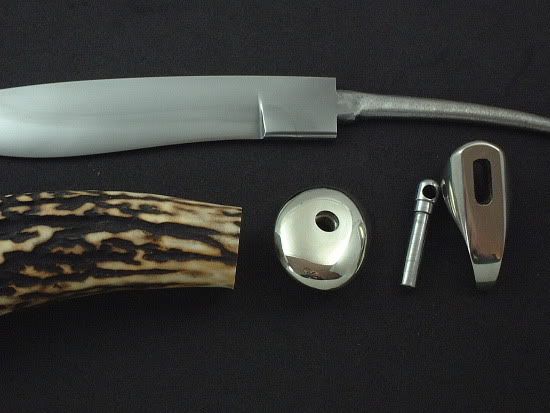
Pretty much the same as the previous one.
Pretty much the same as the previous one.
fitzo
Gold Member
- Joined
- Aug 14, 2001
- Messages
- 6,648
The second one, there, yes, Karl. For some reason I got it in my head that the tang might be radiused lengthwise right behind the shoulders. I couldn't figure out how in the heck a guy could do that at home on a mill without a REALLY fancy setup.
Just a trick of the foto angle, lighting, and the fact detail doesn't stand out like it used to with these aging eyes. Looked at with the readers and a magnifying glass I could see the detail a little better and realize that part just behind the shoulders was flat, not round.
Thanks, again. I'm sure many here have never seen that operation. :thumbup:
Just a trick of the foto angle, lighting, and the fact detail doesn't stand out like it used to with these aging eyes. Looked at with the readers and a magnifying glass I could see the detail a little better and realize that part just behind the shoulders was flat, not round.
Thanks, again. I'm sure many here have never seen that operation. :thumbup: