Mini flashlights?

i carry a surefire e2 24/7... but find it's run life is too short and it is too bright for in the woods.. ruins night vision... i bring it for emergency and gun use... i try not to use a light when in outside fire gen works, but i have various cheapo led lights i like them for long run life....there when u need it if u will.... but have just found out about the cyber guys conversion for mini mags... six year run time w thumb switch.. loving it... picking up two for payday as my oh crap light... i also keep a shake up led light in the oh crap bag in the truck....
 
As with knives, the one you have with you will be your survival light.

The $1 rigs from CountyComm and Lighthound.com should be all over your kits, cars and living spaces. It is such a pain to replace the batteries that I recommend carrying a spare light instead of a spare battery. At $1 each, the batteries may cost more. Photon makes excellent ones--- and they are ridiculously over priced.

One of my favorite coin cell LED lights is the Princeton Tec Pilot. It was designed to go on the headband of a large headlamp, for backup and to use when the big light is too bright and overkill for the task. They have a base that goes on a strap and is just the right size for the straps typically used for compression and holding down flaps. The straps that typically run down your backpack straps are perfect for these little lamps. The lamp body can be removed to use like a flashlight. It has a blink mode that I like for walking the dog a night and it fits on the leash. You will see them on sale for $5-$6 -- retailers have to move them before the batteries expire.

I have Fenix E01 and P2D lights in my pocket kits. They are small, bright and easy to replace batteries in the dark by touch.

Don't forget headlamps. Petzl, Black Diamond and Princeton Tec make excellent ones. I have a Petzl E+Lite that is about the size of a Zippo. My main hiking headlamp is a Black Diamond NightRay with 5 switchable LED's. It's a landing light :) Headlamps are much better when working with your hands and walking. The Cyclops Atom headlamps are another tiny model, running on coin cells and cheap when on sale-- about $10. I would want a backup for survival, but these are great for small kits where you want a headlamp.

The old Maglites still do the job. I got one at Goodwill yesterday for $0.99. The bulb was missing, but there was a new one in the tail cap. The batteries still worked! I did the LED conversion on one for my wife and I was impressed with the results.

 
I carry a River Rock from target. It's the AA model with the clip and xenon bulb; bright enough to shoot by and batteries last forever. I think its 40-60 lumens. At 23 USD you really can't beat it.
 
I've got a small collection of the CountyComm $1 lights. The red ones are particularly useful in protecting night vision.

At the local Fred Meyer last year I stumbled across a mini-dynamo flashlight from Viatek and put it in one of my bags. It seems to work well but has not been subjected to harsh conditions yet.

What do you think of this? (BTW, Amazon's price is high; they're $7-8 at Fred Meyer if one is near you).http://www.amazon.com/Viatek-Mini-Dynamo-Flashlight-Black/dp/B000TF8UOE
 
hahaaaa ... i just bought a fenix e01 cos of these threads and waiting for the postman in great anticipation.
 
Try the streamlight stylus pro basically a microstream with double the batteries and more than double the runtime
 
Button cells are a nuisance though, much as I appreciate Doug Ritter's contributions to survival gear.
 
Button cells are a nuisance though, much as I appreciate Doug Ritter's contributions to survival gear.
Absolutely right.

It's impossible to get replacements, and by his own admission, the light doesn't last a very long time, dropping 40% in the first hour.

The Fenix E01 is a much more robust alternative, that's only marginally larger. With 8-10 hours of regulated 5-6 lumen output and an easily-replaceable AAA battery, it's a much better choice for a survival light. Actually, it's probably the light I'd recommend for most people to throw in their pack or BOB, given its features and very low price.
 
Ritter's light looks a lot like the the Streamlight Nano.

19942_Streamlight_Nano_m.jpg


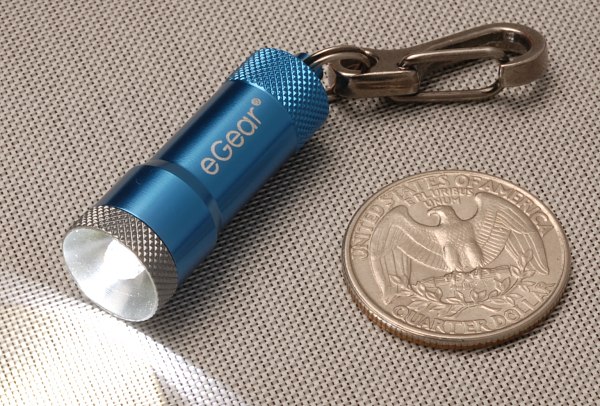
PICO_egear_quarter_600w.jpg
 
For me, these little flashlights aren't there for anything more than emergency use as I'm mostly a day hiker.

I agree that button cells are, well, iritating. It seems like Doug Ritter designed his tiny little LED flashlight mostly for kit use - to be kept for emergency use, rather than regular day-to-day use. In that usage, the button cells would be OK, since they provide the tiny size needed for kit stowage or for use on a keychain/zipper.

The original post said that the need for the little flashlights was needed for emergency use - not regular night-time usage.
 
Ritter's PICO light looks a lot like the the Streamlight Nano.

One of the testers of PICO light who also has the Nano says that PICO light has an o-ring which makes it more waterproof.
 
Last edited:
kenk, the only problem is that in an emergency situation, you will likely need more than one hour or so of light. I'll sacrifice a little size for longer run time.
 
kenk, the only problem is that in an emergency situation, you will likely need more than one hour or so of light. I'll sacrifice a little size for longer run time.

Doug's description says that it still provides enough light for survival chores after 48 hours on. It says that after 10 hours of use with a 20 minute "rest" it came back with about 75% of brightness.

Plus, who in heck will keep the light on all the time? I'd be using it VERY sparingly.

Remember, its intended for a survival light - not an every-day-use light.

Quote from Doug's site:
"There is a fairly steep drop-off in brightness during the first hour until it is producing at about 40% brightness. From there you can expect a slower drop-off of about 10%/hour, which is very nearly asymptotic, a fancy math term that in this case means it keeps getting lower and lower, but [almost] never quite gets to zero. ... [clip] ...

Even after 48 hours we found that there is still enough light so that with fully dark adapted eyes, I could perform survival chores and find my way around, though ithe light by this time was certainly not bright, it was adequate. This rundown curve is what you get when running continuously. If used intermittently, in shorter bursts, as is typically the case for EDC use and even in an emergency in many cases, the alkaline batteries will recover significantly between uses and will provide more illumination during use and last longer. As an extreme example, after a 10-hour rundown and a 20 minute rest, they output approximately 75% of inital illumination for five minutes before resuming more or less where they left off. At full brightness, the light can be seen for over a mile in the dark."
 
Back
Top