Mirror Polishing CPM-M4?

Joined
Jul 22, 2009
Messages
11,409
For a while now I've been putting a mirror polish on every small knife I own, with relative ease. Until I tried the same on my Gayle Bradley folder with CPM-M4.

Using a buffing wheel and an Extra Fast Cut Stainless Steel Compound, it didn't manage to put even a tiny scratch on the blade. Now, my other Spyderco folders have similar if not the same finishes and they all buffed up to a pretty reflective shine with just that compound alone. Moving through a few other compounds including Green Rouge, White Rouge, and a "White Lightning" Compound, the blade only looks slightly shinier.

Even ZDP-189 hasn't given me this much trouble, and I'm not entirely sure what to do here. Will my current abrasives(all from Caswell) eventually polish the surface if I keep at it long enough? Or will I have to attempt to apply diamond paste/spray to the buffing wheels in order to make any progress?

I also have some aluminum oxide powder coming in at 320 grit that is supposed to be "glued" onto the buffing wheel, though I'm not sure if that will leave a finer finish than the factory finish.
 
The compounds you are using are softer than the steel and if you do your homework about compounds you will find you are using these compounds out of their designed application.

Using diamond on your wheel will be a waste, its not designed for that use and will not be effective. Putting it on balsa or leather will be a different story though, but if your not working up to that point with stones then again its a waste.
 
The compounds you are using are softer than the steel and if you do your homework about compounds you will find you are using these compounds out of their designed application.

Using diamond on your wheel will be a waste, its not designed for that use and will not be effective. Putting it on balsa or leather will be a different story though, but if your not working up to that point with stones then again its a waste.
Now see, that doesn't make much sense. The extra fast cut compound might be softer, but the green rouge will easily put a mirror finish on my Endura 4 with ZDP-189, which ought to be at the same hardness if not even harder.

I also don't think that M4 has as high a volume of carbides compared to ZDP-189. I suspect the fact that it's a "high speed" tool steel has something to do with it, as I've heard that heat plays a role in buffing the metal.

I simply assumed that most of these products use either aluminum oxide or silicon carbide to buff the metals. I'm not sure it's fair to say that I'm using these compounds outside of their intended application, as I doubt any buffing compounds available today were "intended" to buff steels harder than Rc 60.

I'm considering the cerium oxide powder, which is meant to polish glass.
 
I'm not using power tools on my knives, so I can't say anything about that. Have no experience with M4, so I'm out of my league there too.
But I do know that diamond paste on a strop will put a polished edge on any steel since diamonds are harder than steels.
you might want to give dmt diamond pastes a try. you can get the 6 + 3+ 1 micron paste for 22 dollars in a package.
 
My specialty is high wear resistant steels, there is a big difference between hardness and wear resistance and your compounds are proving that point. I've been there done that with learning proper use of abrasives, its your choice to believe me or not.

Most rouge compounds are made to polish and color the surface and depending on color will provide different results per type of metal.

M4 is not going to polish or sharpen the same as ZDP, you can sharpen ZDP on water stones easily... have you tried the same with M4? I can tell you that its not going to be the same. I tried polishing a M4 blade on my 12k naniwa and after 20 minutes and still NO metal building up on the stone I went back to my diamond compounds. Its been the same result with other softer abrasives too. Some HA chromium oxide might work though, haven't tried mine in a while so I'm not sure.
 
Actually sharpening M4 was so easy it was almost laughable given what I heard about it.. I used my paper wheels which has silicon carbide glued to one wheel and probably aluminum oxide on the white rouge for the slotted wheel. The slotted wheel managed to put a mirror finish on the edge, although it still looks a little cloudy.

I think I'll set aside a couple hours tomorrow and try the green and white lighting compounds for about an hour each on the blade. The blade did get shinier, so ultimately I think the abrasives are harder than the steel itself.

Diamonds would be a last resort, as the pastes seem to fly right off the wheel when I turn it on. I suspect it would also be the same with the spray. So if I really have to use that method, I'd need an adhesive to hold the diamonds onto the wheel, and it needs to be able to take the heat.
 
The diamond compounds fly off because they are not a bar compound with a wax binder designed to be used with power buffers. White rouge IIRC is cerium oxide, the haze you see is because of the wear resistance and the compound not actually being fine enough for a mirror polish. White rouge is best for stainless, soft metals, and aluminum. Nowhere in the description does it say "best for high alloy steels". Green rouge is for final finish and suggested for harder metals, this does not mean it will work property though.

Try and find some silicon carbide or boron carbide compound, it should work much better.
 
The diamond compounds fly off because they are not a bar compound with a wax binder designed to be used with power buffers. White rouge IIRC is cerium oxide, the haze you see is because of the wear resistance and the compound not actually being fine enough for a mirror polish. White rouge is best for stainless, soft metals, and aluminum. Nowhere in the description does it say "best for high alloy steels". Green rouge is for final finish and suggested for harder metals, this does not mean it will work property though.

Try and find some silicon carbide or boron carbide compound, it should work much better.
A big problem is that most companies don't list the materials used in their buffing compounds. I found something that seems to be like sandpaper in a wax binder for the buffing wheels, though I'm not sure if it's silicon carbide.

They also don't list the coarseness of each compound, nor the grit "size" relative to the other. However, the kit did say to use green before white, so I assume white would be the finer grade. The Extra Fast Cut compound typically would leave a finish that is nearly a perfect mirror finish on my other knives, which I assume is about 800 grit.

I think the real problem might be that the compound breaks down into a finer grit before any significant amount of metal is removed. So coarse abrasives to begin with might be the solution.
 
White rouge is before green, when I get home I'll link a site with some great info on the subject. Rouge is its own class of compoun and not to be confused with other types. For example: HA or leevally chromium oxide is NOT rouge.

The break down of the compound will not be that great, your not going to start with 800 and end up with 8000. If it did we would all use it and never need a stone.
 
Almost forgot, look uup a product called white diamond, it does not contain diamond but does use ceramic for a abrasive. Its for buffers and is about 1500+ grit, also a bar compound.
 
White rouge is before green, when I get home I'll link a site with some great info on the subject. Rouge is its own class of compoun and not to be confused with other types. For example: HA or leevally chromium oxide is NOT rouge.

The break down of the compound will not be that great, your not going to start with 800 and end up with 8000. If it did we would all use it and never need a stone.
That's debatable. I believe the silicon carbide grit on the paper wheel is 80-120 grit. Whereas the slotted paper wheel White Rouge is said to be 3-4 microns, yet it leaves a mirror finish on the edge and will eliminate the previous grind lines. And also, the finish on the slotted wheel seems to be even finer than the finish I get using 0.25 micron diamond spray(the diamond finished edge feels more "toothy" when cutting paper compared to the finish off the slotted wheel).

Most companies don't seem to point out any differences between "compound" and "rouge", and will often use both words to describe the same item.
 
White rouge is not even close to as fine as 0.25 1/4 micron 100,000 grit compound. when 0.25 is used in proper progression the result is a very deep mirror finish with a edge that feels smooth as glass and is perfect for your morning shave. The 0.25 finish will be so glossy you will have a hard time viewing it and it almost turns black/invisible at select angles. I'm talkin bathroom mirror, mirrored out finish.

Your white rouge may give you the effect of mirror finish but in truth its far from it.
 
White rouge is not even close to as fine as 0.25 1/4 micron 100,000 grit compound. when 0.25 is used in proper progression the result is a very deep mirror finish with a edge that feels smooth as glass and is perfect for your morning shave. The 0.25 finish will be so glossy you will have a hard time viewing it and it almost turns black/invisible at select angles. I'm talkin bathroom mirror, mirrored out finish.

Your white rouge may give you the effect of mirror finish but in truth its far from it.
The white rouge finish typically push cuts paper like a smooth piece of glass. But when I take that same finish to my leather bench strop loaded with Dupont 0.25 micron diamond spray, that edge tends to "drag" on the paper more when push cutting.

One member noted when viewing the edge through a microscope that the white rouge finish was almost perfectly smooth while the diamond finish had a mess of scratches.

Unless I'm screwing up the stropping so badly that I'm degrading the edge.

Still, the fact that the white rouge seemed to put a mirror finish on the edge so easily is certainly interesting.
 
I'd like to see those pics.

I've used white rouge, I've seen the edge from a paper wheel, neither was as fine as even 1 micron compound.

Your not progressing properly so your results from the 0.25 is not going to be what it should.

From what I know of diamond products 0.25 should leave no scratches.


Here's that link http://www.ganoksin.com/borisat/nenam/buffing-material.htm
 
Last edited:
Noctis here is a pic of a M4 blade knifenut1013 sharpened for me. I believe he did it progressing thru the grits of his dmt plates and stropping with diamond paste or spray on leather strops.

attachment.php
 
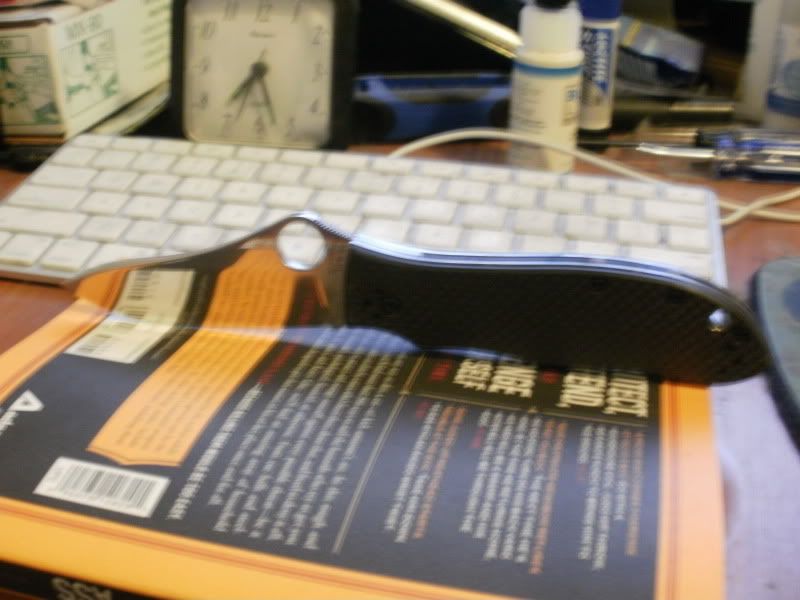
After spending 1 1/2 hours buffing my Gayle Bradley, it finally took an extremely reflective shine. Not quite a perfect mirror finish, but it's nice to know that my abrasives can scratch it.

The factory grind lines are still there, but I'd love to see if 320 grit Aluminum Oxide powder can fix that up.
 
It's ALIVE!!!

P8220003.jpg


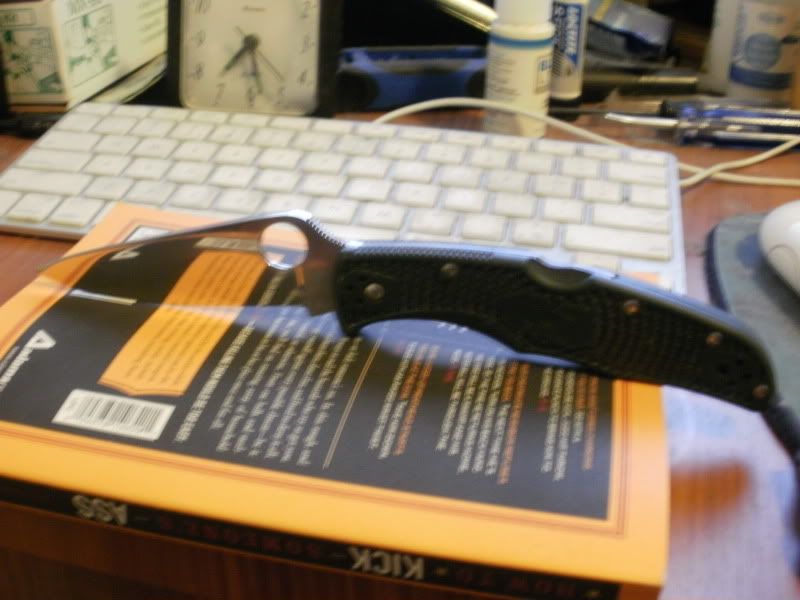
The 320 grit Aluminum Oxide powder did the trick and smoothed down the factory grind lines. Buffing still took a good hour or two switching back and forth between the white and green compounds, but it was all worth it.

And just for fun, my Endura 4 "Kreined" FFG with ZDP-189:
P8220004.jpg


I love my handheld mirrors.
 
You never said you were trying to polish the whole blade. Rereading, it stands out that that was you intention but it still helps to know exactly what your trying to accomplish.

Good work, they look nice.
 
Back
Top