
-
The BladeForums.com 2024 Traditional Knife is available! Price is $250 ea (shipped within CONUS).
Order here: https://www.bladeforums.com/help/2024-traditional/
You are using an out of date browser. It may not display this or other websites correctly.
You should upgrade or use an alternative browser.
You should upgrade or use an alternative browser.
mokume
- Thread starter foxbat34
- Start date

Bill DeShivs
Knifemaker / Craftsman / Service Provider
- Joined
- Jun 6, 2000
- Messages
- 12,958
Quarters ARE mokume. You could just silver solder a bunch together......

TekSec
Böse Messer
- Joined
- Dec 8, 2006
- Messages
- 2,933
Stacy Apelt had some info on this. Just replace the other material with quarters and you should get something out. Here is his quote...
"I make mokume' gane for jewelery purposes and for knives. The jewelery mokume is various combinations of gold, silver, platinum, copper, and nickel.
The knife mokume is usually brass, nickel, and copper. I have a mokume press made from two 3.5X3.5" plates of 3/4" steel. They bolt together on the corners with 1/2" bolts. I stack the 2X2" sheets of 16 to 20 gauge metal up (surgically clean and pickled) and bolt as tight as I can. I seal the assembly in a foil HT bag with some powdered charcoal. I put it in the HT oven for up to 8 hours at a temperature about 50 degrees BELOW the eutectic point of the metals. The metal will come under high pressure and fuse during the process.When cooled down to about 1000F I take it out and GENTLY give it a light forging, increasing the force as it cools and firms up. DO NOT pound away at it. When at black heat, dunk in a bucket of water. The block should be sawn/ground to make all sides smooth. This will prevent cracks from forming when drawing out the billet, and will show any bad joints. You CAN save a bad billet, but it can be complex and frustrating. Once the billet is cleaned up, you forge it out to the size/thickness you want. Anneal ocasionaly by heating it to red and quenching in water. Work it with gentle force and work it cold. If you must work it hot,do not hot forge mokume any hotter than dull red. Pickling after quenching helps keep it clean from oxides. The billet can be folded, twisted, and drilled as would a damascus billet. I like to bring it to about 1/2" thick and then reduce it with a ball peen hammer. This produces a nice water pattern.
Here is a photo of a tsuba made in fine silver and copper.
BTW, Midgett's book open "Mokume Gane" is excellent."
Stacy Apelt
"I make mokume' gane for jewelery purposes and for knives. The jewelery mokume is various combinations of gold, silver, platinum, copper, and nickel.
The knife mokume is usually brass, nickel, and copper. I have a mokume press made from two 3.5X3.5" plates of 3/4" steel. They bolt together on the corners with 1/2" bolts. I stack the 2X2" sheets of 16 to 20 gauge metal up (surgically clean and pickled) and bolt as tight as I can. I seal the assembly in a foil HT bag with some powdered charcoal. I put it in the HT oven for up to 8 hours at a temperature about 50 degrees BELOW the eutectic point of the metals. The metal will come under high pressure and fuse during the process.When cooled down to about 1000F I take it out and GENTLY give it a light forging, increasing the force as it cools and firms up. DO NOT pound away at it. When at black heat, dunk in a bucket of water. The block should be sawn/ground to make all sides smooth. This will prevent cracks from forming when drawing out the billet, and will show any bad joints. You CAN save a bad billet, but it can be complex and frustrating. Once the billet is cleaned up, you forge it out to the size/thickness you want. Anneal ocasionaly by heating it to red and quenching in water. Work it with gentle force and work it cold. If you must work it hot,do not hot forge mokume any hotter than dull red. Pickling after quenching helps keep it clean from oxides. The billet can be folded, twisted, and drilled as would a damascus billet. I like to bring it to about 1/2" thick and then reduce it with a ball peen hammer. This produces a nice water pattern.
Here is a photo of a tsuba made in fine silver and copper.
BTW, Midgett's book open "Mokume Gane" is excellent."
Stacy Apelt
The idea is to make a small billet for a guard.
I was wanting to know what process, if any, someone has used to weld the quarters together to make them workable for this purpose.
How were they held together, what was used to heat them, what heat do they need to be forged and worked?
Thanks again
I was wanting to know what process, if any, someone has used to weld the quarters together to make them workable for this purpose.
How were they held together, what was used to heat them, what heat do they need to be forged and worked?
Thanks again

TekSec
Böse Messer
- Joined
- Dec 8, 2006
- Messages
- 2,933
Yea, I don't know the eutectic temp for quarters. I know I talked with Chad Nichols about this once and he said he just puts them in at temp and watches closely until they start to "sweat" and quickly takes them out and softly taps them to set the weld. He doesn't use a bag and I seem to remember his saying around 1800 degrees, but don't quote me on that. Hey, for a $10 roll of quarters, can't hurt to try it a few times to get the process worked out 

- Joined
- Aug 1, 2008
- Messages
- 1,762
you can use quarters however there are other materials that are much easier to get complete welds with and to pattern and manipulate after welding. the easiest that I have used is copper and fine silver. in the long run it will be cheaper to get a large enough piece for a guard by buying silver and copper discs. I parsonally have melted over a hundred dollars worth of quarters together and only gotten two or three completely welded billets. On the other hand I only screwed up about thirty dollars worth of copper and silver before getting good billets and have had no problems since perfecting my proceedure.
That may be true, but there is something about seeing the shock on someone's face after telling them the gaurd/bolsters are made from quarters.
i found that $4 in quarters is enough for most knives 9" and under. So, if you screw it up, your out 4 bucks and maybe a lesson ot two. You re right though, I can't get a perfect weld every time with the quarters. I use a homemade gas forge without any controls other than the knob on the Bernzomatic torch. So control plays a factor in my errors. However, if I can do it, anyone can.
i found that $4 in quarters is enough for most knives 9" and under. So, if you screw it up, your out 4 bucks and maybe a lesson ot two. You re right though, I can't get a perfect weld every time with the quarters. I use a homemade gas forge without any controls other than the knob on the Bernzomatic torch. So control plays a factor in my errors. However, if I can do it, anyone can.
Bill DeShivs
Knifemaker / Craftsman / Service Provider
- Joined
- Jun 6, 2000
- Messages
- 12,958
If you use good flux, high temperature silver solder, and clean the coins, the result will be good. You can even do it with a propane torch.

Stacy E. Apelt - Bladesmith
ilmarinen - MODERATOR
Moderator
Knifemaker / Craftsman / Service Provider
- Joined
- Aug 20, 2004
- Messages
- 38,709
Soldered joint mokume will work if you anneal the stack often while reducing the billet. The solder joints tend to shear under the hammer, though, due to the fact that the solder is far more brittle than the copper and nickel in the quarters. The good thing is that if a shear forms, the stack can be pickled, cleaned, and re-soldered.
You really need to file the quarters to a smooth and flush surface to get a good joint on making them fuse....no matter which way you do it.
Stacy
You really need to file the quarters to a smooth and flush surface to get a good joint on making them fuse....no matter which way you do it.
Stacy
- Joined
- Aug 1, 2008
- Messages
- 1,762
That may be true, but there is something about seeing the shock on someone's face after telling them the gaurd/bolsters are made from quarters.
i found that $4 in quarters is enough for most knives 9" and under. So, if you screw it up, your out 4 bucks and maybe a lesson ot two. You re right though, I can't get a perfect weld every time with the quarters. I use a homemade gas forge without any controls other than the knob on the Bernzomatic torch. So control plays a factor in my errors. However, if I can do it, anyone can.
You are right about the expression on peoples faces. I have tried every thing I could think of from just holding in a pair of tongs like i seen on the interenet to flattening pickling and scubbing very clean, to get a reliable way to weld quarters and gotten good results one time and junk the next three times so I just gave up.

gotten good results one time and junk the next three times so I just gave up.
Aww come on " winners never quit", that's why i still smoke...

- Joined
- Aug 1, 2008
- Messages
- 1,762
Aww come on " winners never quit", that's why i still smoke...
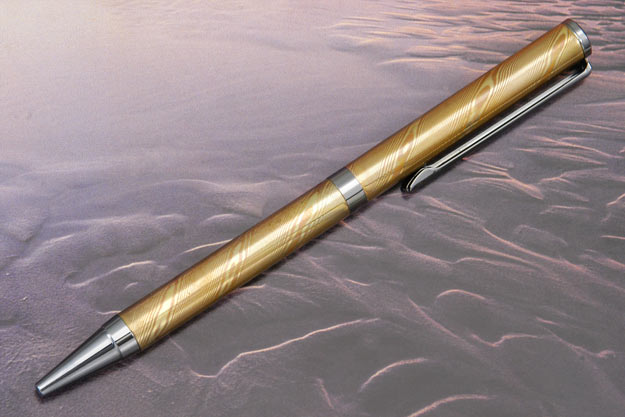
Well I didn't actually quit I just started using fine silver and shakudo or copper or brass and copper or nickle and silver or anything else that I know for sure what it is and figure out the liquidous point of the two. I did try the plate like you showed that it actually how I got the best results. this is not quarters but I think it is pretty cool
Last edited:

- Joined
- Jan 17, 2008
- Messages
- 3,721
i tried the quarters way once, worked out ok for what it was for, ended up making a heart shaped keychain for my one daughter with it.
it was 7 quarters......not for any reason other than thats how many were in my pocket , I did it with long tongs....just held it there till it looked like the silver line between them was at the melting point, forged down a bit, drilled wholes, then hammered out flat.

it was 7 quarters......not for any reason other than thats how many were in my pocket , I did it with long tongs....just held it there till it looked like the silver line between them was at the melting point, forged down a bit, drilled wholes, then hammered out flat.
- Joined
- Aug 1, 2008
- Messages
- 1,762
Bill, that pen is awesome.
foxbat34, I hope it works for you.
thanks. I hope that I didn't come across as discouraging to anyone. Like I said I have used quarters and I also had alot of fun doing it. I just wanted to inform interested parties that they would likely have more success using known materials.