
-
The BladeForums.com 2024 Traditional Knife is available! Price is $250 ea (shipped within CONUS).
Order here: https://www.bladeforums.com/help/2024-traditional/
You are using an out of date browser. It may not display this or other websites correctly.
You should upgrade or use an alternative browser.
You should upgrade or use an alternative browser.
More reticulation
- Thread starter Tai Goo
- Start date

- Joined
- Oct 19, 2005
- Messages
- 20,033
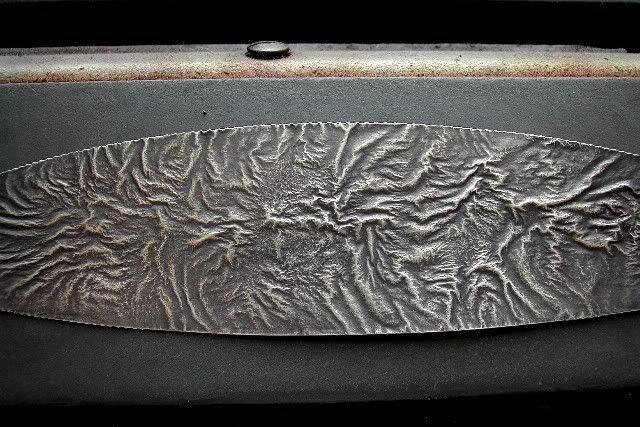
I assume reticulation is the texture?? How did you accomplish that?
Neato, btw!
Neato, btw!

Tai Goo
BANNED
- Joined
- Apr 7, 2006
- Messages
- 3,806
Basically, you start with a piece of copper bearing silver alloy, like sterling or coin silver, about 20 gage or so. Then you heat the silver until a black layer of cupric oxide (copper) forms on the surface, and then pickle the oxide and copper away. After you repeat this process a few times you will begin to build up a thin skin of “pure silver” on the surface. Once this is accomplished you heat the silver with a torch or other heat source until the core, which melts at a lower temperature than the skin, buckles and "reticulates" the piece. The internal alloy melts before the surface skin.
It looks similar to the earth's crust and like an aerial view of the landscape, if you do it right.
It looks similar to the earth's crust and like an aerial view of the landscape, if you do it right.
Last edited:

- Joined
- Dec 3, 1999
- Messages
- 9,437
Tai, you may be a nut... but you're a very skilled/talented one! 

Thanks for sharing... this is something I knew nothing about. Thanks for sharing your technique... your results are fantastic. :thumbup:
Thanks for sharing... this is something I knew nothing about. Thanks for sharing your technique... your results are fantastic. :thumbup:
- Joined
- Oct 19, 2005
- Messages
- 20,033
Googling pickling...

- Joined
- Mar 24, 2005
- Messages
- 540
"It looks similar to the earth's crust and like an aerial view of the landscape, if you do it right."
I would say you did it right. . .
I love the "organic" feel of that technique. It will be great match to the feral steel manipulation you are so great at conjuring. Be sure to let us see pics of the knife!
kimsalls
I would say you did it right. . .
I love the "organic" feel of that technique. It will be great match to the feral steel manipulation you are so great at conjuring. Be sure to let us see pics of the knife!
kimsalls

- Joined
- Jan 5, 2005
- Messages
- 2,531
Basically, you start with a piece of copper bearing silver alloy, like sterling or coin silver, about 20 gage or so. Then you heat the silver until a black layer of cupric oxide (copper) forms on the surface, and then pickle the oxide and copper away. After you repeat this process a few times you will begin to build up a thin skin of pure silver on the surface. Once this is accomplished you heat the silver with a torch or other heat source until the core, which melts at a lower temperature than the skin, buckles and "reticulates" the piece. The internal alloy melts before the surface skin.
It looks similar to the earth's crust and like an aerial view of the landscape, if you do it right.
That looks great ! If I may ask, what are your plans for the piece related to the knife your making ?
Thanks for the definition and explanation of the technique. I've wondered for quite some time how that look and texture was created.
Your skills never cease to amaze me Tai :thumbup:
Tai Goo
BANNED
- Joined
- Apr 7, 2006
- Messages
- 3,806
Andy, Pickling means to clean the surface using acid. I use a jeweler's pickling compound.
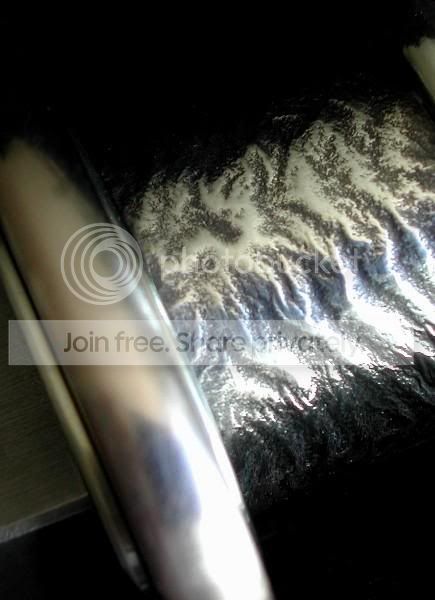
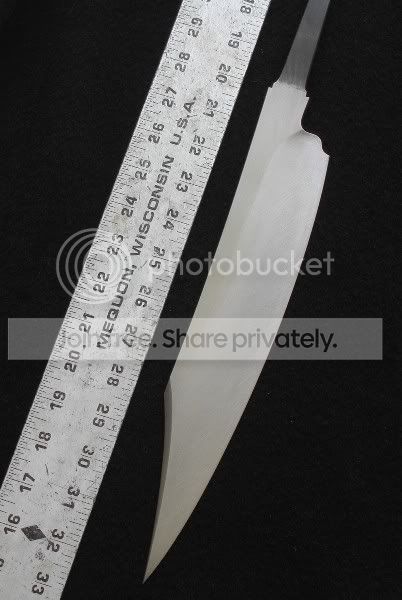
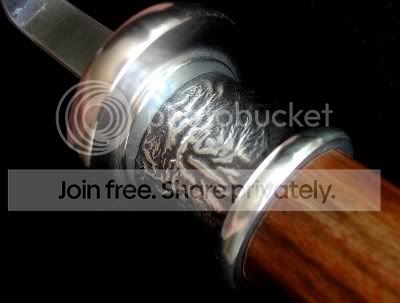
David, I'm going to use it for a ferrule... bend it into an oval and solder the seam. It will be supported on the inside with the wood of the handle and protected by the guard on one end and a raised sterling silver ring on the other. It’s for a big bowie.
David, I'm going to use it for a ferrule... bend it into an oval and solder the seam. It will be supported on the inside with the wood of the handle and protected by the guard on one end and a raised sterling silver ring on the other. It’s for a big bowie.


Stacy E. Apelt - Bladesmith
ilmarinen - MODERATOR
Moderator
Knifemaker / Craftsman / Service Provider
- Joined
- Aug 20, 2004
- Messages
- 38,685
Aww, come on tai....
A real silversmith would fuse the silver into the ferrule, and reticulate it as one seamless tube. .
.
Nice reticulation Tai.
My theory on the discovery of reticulation is that an apprentice was working on forming a chased rim on a silver plate. He kept on annealing it and pickling it in sulfuric acid. After many many cycles he accidentally over-heated it and the whole center crinkled up. The shop owner came over to see what made the novice cry out "Merd!". He saw the interesting new pattern, and exclaimed, "Magnifique, you have created a masterpiece!" Then to humble the apprentice, he said dryly, " Now, plannish it back smooth again."
Stacy
A real silversmith would fuse the silver into the ferrule, and reticulate it as one seamless tube.
.Nice reticulation Tai.
My theory on the discovery of reticulation is that an apprentice was working on forming a chased rim on a silver plate. He kept on annealing it and pickling it in sulfuric acid. After many many cycles he accidentally over-heated it and the whole center crinkled up. The shop owner came over to see what made the novice cry out "Merd!". He saw the interesting new pattern, and exclaimed, "Magnifique, you have created a masterpiece!" Then to humble the apprentice, he said dryly, " Now, plannish it back smooth again."
Stacy

- Joined
- Oct 3, 2002
- Messages
- 12,297
That's just really cool, Tai !
I know someone in NY is going to be very happy
I know someone in NY is going to be very happy
Tai Goo
BANNED
- Joined
- Apr 7, 2006
- Messages
- 3,806
Stacy, actually, reticulation was pioneered by master Heikki Seppa.
http://www.hauserandmiller.com/fab/reticulation.html
The I chased the seam with a scraper, a wire brush, pickling and patina... hardly noticeable.
It's actually a damn nice looking seam, and a killer fit!
http://www.hauserandmiller.com/fab/reticulation.html
The I chased the seam with a scraper, a wire brush, pickling and patina... hardly noticeable.
It's actually a damn nice looking seam, and a killer fit!
Stacy E. Apelt - Bladesmith
ilmarinen - MODERATOR
Moderator
Knifemaker / Craftsman / Service Provider
- Joined
- Aug 20, 2004
- Messages
- 38,685
Indeed, you are good at what you do!
Heikki Seppa promoted and re-initiated the process of reticulation into modern jewelry design, along with his innovative use of shell structures. He was greatly influential in the latter 1900's in developing what is now called "art jewelery". He is to reticulation and jewelry design what Bill Moran was to damascus and modern knife making. He didn't invent it, but he re-introduced it. Seppa and I were contemporaries....sort of , although he has about 20 years on me, he didn't really develop his style until after he entered schooling in the USA in the 1960's. He wrote some articles (and later teaching books on his processes) which I read in the late 60's. I used his techniques in my early experimental days, but adopted a more traditional styling, as it was what sold to the public at the time. Seppa became famous, and I became employed, such is life. Now I am drawn back by things like Tai's work, to good remembrances of wonderful techniques, and great teachers, like Heikki.
The popular use of this technique predates Heikki by about one hundred years ( although it has appeared in much more ancient pieces). The Finns learned the process in Russia, and brought it to Finland. Heikki brought it with him from his homeland of Finland, where he learned it as a student, and popularized it in the USA by teaching it to his students in St. Louis. At that time most jewelry design was plain, and had changed little for two or three hundred years. The styles of the art nouveau period and art deco period were utilitarian compared to the "art" shapes Heikki fostered.
By making an alloy of copper and silver,or copper and gold,the alloy becomes amenable to reticulation. 20/80% copper/silver ( coin silver), and 25/75% copper/gold (electrum) work well. As Tai stated, the repetitive annealing ( 10 to 50 cycles) and pickling ( soaking in sulfuric acid) of the piece creates a fine (pure) metal shell that traps a eutectic alloy core. This part of the process is called depletion gilding, and is used to create a bullion color on some jewelry. When the shell is of sufficient depth a final carefully controlled heating ,with a hand held torch,will allow the core to melt before the shell. The resulting contraction of the molten core causes the thin skin to wrinkle and distort. Torch control is the key here. Too much and it is a puddle,too little and nothing happens.The resulting reticulation can be subtle or dramatic. (The mechanics are somewhat similar to the way the sori forms in a Japanese blade.) Thickness, alloy, shape,number of quench cycles, and torch control allow a great variety of structures to form. Every one is individual, and can not be duplicated.
Thanks for posting your work, Tai.
Stacy
Heikki Seppa promoted and re-initiated the process of reticulation into modern jewelry design, along with his innovative use of shell structures. He was greatly influential in the latter 1900's in developing what is now called "art jewelery". He is to reticulation and jewelry design what Bill Moran was to damascus and modern knife making. He didn't invent it, but he re-introduced it. Seppa and I were contemporaries....sort of , although he has about 20 years on me, he didn't really develop his style until after he entered schooling in the USA in the 1960's. He wrote some articles (and later teaching books on his processes) which I read in the late 60's. I used his techniques in my early experimental days, but adopted a more traditional styling, as it was what sold to the public at the time. Seppa became famous, and I became employed, such is life. Now I am drawn back by things like Tai's work, to good remembrances of wonderful techniques, and great teachers, like Heikki.
The popular use of this technique predates Heikki by about one hundred years ( although it has appeared in much more ancient pieces). The Finns learned the process in Russia, and brought it to Finland. Heikki brought it with him from his homeland of Finland, where he learned it as a student, and popularized it in the USA by teaching it to his students in St. Louis. At that time most jewelry design was plain, and had changed little for two or three hundred years. The styles of the art nouveau period and art deco period were utilitarian compared to the "art" shapes Heikki fostered.
By making an alloy of copper and silver,or copper and gold,the alloy becomes amenable to reticulation. 20/80% copper/silver ( coin silver), and 25/75% copper/gold (electrum) work well. As Tai stated, the repetitive annealing ( 10 to 50 cycles) and pickling ( soaking in sulfuric acid) of the piece creates a fine (pure) metal shell that traps a eutectic alloy core. This part of the process is called depletion gilding, and is used to create a bullion color on some jewelry. When the shell is of sufficient depth a final carefully controlled heating ,with a hand held torch,will allow the core to melt before the shell. The resulting contraction of the molten core causes the thin skin to wrinkle and distort. Torch control is the key here. Too much and it is a puddle,too little and nothing happens.The resulting reticulation can be subtle or dramatic. (The mechanics are somewhat similar to the way the sori forms in a Japanese blade.) Thickness, alloy, shape,number of quench cycles, and torch control allow a great variety of structures to form. Every one is individual, and can not be duplicated.
Thanks for posting your work, Tai.
Stacy
Tai Goo
BANNED
- Joined
- Apr 7, 2006
- Messages
- 3,806
Stacy, I learned it from a fellow named John Hays. Hays was a follower of Seppa and the innovative work of Albert Paley. Hays used an oxy/acetylene torch and could raise the texture up near 1/4 inch! It was amazing stuff and a great period in time for new growth in metalsmithing! I've used it on and off over the last 30 years or so... and always wondered why it wasn't more common in bladesmithing.
I used a little oxy/mapp torch for this piece, which seemed to work just fine. I've had the best luck with a hot oxidizing pencil flame. Coin silver reticulates easy, but reticulated coin silver tends to be brittle in fabrication. I use sterling more often.
I used a little oxy/mapp torch for this piece, which seemed to work just fine. I've had the best luck with a hot oxidizing pencil flame. Coin silver reticulates easy, but reticulated coin silver tends to be brittle in fabrication. I use sterling more often.
Last edited:
