Most recent almost finished...

weo

Joined
Sep 21, 2014
Messages
3,117
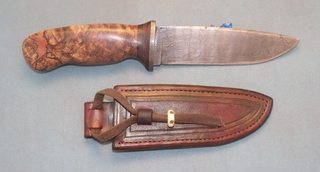
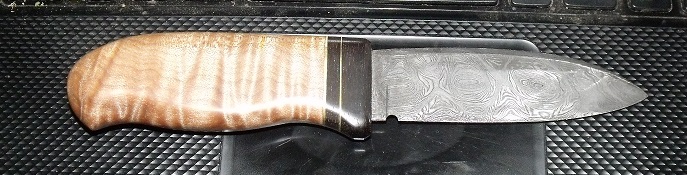
Hello all. Here's the knife I was planing on entering the KITH without an edge.
dnlrm0S.jpg


I'm not happy with how the sheath came out, so I did a second one, and not happy with those colors either. So I'd like to do a 3rd but don't want to waste the other 2, so is this design good enough to make a few more? If not, are there any modifications I should do? I realize they'll have to be limited...
Thanks in advance.
~billyO
 
don't have the handle higher than the spine of the knife.
make some knife drawings on paper to get an idea of how lines flow and how ideas look
 
This is just an on opinion of course, but I wouldn't use a more expensive material like forge welded steel on a knife until I had made quite a few, and could be pretty sure it wouldn't go to waste of I flubbed the execution. I've made about fifty knives so far, and I still haven't used it. When I see a pattern welded blade I expect the rest to be flawless. That's just my opinion of course.
 
Good morning, Kevin. No worries about offering your opinion, it's how we understand each other.

I'm actually coming to knifemaking from a forging background. I wanted to learn to weld etchable billets with the eventual plan of forging out a tiger's head or full tiger out of a ~2.5-3" square bar (or smaller. I've done a number of different animal heads in mild steel from 0.5-1/5" sq bar.) So I was able to acquire a source of free 15N20, welded up some billets using a friend with a #250 Chambersburg to draw out each billet after welding and he took a chunk of each billet to make a knife. So I ended up with a number of billets of 15N20 with 1095and 1080 which were drawn down to ~ .5 x 1.75" bars about 24" long.

I like you, don't like to waste, so decided to learn knife making and started the journey about 2 year ago, making about 13 knifes, trying different styles mainly for learning, from a 10" hunting knife
zMMFeJGm.jpg
, a coupe of version of Dave Lisch's 'Rat Knife
KqcSJs1m.jpg
MlWvHyBm.jpg
cDUlQJqm.jpg
, and a few kitchen knives
3zXZf4mm.jpg
and a tang straightening failure
q4B65KEm.jpg
and the one above.

Each on was a wonderfully fun and useful learning experience. My most recent learning experience was sheath making, and it tok 3 attempts to get the colors I wanted on this one and need to make 2 more knifes close to this shape so as not to waste the sheaths.
`billyO
 
Last edited:
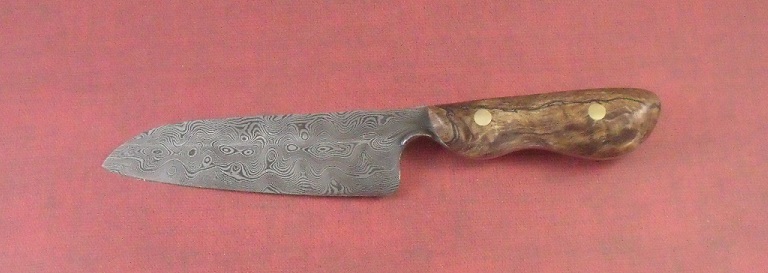
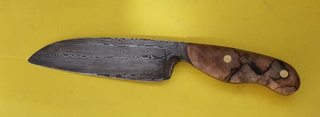
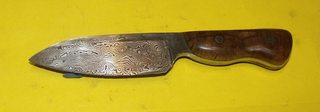
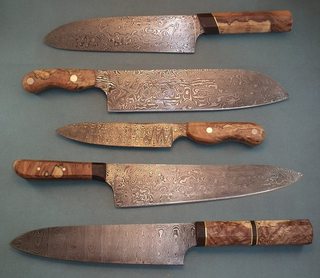
Great looking steel Bill! The wood finish is pretty and the fit up is tight. It's obviously a personal choice, but I think the first knife in your post and several of the smaller knives you posted would look better with better defined lines on the handles and bolsters. I always think contrast can be interesting. So you have some nice curving on the spine for instance, if you contoured the handle sides between the butt and middle, it would complement and set off the curves elsewhere. Same for the guard, rounded sides, with maybe a tighter radius at the edge and spine side transitions. Think about bringing some of your wa handle geometry into the other handles. Kind of like BBQ- spicy is good, sweet is good. Sweet+Spicy= Fantastic! I hope that's helpful.
 
I'll offer some design critiques on the first knife, and a few comments in general on the rest:
1) The handle is quite oversize for the blade. It looks very fat that way. It most likely still can be reduced to a more comfortable and visually pleasing size.
2) As Kevin pointed out, having the spine of the handle above the blade looks off. If the belly is too low, or the from=nt of the handle extends too far down, it also looks unwieldy. It can affect the grip and cutting power if too far off.
3) I like the choil to be bisected by the plunge, not in front of it.
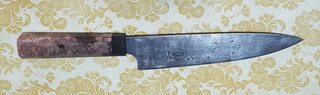
4) The blade part of of the other blades shown looks good. A few of the handles have too much curve and bulge, and are a bit fat. Remember that simpler is usually better. Look at the photo of the five kitchen knives. Three look like you would pick them right up and go to work. The two with the funny shaped handles don't invite you to use them.
5) Your damascius looks great. However, a kitchen blade made in carbon damascus is sort of asking for rust spots to show up. It is OK to do, but prompt and thorough blade care is essential with every use. I prefer stainless damascus, and especially Damasteel, for kitchen blades the will be used regularly.
 
Thanks for all the info everyone, exactly the type of info and comments I was looking for.
It did take a bit of education to the family on the benefits of immediate cleaning of the knives...
Again, thanks.
~billyO
 
Back
Top