Mountain climbing

Joined
Feb 22, 2008
Messages
18
Hey i live in NY and i'm pretty young and restless and lately i've been yearning to climb some rocks after i saw some beautiful onces while hiking. I've always kind of liked to climb random surfaces as a kid (monkey) and rock climbing is really starting to interest me. Who knows maybe one day ill graduate to mountaineering :D

the question i'm asking is how does one get started?
 
Take a class. Look for a local climbing shop or gym, they may offer some beginner basic rock classes. Even some community colleges are starting to offer a few basic ropes and rock courses. If you're in NY, then you may be close to the Gunks. I'll bet there's a climbing community nearby that you can get involved in. But definitely ask around, one of the local rock jocks can probably point you in the right direction. If all else fails, EMS offers some pretty good classes up in NH in the summer. You can probably find out more on their website. Hope this helps.
 
Tzkid,

I'd suggest not going at this recreational sport alone. Learn from others, it is safer than doing it on your own. I learned from the EMS Climbing School when I was a part-time worker at one of the retail stores. If you get a part-time job there, you are elligible for free lessons. I took vertical ice climbing and mountaineering courses and absolutely loved the experience. If you are in NY, you have access to the Gunks, Dacks and Catskills. All are great places to climb and learn the sport. You can join the AMC, a local indoor gym or again, take formal outdoor lessons.

For now, get yourself a book or look up a few knots online that you'll end up needing to know. For starters, learn and then have someone check your

Bowline and for fun, the one handed bowline
Figure 8 and figure 8 retrace
Girth Hitch
Prussik knot

There are more but these are very practical and used frequently.
 
Look for an indoor gym, they will teach you how to climb rocks properly. Then find someone to teach you how to set up ropes on real rock. Spend $1,000 on shinny stuff and have fun! I have found REI to have lots of people who can give you advise for your local area!


Thats how i learned plus please read these books.
Every one who hikes or climbs should read these books Accidents in North American Mountaineering. They come out every year. It sums up well Accidents in North American Mountaineering, it is told from the view point of the people who found the bodys or the people who lived through the Accident or the authors commenting on what was found at the site. What went wrong what went right. These books teach you that wow bad stuff can happen to me/ normal people, and OMG helmets do save lives! As well as having the right training. And there is no shortage of people finding dead bodys with the new tags still on the equipment. Knowing how others have messed up will help you avoid there mistakes!

For learning rock climbing these books are not bad

How to Rock Climb!, 4th (How To Climb Series) (Paperback) Over view

Knots for Climbers, 2nd (How To Climb Series) (Paperback) Well its knots

How to Rock Climb: Toproping (How To Climb Series) (Paperback), great safer way to start climbing out doors

Self-Rescue: How to Rock Climb Series, always good to know.


And of course there is always the bible to protect you. No not that one this one

Mountaineering: The Freedom of the Hills AKA the climber's bible
 
Look for an indoor gym, they will teach you how to climb rocks properly. Then find someone to teach you how to set up ropes on real rock. Spend $1,000 on shinny stuff and have fun!


Thats how i learned plus please read these books.
Every one who hikes or climbs should read these books Accidents in North American Mountaineering. They come out every year. It sums up well Accidents in North American Mountaineering, it is told from the view point of the people who found the bodys or the people who lived through the Accident or the authors commenting on what was found at the site. What went wrong what went right. These books teach you that wow bad stuff can happen to me/ normal people, and OMG helmets do save lives! As well as having the right training. And there is no shortage of people finding dead bodys with the new tags still on the equipment. Knowing how others have messed up will help you avoid there mistakes!

For learning rock climbing these books are not bad

How to Rock Climb!, 4th (How To Climb Series) (Paperback) Over view

Knots for Climbers, 2nd (How To Climb Series) (Paperback) Well its knots

How to Rock Climb: Toproping (How To Climb Series) (Paperback), great safer way to start climbing out doors

Self-Rescue: How to Rock Climb Series, always good to know.


And of course there is always the bible to protect you. No not that one this one

Mountaineering: The Freedom of the Hills AKA the climber's bible

Mountaineering: The Freedom of the Hills is the book I'd also say everyone should own. Very good information about traveling in that environment. AWESOME READ!
 
Whats funny is i never bought it becuase by the time i thought to buy it i already had all the other books in other series that covers what the Bible covers. :cool: I like having small books i can take out with me and try out some things in them, with the Bible its too bulky. But i listed it because will you cant go wrong with it! And it does cover every thing for sure!
 
oh duh!! i forgot about local clubs haha.

and estela i definitely don't want to just get caught up in the sport, the sport is more of a platform for me to go mountaineering and climbing glaciers and stuff. I always wanted to climb cliffes and high mountains and not just stair at them from the trails :)

I've always wanted to climb the alps ;).

I live in rockland county which is close to the new jersey state border and the only rock climbing club i think of around here is just the NY sports club.

I guess i'll give them a call!
 
You are not far from the gunks in New Paltz, great place to climb. The above advice is good. I will also recommend EMS

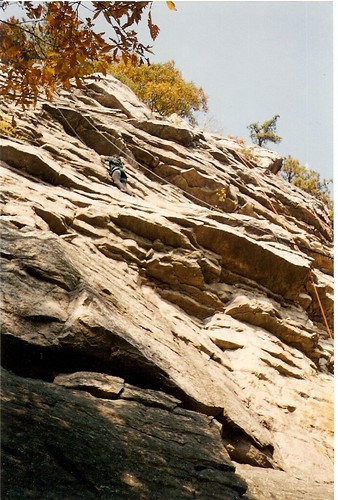
here is a pic of my wife at the gunks

2282016901_0ec83a8082.jpg
 
Skip the BS indoor stuff unless you are very nervous. You sound already committed to climbing some REAL rocks so skip the plastic. (yes I am a snobby Trad climber).
The Gunks in New Paltz NY is an awesome place to start with a ton of super easy (5.0-5.4) multi pitch routes. There is also a ton of bouldering too.
There is an EMS climbing school in town; hire an EMS guide to take you out and tell them you want to LEARN something.
Good luck and remember when someone asks how long you have been climbing remember your childhood and resond; "all my life..."
Have fun!
Bill

PS there is several bouldering spots in Central Park; Rat Rock and Cat Rock are two.
 
the question i'm asking is how does one get started?
Just visit your local climbing place and start. You don't really need to read books before you begin. Just make sure there are experienced people around (shouldn't be a problem in a climbing gym). You learn the most about climbing from your own experience. You can read the books when you are resting out :) (I'm talking about technique, of course you have to study some basic safety rules first)
And after some weeks you will need to buy some good climbing shoe's. Make sure you buy them from/with somebody who knows what is important in a cllimbing shoe, as good shoe's can have a big impact on your climbing experience, and it ain't easy to find the ones that fit you best.

Skip the BS indoor stuff unless you are very nervous. You sound already committed to climbing some REAL rocks so skip the plastic. ...

I don't fully agree with that.
To keep/build up your climbing strength, it is important to at least practice climbing twice a week(three is better), and that is not always possible if you haven't got good rocks close by. And by bouldering indoors, you've got a lot more chances to see how others take their routes and learn from them.

But if you have good rocks close by, and have enough experienced friends willing to go climbing with you a lot, you can indeed skip the indoor part.
There is a difference between the two kinds of climbing, so when you want to be really good with climbing rocks, you also need to practice on them.
But the climbing basics are the same, so it doesn't really matter on which you start learning climbing IMHO.

I'd suggest not going at this recreational sport alone. Learn from others, it is safer than doing it on your own.
Very true. Not only because of safety, but also because it makes you progress a lot faster. When you see your friends doing difficult routes you may try to keep competing with them, but when you're not climbing with people of a higher skill level, you will not feel the need to start that difficult route. I've experienced that myself.

 
Buckabee,
Indoor climbing IMO fosters very bad belaying habits and a false sense of security. Yes a climbing gym is better than no climbing but I have seen very dangerous things done by folks who can climb the 5.12s in the gym and think they are ready for rock.
Real rock involves wandering routes (Gyms are typically straight up), cracks (very rare in gyms and very common on real rock. Come to Yosemite and watch solid visiting climbers flail on a 5.7 granite crack.), loose rocks, vegetation, red ants (!!) and the weather just to name a few key factors in real climbing that a gym does not ever address.
If you learn in a gym realize that you now need to learn how to actually climb outdoors which is a lot more involved.
I will admit that I personally think gyms are kind of dumb but I also know gyms get a lot of folks started. I also know that gyms do not teach what you need to know for climbing outdoors (it is an outdoor sport) and that can be dangerous. I have taken solid gym climbers who can climb harder gym routes than me out on real rock and have often been suprised how little they know.
Even rope management is not addressed in a gym and I have seen gym climbers with deadly flaws in their belaying skills.
Gyms create a false sense of security.
Bill
 
If you wnat to climb outdoors first, then a lesson from a climbing school is an excellent way to start. I would also check out local outdoor clubs and programs through the YMCA, but be advised that the qulaity of instruction can vary widely.

In programs or school where the instructors are volunteers, look closely at how they approach safety as an indicator of quality: do they insist that students and instructors wear helmets, are their belay anchors solid, do they enforce a minumim safety clearance distance around the top of a cliff?

Well established schools like EMS have these systems nailed down. Equually important, they probably have established areas and climbs that will suit your ability level, so that you'll enjoy your firstclimbing experience.
 
billym, I'm indeed not often doing rock climbing - only on vacations - because there aren't any nearby here. I would love to do it more, but it is simply not possible for me.

When I said it doesn't matter whether climbing indoors or on rocks, I was talking about the starting phase only.

It is true, although I'm rather good in bouldering indoors, I admit I'm only of a very moderate level in rock climbing. Certainly when talking about rope skills and stuff. But I don't think I have a false sense of security there myself because I'm aware that and don't overestimate myself on rocks.
 
If you wnat to climb outdoors first, then a lesson from a climbing school is an excellent way to start. I would also check out local outdoor clubs and programs through the YMCA, but be advised that the qulaity of instruction can vary widely.

In programs or school where the instructors are volunteers, look closely at how they approach safety as an indicator of quality: do they insist that students and instructors wear helmets, are their belay anchors solid, do they enforce a minumim safety clearance distance around the top of a cliff?

Well established schools like EMS have these systems nailed down. Equually important, they probably have established areas and climbs that will suit your ability level, so that you'll enjoy your firstclimbing experience.
Good advice; use an AMGA certified guide.
 
Here's a big plus one for Mountaineering: The Freedom of the Hills.

If you don't want to buy it phone around and find a local library that has a copy. Go read it.

The term mountain climbing can encompass almost any number of skills and techniques, for organizational purposes they are broken down into five main classes.

Class I – walking, sometimes steep, but never with doubtful footing or any danger of a fall.
Class II – difficult walking, often steep with doubtful or slippery footing. A slip or tumble is possible. You never need to use your hands to make upward progress.
Class III – climbing, often on steep rock or snow. Handholds and footholds must be utilized to make upward progress. Injury inducing falls of up to five or six feet are possible. You must use your hands to make upward progress.
Class IV – climbing on sustained steep rock or snow. Knowledge of roped climbing is required. Climbers should move one at a time and be belayed, that is protected by an anchored rope. Long, fatal falls are possible, especially for the leader.
Class V – technical rock climbing. Each climber moves in turn. Use of specialized protection equipment, helmets and shoes is required. Detailed knowledge of climbing, anchoring, protection and descent techniques is required. The rope is anchored at all times and is secured to the mountain at intermediate points by the leader. Upward progress is made using natural hand and foot holds, however. The rope is used only to protect against falls. Long, serious falls are possible.
Class VI – technical rock climbing. Same as for class V, except that natural holds are not available. Climbers make upward progress by attaching the rope to the cliff and climbing it, or being hauled up by it. Artificial ladders or etriers will likely come into use. Highly technical equipment for attaching the rope and ladders to the cliff must be used. El Cap in Yosemite Valley is the most famous venue for Class VI climbing. (this is often called aid climbing)

There is alot of great climbing, even expedition length adventure, to be found within the first three classes of climbing. So don't let the highly technical (and usually $$$ gear intensive) aspects of the other classes put you off from starting into a great outdoor activity.

Also, try doing some internet and local/regional searches for 'peak bagging.'
 
Freedom of the Hills is a classic and definitely worth reading but its focus is more mountaineering than technical traditional (placing protection on lead) or sport (clipping preplaced bolts) climbing.
The book by John Long probably taught more climbers in the US than any other book.
Bill
 
Back
Top