
Mounting a guard

Joined
Dec 4, 2009
Messages
503
Hello all, I'm new to the Blade Forums community.

I'd like to pose a quick novice question. I'm thinking of starting a new project based on the European seax pattern. So far everything I've made has lacked a guard/bolster. However, I'm thinking of incorporating a guard to join the handle with the blade in this project like this:
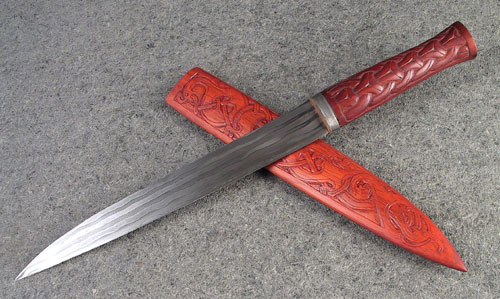
2seax1.jpg


However, I'm having trouble finding a way to mount such a guard. I do not own a welder or such but I do have epoxy, pin stock, and a drill. I was thinking of drilling a hole in the guard and tang of the blade and peening a pin through the hole in addition to epoxying the two pieces together. Am I on the right track?
 
What type of guard are you thinking about mounting?

Like the one pictured?
 
One tip, make sure that the tang is no thicker than the ricasso.
If it is, the slot in the guard will show a gap when mounted.
Just make sure the ricasso is the thickest part of the knife.

Make a small brass tool to 'push' off exess epoxy from the ricasso. (like a small chisel, brass won't scratch steel)
Also have some cloth and acceton at hand when glueing, you can remove most of the exess off the ricasso that way.
 
I believe the problem is that Mr. Chou does not understand how a guard/bolster is installed.

The bolster you have shown has a slot in it that slides down the tang. The tang is smaller than the blade width and thickness. The seat at the ricasso makes the bolster sit firmly. If the slot was filed and fitted correctly, the fitting should be snug. The handle is mortised to fit inside the bolster and thus hold it firmly in place. The epoxy holding the handle and bolster in place will be sufficient to make this a solid assembly. Pins and/or pommel nuts are often used to make the handle more secure, but are not necessary always.

Filling out your profile is helpful.

Stacy
 
To make the fitting easier, and tighter, taper the tang slightly up to the last 1/8" near the ricasso.
 
I believe the problem is that Mr. Chou does not understand how a guard/bolster is installed.

The bolster you have shown has a slot in it that slides down the tang. The tang is smaller than the blade width and thickness. The seat at the ricasso makes the bolster sit firmly. If the slot was filed and fitted correctly, the fitting should be snug. The handle is mortised to fit inside the bolster and thus hold it firmly in place. The epoxy holding the handle and bolster in place will be sufficient to make this a solid assembly. Pins and/or pommel nuts are often used to make the handle more secure, but are not necessary always.

Filling out your profile is helpful.

Stacy
You are completely right Stacy; I'm all very new to knife making. So pins, in this case, would not be entirely necessary. Right?
 
You are completely right Stacy; I'm all very new to knife making. So pins, in this case, would not be entirely necessary. Right?

Correct. The handle itself holds the guard in place, along with epoxy or solder to seal the joint, and a good tight fit to the blade. Pinning it would be overkill (not necessarily a bad thing), IMO. One interesting method seen on some older knives is a short pin under the guard to hold it in place, then covered by the handle....

The knife you show might not be the best example, though, I'm almost sure that is a open-ended ferrule (a ring), not a guard plate... Guards are rare on saxes outside of Scandinavia, with the exception of the early narrow saxes.
(I like saxes, don't get me started, I'll talk your ears off...:))
 
Back
Top