Multiple Microbevels

me2

Joined
Oct 11, 2003
Messages
5,105
Just recently came across some work by Brent Beach. He has done quite a bit of work on sharpening planer blades using a coarse, medium, fine, extra fine series of abrasives, with a small angle change between each one. Has anyone tried this on knives? I did it on my Cold Steel Kudu, but haven't used or carried it since then. He only uses a 2 degree angle change between grits, while I used about 4-5. The final edge angle made it up to about 30 degrees per side, but I can't see that microbevel at 40x on my pocket microscope.

Beach's work is an extension of the Scary Sharp method using fine grits of sandpaper on a flat backing, like glass or granite. He uses a coarse Norton Crystalon stone for shaping the edge. He then hones the edge using 15 micron, 5 micron, and 0.3 micron PSA backed abrasives made by 3M. He is a strong proponent of using angle guides, and makes his own. I picked up some honing films of the proper grit and a flat aluminum honing plate today and will give it a try. Interestingly, he does not support forming a burr on the coarse abrasive, but going to just short of it. He also claims, and has micrographs showing, that stropping on wood with green, white, red rouge, or tripoli will degrade the edge. Even bare wood left a handful of coarser scratches than the final 0.3 um abrasive sheet. He did not try various diamond compounds.

Link to the page:

http://www3.telus.net/BrentBeach/Sharpen/sitemap.html
 
Just off the top of my head it seems that your final bevel should be more like 40 degrees inclusive instead of 50 and thus you would change only 1 or 2 degrees between grits. I also agree that you don't need a burr with the coarser grits. You could take the coarse grit down to a point where you have the smallest amount of blunt edge left, then when you go to the next grits at steeper angles you work the blunt edge down to a burr. I think if you could manage to get it just right, you would only need to form a burr at the last few stages. I don't think this would be very easy to do partly because it is hard to detect when you are just about ready to begin a burr, and different parts of the edge will be duller than other parts and thus a burr might start at one place before it would start at another place.
 
The apex of the Kudu is actually over 60 degrees inclusive as it stands now. This is not where I'd leave it, but I have a little experiment going to see what happens at such a high angle. For normal use, I'd start at say 12-15 degrees per side, and increase 2 or so each grit. I'm not sure I can hold 2 degrees the way I sharpen, but we'll see.
 
Two things strike me when reading the first post - without a guided system there's no way this method is practical. And, if stropping on bare wood scratches up the edge (which I have no doubt it does depending on the type of wood), what does it look like after making a few passes during actual use? I've been on his site before, he had only a 200x microscope upon which to base many of his observations - not good enough to draw conclusions IMHO. He also proposed quite confidently that using a mud slurry on a waterstone would only change the reflective qualities of the metal, and not influence the grinding action of the abrasive (which is untrue - I almost sent him the micrographs at 640 and 1000x).
I would think performing a convex edge with the same abrasives would be a good deal faster, require less careful observation, and result in the same apex qualities and same equivalent bevel geometry.

Lots of good technical info on his site, it makes for a good read.
 
During use, it puts what he calls a wear bevel on it. He is clear that he supports the use of a jig system for this kind of sharpening. Some, maybe a lot, of his information comes from metallography prep, which is virtually unique to his site. No one else I've read mentions it. Do you still have the micrographs? I don't intentionally use a slurry on my waterstones, but that might be the issue I'm having with my new 4k stone.
 
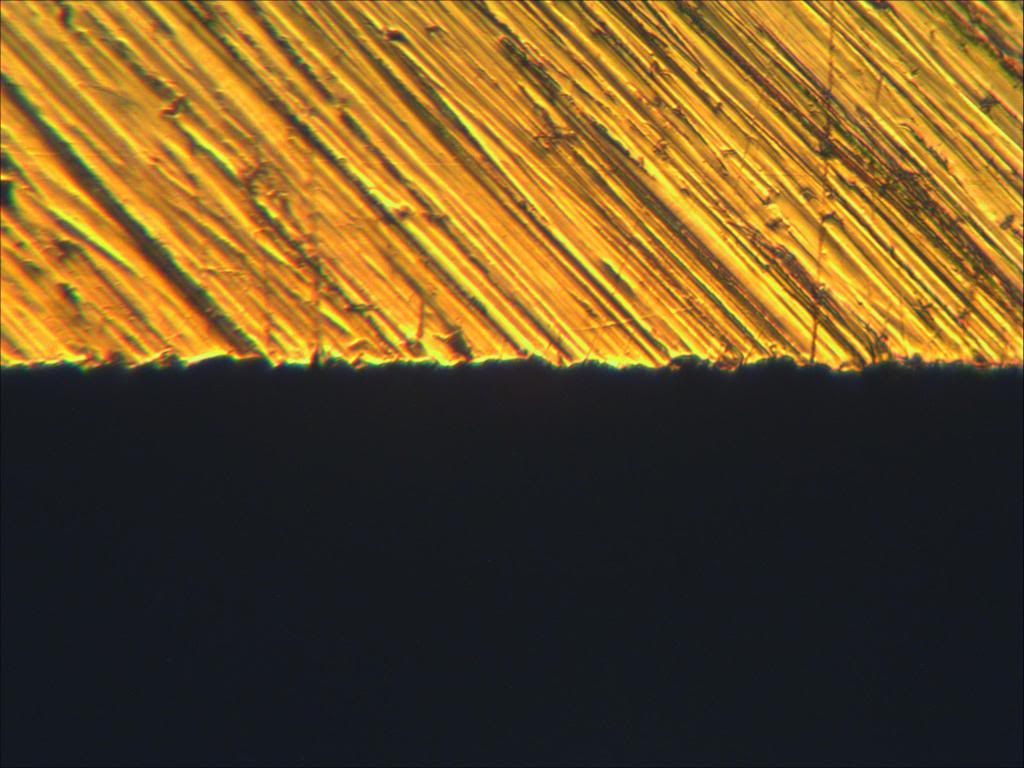
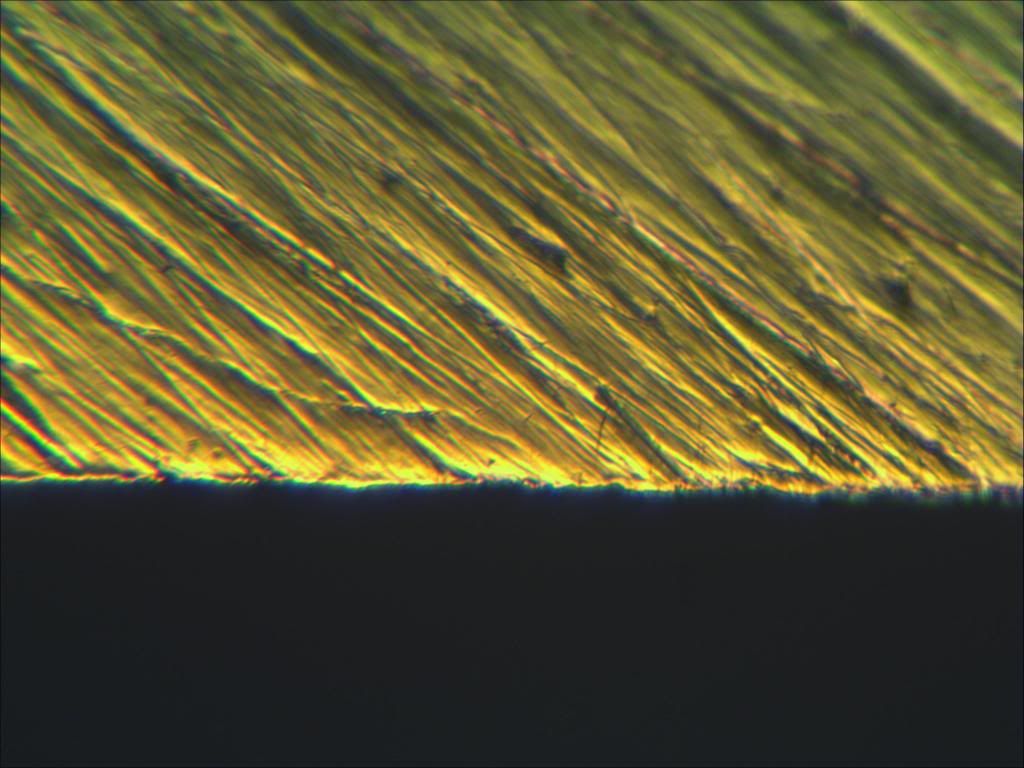
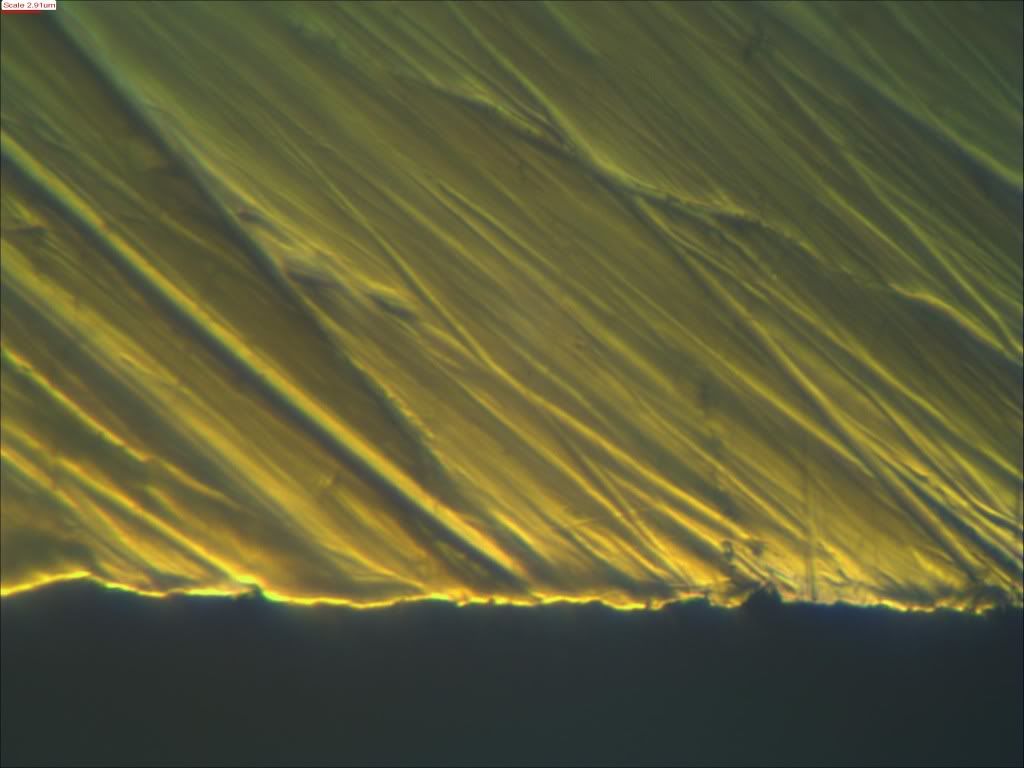
Here's what I've come up with, all of the pics show 1095 steel worked on a King 1200 grit waterstone. The first is at 120x, the second two are taken at 500x, the fourth is taken at 1000x. The first two are using the stone with frequent rinsing, no mud or slurry allowed to form - it looks very much like the grind pattern from a whetstone. The third and fourth show an edge that was worked with a fairly rich slurry and finished with some backhoning on same. There is a huge difference in how the abrasive is interacting with the steel, not just a minor reflectance issue. Consider, the two middle pics are at the same scale. Not only do the individual grind tracks appear different, the entire scratch pattern is different. The edge quality is very different as well, with the slurry-worked edge exhibiting more refined cutting characteristics by a clear margin.

Not sure if this will help you any with your 4000K. All I can say on the subject is that when it comes to some brands of waterstone, the way the slurry is managed can have a huge effect on edge quality and it can take a month or more to develop an instinctive understanding of how they work. I'm used to King and Norton, I always finish with some edge trailing strokes when using these stones, especially the polishing grade stones.

1095_1200K_tst.jpg


1095_1200k_noslurry.jpg


1095_1200k_slurry_backhoned.jpg


1095_1200k_slurry_backhoned1600_Scale.jpg
 
Last edited:
006ob.jpg

Shot at 2011-07-07

The upper blade are grinded in 9, 10 and 11 degrees, I have left the 10 degree surface coarse.

The lower blade has 5 facets. It is 0,75 degrees between the facets, The facets are about 1 mm wide and the lines between them are straight all the way from the handle out to the tip.

I got a question if things like this was possible to do, so I tried it – and it was possible to do, and also fun to do!

Thomas
 
Hi HeavyHanded,

Wow, nice microscope images! :)
In the last and final image, what's the magnfication, and what is the approximate scale for the image?

I'm also curious if you are using bright-field or dark-field illumination?

Sincerely,
--Lagrangian
 
Hi HeavyHanded,

Wow, nice microscope images! :)
In the last and final image, what's the magnfication, and what is the approximate scale for the image?

I'm also curious if you are using bright-field or dark-field illumination?

Sincerely,
--Lagrangian

Hah, hah, I was waiting for you to bust me on the scale! These pics were taken before I had a scale I could apply in the software package, and the tablet that runs that software (and the camera for the microscope) is isolated from the network and the web. Add to that I cannot find my thumbdrive, so I put them up with no scale - my apologies. As a rough guess, the image area is about 70 microns across.

The magnification for the last image, taking into account the digital boost from the camera is supposedly 1600x. In reality, its only 1000x (or so) of quality magnification, as the wavelength of light prevents higher magnification optically. If I can move the pic around and get a precise scale applied I'll be sure to update it.

Illumination is EPI, so the objective acts as the condenser, light source is directly above the item.

EDIT:
I corrected the image with one that has a scale. :)
 
Last edited:
Hi HeavyHanded,

Thanks!! :)

Sincerely,
--Lagrangian

P.S. I'll have to read up on EPI illuminiation... I have heard that in many metallurgical microscopes, the objective also contains the illuminator optics, but I don't know any of the details. I can't afford or get access to a metallurgical microscope, but I'm hoping to rig up something for a simple microscope I have. But probably, i can't do any fancy illumination, which may be a problem.
 
Hi HeavyHanded,

Thanks!! :)

Sincerely,
--Lagrangian

P.S. I'll have to read up on EPI illuminiation... I have heard that in many metallurgical microscopes, the objective also contains the illuminator optics, but I don't know any of the details. I can't afford or get access to a metallurgical microscope, but I'm hoping to rig up something for a simple microscope I have. But probably, i can't do any fancy illumination, which may be a problem.

That's the toughest part. For better contrast when photographing paper formation and toner infiltration into the substrate, I rigged up a light from a short length of fiber optic. I drilled out the lens on a small LED flashlight and just pressed the fiber through the hole till it was just off the LED. From there you could tape it to the objective, use a small clamping system to hold it where you need. In my case I stripped the jacket from the last few cm and teased the fibers apart. When the objective comes down it can compress the fibers and I get light in a very tight spot.
 
Hi HeavyHanded,

Nice!! I also bought some used/surplus fibre optics for lighting, but I haven't had time to mess around with it. I'm thinking about how to couple a LED flashlight to the fibre. I may try what you mentioned (drilling out the lense of the flashlight and then putting the fibre right up to the LED itself). Although, I wouldn't do that for my main light because that LED light is the one I use for riding my bicycle at night! I bought a very cheap surplus ball lense, and may try using that, and/or some flashlight reflectors in reverse.

I've been poking around some surplus/used optical parts from SurplusShed, which I like a lot (that's where I bought some spare optic fibres, and the ball lense).
http://www.surplusshed.com/

I was also thinking of maybe just getting a 1/8th inch acrylic rod, and then whittling it down to a flat screw-driver head like shape and polishing it until the sides were all smooth, so that it would be a light guide. Don't know if I could actually get this to work. Guess I'll try the ball lense and optical fibre first; if that fails I may mess around with trying to shave off an acrylic light guide.

If it's not too much trouble, I would love to a photo of your microscope and your lighting setup.

Sincerely,
--Lagrangian

P.S. I've heard about GRIN lenses (gradient of index of refraction lenses) being used to couple a light source to a fibre optic cable, but I know very little about them. I'm more familiar with the idea of using a ball lense (or some other kind of lense) to focus light on the the end of the fibre.
 
Last edited:
This is the microscope:
http://store.amscope.com/me300tz-5m.html

I'll try to get my light back - lent it to a coworker to use as bore-light for an rifle he inherited and I guess he fails to appreciate just how special the thing is...

If the power of your microscope isn't too high you should be able to rig up a light fairly easily - might not give you the best results, but good enough I'd imagine. I toyed with the idea of painting a microscope slide with silver paint except for one flat section where the flashlight would be focused, and one thin edge where it would shine on my samples. Never tried it - to be honest I don't know that much about manipulating light. Painting the inside of a short sleeve that would completely encompass the sample but allow the objective to be lowered in and a light to shine from above might work too. Be careful, you can loose your mind staring through these things...
 
Still going with this on my Cold Steel Scalper, which has become my favorite utility knife around the house. Right now I'm using a 12 degree bevel on a 1000 water stone, stopping just shy of removing the microbevel. Then it's onto the 15 degree slots on the Sharpmaker, then just a few strokes on the 20 degree. Edge durability is nice, as I have used it for some light chopping, and edge holding is nice as well. I've broken down a lot of cardboard and other such stuff in the last couple of days, and it was still cutting cardboard well, though it would barely cut paper. I decided to sharpen it for a fresh edge and remove some rust from the edge from accidentally leaving it in the sink. These old CS Scalpers are really useful, and still in Carbon V. Mine was tested at 59-60 HRc.
 
I do something along those lines for kitchen knives but by the time I'm done its convex.
 
Back
Top