Mushroom Hunting?

IMO it is always better to eat the mushrooms once you have actually seen someone else in person identify them and eat them.

HOWEVER all the wild mushrooms I ever ate I identified from books and went ahead and ate. Not huge amounts(at first) of course because one can be allergic to even edible ones, but I'm not dead yet

In fact the first huge patch of morels I ever found I didn't eat because people kept warning of look alikes that were poision but it's pretty hard to mistake a morel, or an oyster, or a chicken of the woods, or a puffball.
 
Anyone know anything about mushroom hunting? Any good books on the subject? Is it a waste of time? What's the chance of poisoning myself? Is it even possible to do this anywhere near the NYC area?

Hopefully someone can tell me it's not fun, I'm going to poison myself, and I need to be in Scandanavia to do it so I can go on my merry way.

Yes, I know a fair amount about mushroom hunting. The best book on the subject, by far, is Mushrooms Demystified, by David Arora. Eventually, you'll also want to get the companion book, All the Rain Promises. Arora's books are specific to the central coast of California, but many of the species are common elsewhere, too, and the general principles apply, regardless of where you are.

You might also want to get the Audubon book, the Peterson book, the Roger Phillips book, and various others. These should be secondary to Mushrooms Demystified, IMO, because they are of relatively little help on their own.

It's not a waste of time. It's fun, you learn about biology, you get to try exciting new foods, etc.

The chance of poisoning yourself is low if you learn what you are doing and behave intelligently; and high if you behave foolishly. There really are deadly poisonous mushrooms around, some of them are quite common, and also incurable. However, there are not too many like that, and they are easily recognizable. You learn them first, learn their look-alikes, and stay away from both until you know what you are doing. There are other deadly poisonous ones that are basically not a real risk, since you'd need to eat pounds of them, and they taste bad. And then there are mildly poisonous ones, that will just make you barf. All of them are safe to handle, if you don't eat them.

It's quite possible to do it in the NYC area, though the fungus foraging is 100 times better, out West.
 
Yes, I know a fair amount about mushroom hunting. The best book on the subject, by far, is Mushrooms Demystified, by David Arora.

I have that book too.:thumbup:

I think the strong point of that book is it has some keys that help with positive ID once you find something that looks like one of the pictures.

The weak point IMO is the West Coast Focus (I'm in the East) and the quality and number of pictures.

My copy has 217 color pictures, it's 6"X9" and weighs nearly 3 lbs.

By contrast the Audubon book has 756 color pictures grouped by shape of the fungi is 4"X8" and weighs a pound and a half. I have yet to find a mushroom in my woods that wasn't pictured in this book, and it's small size makes it easy to put in the pack. I find it a way better book to take into the field.
 
look for the ones that make you hallucinate, those ones are great. when i was in highschool, someone next to me handed me a few stems and some caps in the middle of english class, and before i knew it i was seeing patterns dancing around on the carpet, and later on when i was handed a crossword puzzle worksheet in another class, i was not able to complete it because the boxes wouldnt stop moving around on the paper.
 
look for the ones that make you hallucinate, those ones are great. when i was in highschool, someone next to me handed me a few stems and some caps in the middle of english class, and before i knew it i was seeing patterns dancing around on the carpet, and later on when i was handed a crossword puzzle worksheet in another class, i was not able to complete it because the boxes wouldnt stop moving around on the paper.


Love those:thumbup::cool:

But hey, while we are talking fungi, something I have never put the gobble on is any Boletus Edulis. They just aren't common around here:thumbdn:

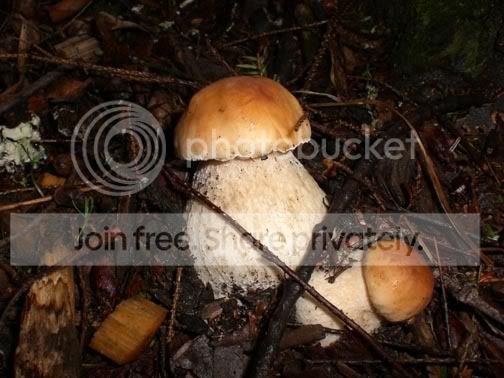
Last summer I was backpacking in the mountains and saw these I thought were BE but I didn't have a book or anything. They definately were SOME form of Boletus. I know it's impossible to positive ID but DO THESE LOOK LIKE BOLETUS EDULUS TO ANYONE WHO KNOWS? Was in the mountains and they were growing in spruce. Sorry for the one pic but it rained like HELL the night before and washed dirt up on the stem of the big one.
be1.jpg

be2.jpg
 
The top ones look like they might be. It is hard to tell without seeing and handling the mushrooms in person, to check for stuff like whether they bruise blue, whether there is reticulation on the stalks, how large the mushrooms are, what they smell like, how firm the flesh is, etc.
 
very cool... i love mushroom hunting...:thumbup: my wife and i, aren't experts by any means.. we usually go with some family friends, that know a lot about mushrooms....

we also have a few really good spots, to pick mushrooms close by... both state parks... there are a lot of different varieties, but the edibles are mainly chatrel's, bolete's and shitake's.. there are few others as well...:)
 
The top ones look like they might be. It is hard to tell without seeing and handling the mushrooms in person, to check for stuff like whether they bruise blue, whether there is reticulation on the stalks, how large the mushrooms are, what they smell like, how firm the flesh is, etc.

What I figured.

Next time I'm there I'm bringing the book even though I'll probably have to ditch some gear to justify it;):thumbup:
 
Ihunt Morels in the spring and Oyster mushrooms in the fall. They are easy to identfy, safe, and delicious.
 
Hmm... I usually have some pop up in the yard every year. Never thought about cooking them though.

FBMSE2.jpg
 
Anyone have experience with this guide?

Wild Mushrooms of North America: A Field-to-Kitchen Guide by David Fischer?
 
I've looked at that book. It's a fine offering; however, again, I would make it secondary to Arora's Mushrooms Demystified. There aren't any other layperson's mycology guides that come close to MD, to the best of my knowledge. Arora has a unique talent at seeing critical differences and creating taxonomic keys. His enthusiasm and humor also contribute to a great read, as well as a great reference.
 
I'd be inclined to advise you to leave them alone unless you have walked and studied with an expert in person to identify them. Even then, if you're tired or distracted, it's easy to let a poisonous lookalike get in by accident. Morels are an example: false morels look very much like regular ones, and you have to carefully i.d. the grain pattern and direction close up to differentiate. There are a few that have no poisonous lookalikes, though.


Ron learned that one the hard way in Solo S...HAHA.. If he can get them mixed up I sure as hell aint touching any of them!!;)
 
What no Panaeolus cyanescens (blue meanies)? Psilocybe cubensis seem to be good eats;)
 
Back
Top