
-
The BladeForums.com 2024 Traditional Knife is available! Price is $250 ea (shipped within CONUS).
Order here: https://www.bladeforums.com/help/2024-traditional/
You are using an out of date browser. It may not display this or other websites correctly.
You should upgrade or use an alternative browser.
You should upgrade or use an alternative browser.
Musso Bowie
- Thread starter LRB
- Start date

- Joined
- May 9, 2000
- Messages
- 29,205
I imagine you are going to be the brass back on the blade. This should be a very nice knife.
- Joined
- Dec 3, 2005
- Messages
- 51
Great looking knife. I've always been a huge fan of the musso bowie

- Joined
- Dec 4, 2005
- Messages
- 1,025
You call .21875" too thin?? That's almost a quarter of an inch.

jdm61
itinerant metal pounder
- Joined
- Aug 12, 2005
- Messages
- 47,357
You call .21875" too thin?? That's almost a quarter of an inch.
yeah.....for a knife that size,i would start with 3/8 stock and end up around 5/16 at the ricasso with a full taper to the point.......hell, i do that with bowies smaller than this one

- Joined
- Jul 31, 2002
- Messages
- 2,959
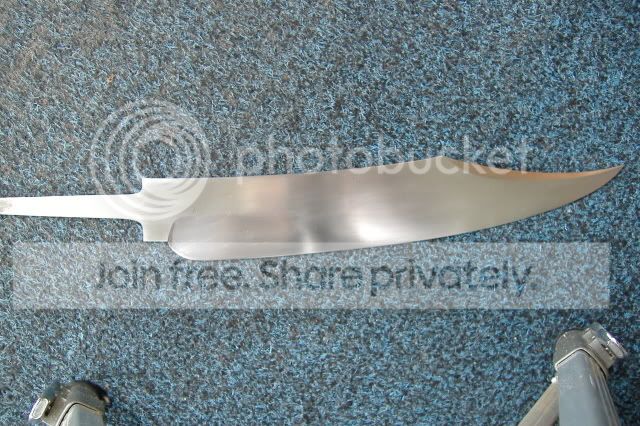
If you noticed, it starts out hollow ground, then blends to convex. Very odd grind...
The main thing that baffles me, is why the hollow grind beginning at the ricasso, and continueing only a couple of inches?
If you just want some speculation, ask in Bernard Levine's forum here. His speculation would probably be far more accurate than about anyone else on Bladeforums.
My own speculation on the topic is far simpler. The whole knife probably started out hollow ground, and then it was used and sharpened a lot, which would also explain that wickedly narrow tip. But I've never seen the original and don't know.
Shear steel was used into the early 1900's by some manufacturers; I have a big I. Wilson butcher knife made from it. If you ever do want to "go that far", it might be easier to collect up a bunch of old shear steel knives & just reforge them into one blade.
I disagree with the comments about using a heavier handle material to "balance" the blade, especially if I'm correct in my above assumption about all the steel sharpened off the tip.
The hollow is deeper than the steel in front of it, which becomes convex. The taper in this blade goes from 7/32" to 3/16" as it nears the clip, then is pretty much parallel until near the point. One thing to bear in mind, is that while the evidence of the age of this knife is relatively convinceing, there is no hard proof that it is from the 1830's. Joe Musso believes it is, and some others do, but there are many who believe it to be a very well done fake.

- Joined
- Jul 31, 2002
- Messages
- 2,959
The hollow is deeper than the steel in front of it, which becomes convex.
Well, yeah, that's just what happens. Maybe it was made that way originally, but considering how many butcher knives, hunting knives, and pocket knives I've seen this exact same thing happen to (including several of my own that have gotten that way through extensive use), I don't consider my explanation too unlikely either.
By the time you sharpen some serious steel off the end of the blade, so it's lost like a half inch or more of width, you start getting up into the thicker steel. If you want to keep the edge thin enough to cut well, you have to start sharpening/regrinding the sides of the blade as well, thereby erasing the original hollow grind.
Now, before we go off on a tangent here, I've seen folks suggest that sometimes grinds like this were done intentionally so you could keep the tip thick for heavy chopping & piercing, while leaving the edge thinner near the handle for whittling & such. That sounds like a nice idea. In fact, I thought it was a darn good idea & made a great big bowie with such a grind. But then real world use showed me it wasn't a good idea at all. By design, the rear portion of the edge is too weak to withstand the heavy work. So the first time I struck a little too far back, or even chopped a big limb so that most of the edge is making contact, that thinner portion of the edge got some big ripples going well up into the main grind.
So I doubt this would be the goal with such a design, and if the rear hollow ground portion of the original was stout enough to withstand the heavy work, then there wouldn't really be a reason/need to make the tip area any thicker either.