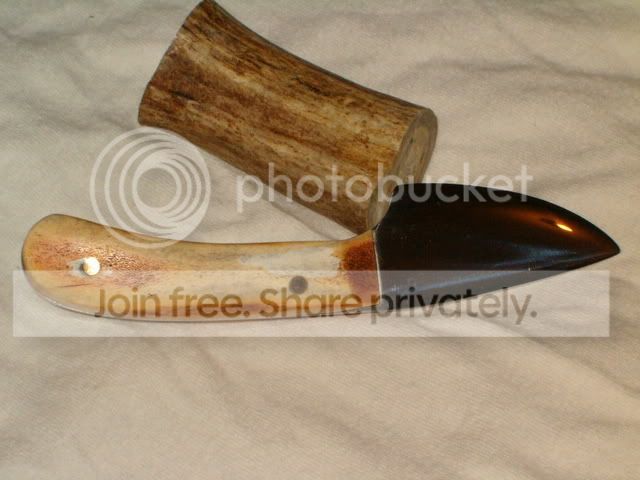
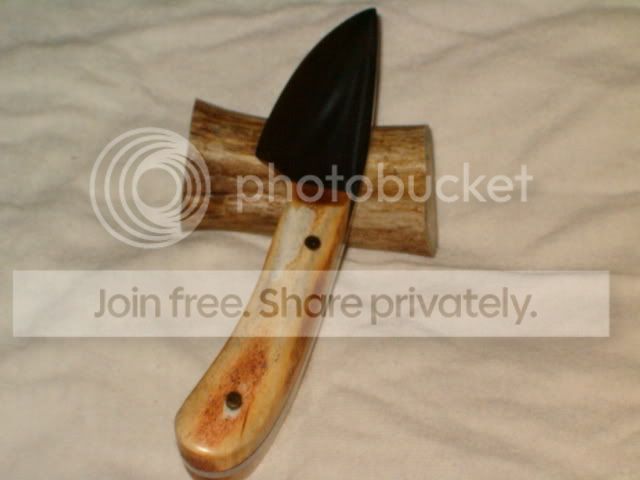
My 1st crude attempt at small blade

Joined
Feb 11, 2005
Messages
582
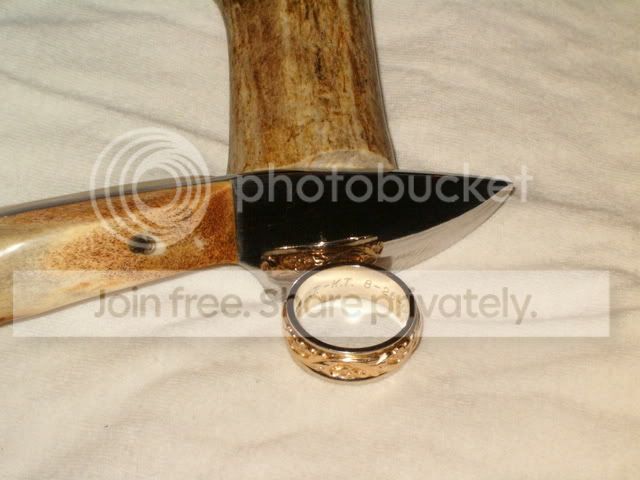
A little skinner/back up blade made from a strip cut off a worn out sawmill ripsaw blade in the early 60's, when the saw blade was made originally I don't know.
I mentioned a while back to my dad that I was considering making a knife, and he went to his shop and pulled out these strips he had kept from before I was born, that he was gonna use to make a knife, and never got around to it, so I consider this his knife as much as mine.
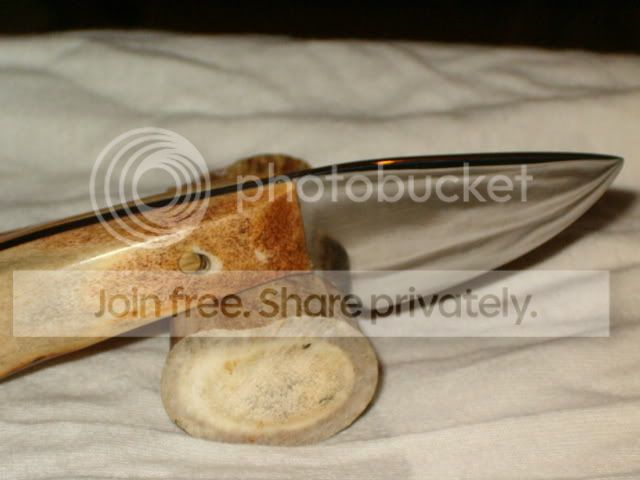
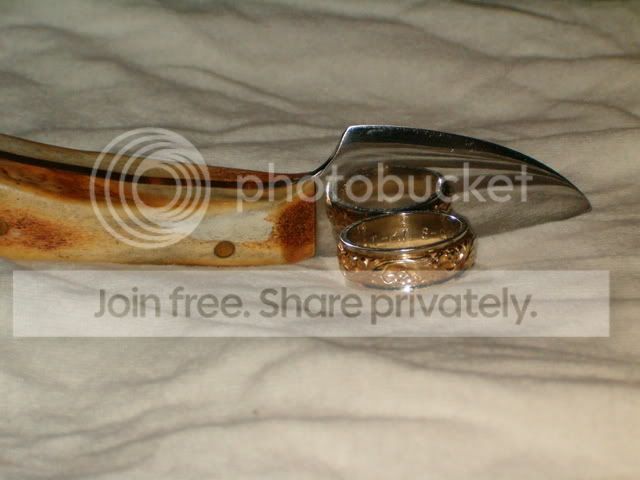
The handle is from a shed whitetail antler I found last year. Overall length is 4 3/4", blade is 2". The grind is convex (that's a story by itself), and shaving sharp. The scales are a bit crude, like the rest of the knife, but it feels good in hand, and holds a very nice edge. I boogered up one of the pin holes, and the scales aren't a dead even match, but I am glad to have it.
Tools used: 4" angle grinder, 5" orbital sander, drill, dremel, and much, much sandpaper.
Comments are welcome, but go easy on a noob.
knives034.jpg

knives031.jpg

knives030.jpg

knives024.jpg

knives023.jpg
 
Great job beckerhead! For a first knife, that is much, much better than I could have done! It takes a lot of guts to give it a try let alone throw it on the internet, but you'll get no criticism from me, just kudos. The good thing is, there are a lot of quality makers here to help give you pointers...when I ever give it a shot, I'll be sure to solicit their help:D:thumbup:

It looks like a perfect little skinner, just in time for deer season!

ROCK6
 
Lookin good. Now go cut something with it. Thats a helluva feeling.
 
Awesome knife! Great design, Nice polish, and I love the antler scales.

In fact, the only flaw I can find is the pins, so I'm going to give you some unsolicited advice.

After you're done with the blade and before you add the scales, drill your pin holes where you want them in the steel tang.
Then tape your scales together real good so they line up, and shape the front of them. Then, attach one scale, and wait until the glue/epoxy dries up(24 hours) then, using the holes that are already in the tang as guides, drill the tang holes through the one scale that you just put on.
Then, epoxy on the other scale, making sure the fronts line up since they've already been shaped. When the epoxy is dry turn the knife over, and use the holes that are already in the first scale as guides to drill through the second scale.

I hope that makes sense. Essentially you will have perfectly lined up pin holes if you do it this way, and they will be even better if you have a drill press, but they will still come out nice if you are doing it freehand.

P.S. Beautiful first knife though, I can't wait to see your next!!! After looking at it again, I gotta say, man I love those antler scales!
 
I think it is great. Neat to have that sense of family history in anything, much less something you made.

Congratulations. Flaws create character in a tool. Cookie-cutter perfection...well, it ain't for users. Nice work.


Kis
 
Damn, looks good. I really like what you did with the antler horn. I have been holding a shed antler for the same exact reason so its really cool to see that it comes out so nice. I guess I should say can come out so nice.

Congrats,
KR
 
Awesome knife! Great design, Nice polish, and I love the antler scales.

In fact, the only flaw I can find is the pins, so I'm going to give you some unsolicited advice.

After you're done with the blade and before you add the scales, drill your pin holes where you want them in the steel tang.
Then tape your scales together real good so they line up, and shape the front of them. Then, attach one scale, and wait until the glue/epoxy dries up(24 hours) then, using the holes that are already in the tang as guides, drill the tang holes through the one scale that you just put on.
Then, epoxy on the other scale, making sure the fronts line up since they've already been shaped. When the epoxy is dry turn the knife over, and use the holes that are already in the first scale as guides to drill through the second scale.

I hope that makes sense. Essentially you will have perfectly lined up pin holes if you do it this way, and they will be even better if you have a drill press, but they will still come out nice if you are doing it freehand.

P.S. Beautiful first knife though, I can't wait to see your next!!! After looking at it again, I gotta say, man I love those antler scales!


Thats great advice Stingray. I'll use it when I try to make my knife. I assume you still do final finishing on the scales after they are attached but you try to get them as close to a fit as possible before attaching them???

And that is a question. :D

KR
 
It looks a whole lot better than my first. Keep at it, that looks really good. :thumbup:

This is my first, too embarassed to show it before this. :o

John
2924ebn.jpg
 
I assume you still do final finishing on the scales after they are attached but you try to get them as close to a fit as possible before attaching them???

And that is a question. :D

KR

You do all final shaping after the scales are attached. The only pre-shaping you do is on the front, because it is hard to shape whatever roundness, etc. on the front without scratching the blade.

The rest of the scale can be as crude as you want, because you want to do all the other shaping after they are attached so they come out nice and even. You don't want to pre-shape your scales too closely and end up that the scale is smaller than the tang.

I hope that makes sense.
 
by sanding some antler, saving the dust. Mix the superglue and dust and use it to repair the hole. After glue dries, sand the patch level with the rest of the scale, then buff...

Saw blade steel typically runs between .60 and .80 in carbon, with some Ni and Cr thrown in, makes a tough blade....

Your knife looks good...
 
Nice looking little blade. I really like the antler handles, they really seem to go with the overall look of the knife.
 
Back
Top