
My clay quenched blades didnt curve...

Joined
Jan 2, 2006
Messages
1,073
hey everybody....
i have a slight problem.

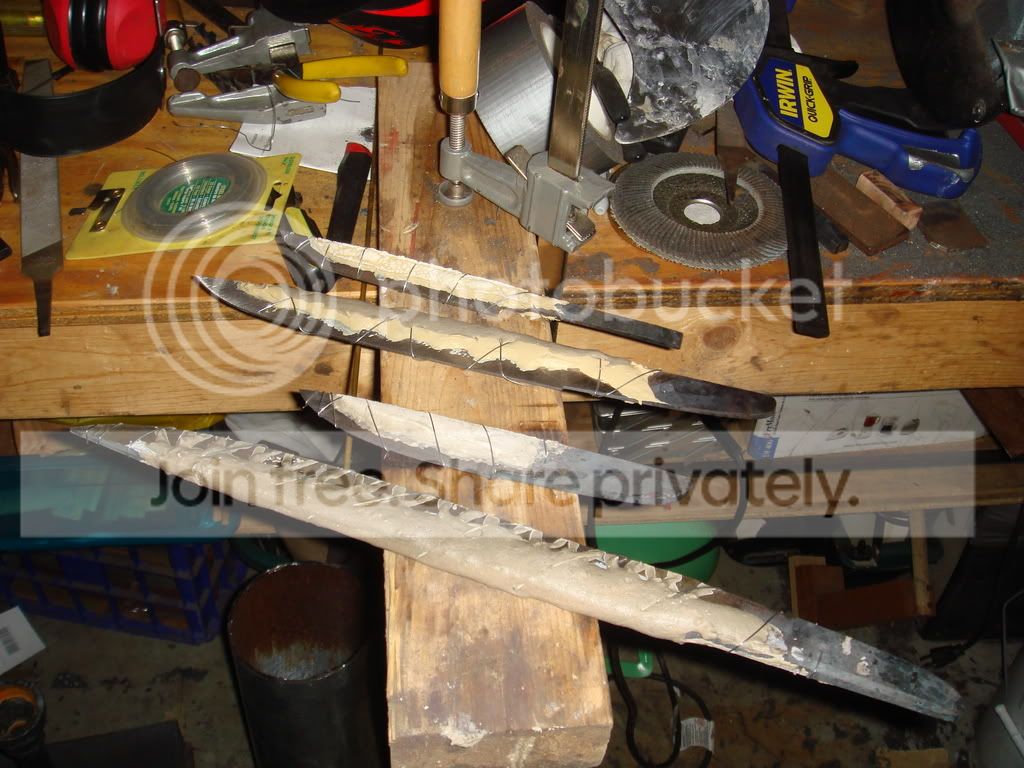
I used my new muffle forge to HT some blades and they have hard edged (i checked with a file) but the ones with clay on the spine didnt curve like they wer supposed to. now i havent checked yet to see if they even have hamon lines (i spilled all my FC acid)
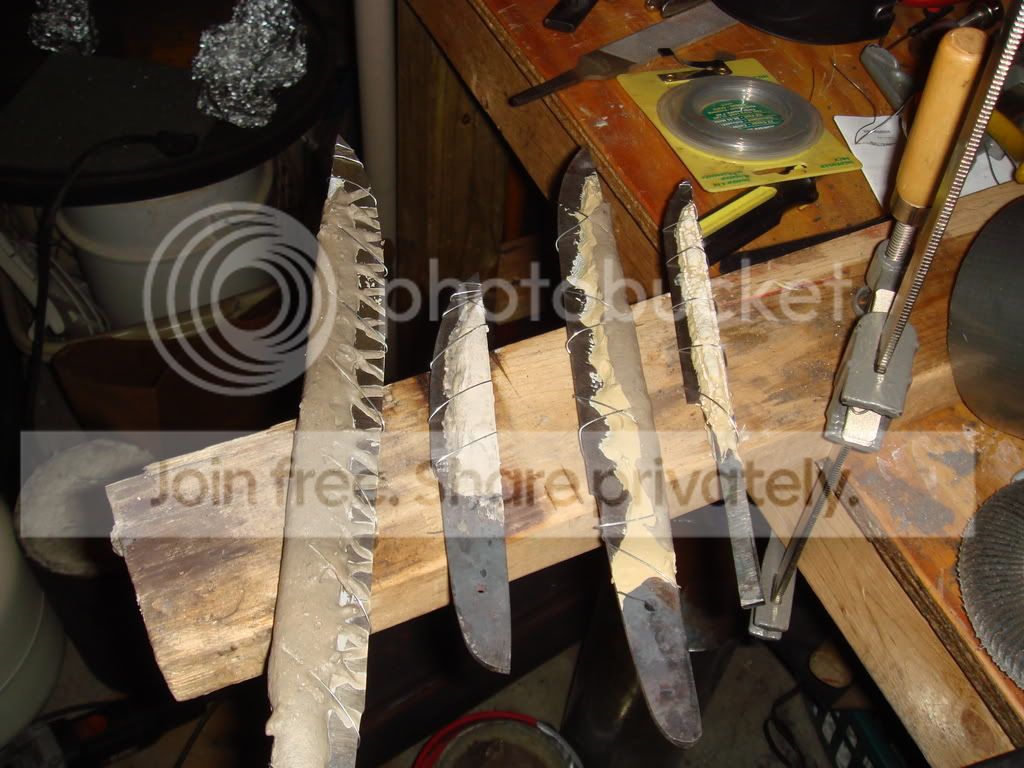
DSC00877.jpg


DSC00876.jpg


what could i have done wrong?
is it worht seeing what kinda hamon line? or does the fact that they didnt curve mean they didnt harden right?
i tempered the knives right away so as to not have them stress crack... should i redo them? or should i be content if they have nice lines? the big blade is W2... and i would rather not crack it.

thanks
~Chris
 
Hi Chris,

I have never had a blade curve using clay. Not in the direction I wanted,
anyway.
I don't think you are working with enough length to show any appreciable
curve during HT.

Your big blade may not have hardened in the areas where the clay is on the edge. It doesn't take much to interrupt the cooling during the quench.

You will know when you hit it with a file.

Fred
 
I havent clay quenched any blades for a hammon yet, but I was given some advice which seems to be fitting to pass on for the large blade. I was told to get a good wavy hammon, clay the spine of the blade and then cut UP into the clay away from the edge and take away, and to not bring any clay down to the edge.
 
What type of steel are they? Were you quenching the whole blade at once as in like an edge quench or point down into a tube? From what i have read the point down into a tube will not curve much at all. But the edge type should curve a little. Down (toward cutting edge) in oil and upward (toward spine) in water.
 
well in the past the blades have curved a good bit sometimes.
the big blade is W2 all the rest are 1095.
I was quenching them in McMaster Carr 11 second quench oil, not in a tube but edge quench style. i heated the oil... should i not have done that?
could the blades have been too hot? too cool? they were non-magnetic...

anyway.. i wasnt able to find any FC acid today... so i guess they will wait some.. it isnt like i am busy or anything. *sardonic laugh*

thanks!
~Chris
 
What I have learned about 1050 and a clay-coated blade.

I use an interrupted quench. I dunk in the water for about 4 seconds, take it out to have a look, then dunk again, then pull it out to again check, then dunk again.

What you learn is that when you pull the sword out that first time, the curve actually goes the wrong way.
then after the 2nd dunking the curve starts to turn and go the correct way.

Now I quench the 1050 blade in water, had I tried to use slower cooling oil Im sure that the blade would not have time left to turn and bend the correct way.
Thus I believe that a oil-quench might well end me up with a straight blade, or one that perhaps bends the wrong way.
 
I had a 15" OAL cutter curve like nuts!!! I first used too much clay and got it to curve into a recurve....pretty dramatic, too. I decided to re-ht and try it with water. Went from a 1/4" drop to a full 1/4" draw back....over 1/2" movement of the tip when i water quenched....


....did i mention it also sheared the entire blade almost in two, with huge amazing fractures along the boundary where the clay was applied?
 
It takes a fast quench to get a good sori. Water, brine, or fast oil. The blade should go in edge down for three seconds, out for three seconds and back in till cooled off. The blade will curve down at first then up into sori. 1050 will curve dramatically.
Stacy

The sori and the hamon are diferent things and unrelated. You may have a super hamon and no sori.
 
Did you try a electronic supply for the ferric cloride. Thats were I get mine. Even Radio Shacks often have it.
 
How thick is your clay?? If it is too thick it can cause problems. I was unable to get any hamon until I started putting it on about 1/8th inch per side. Also i found that the 11 second McMaster oil should only be heated to around 90F. It loses cooling efficiency over 100f.
Chuck
 
I've seen it mentioned in Wally Hayes' katana videos to not coat the actual spine of the blade heavily, but only the sides. Could that have anything to do with forming the sori? Simple speculation; I don't know.
 
The scraping off of the clay on the spine is to control the sori from becoming too severe. It is a trick to prevent breakage on full size katana. It lessens the sori.
 
Thanks, Stacy. Not being a method I pursue, I didn't know but thought it worth asking. :)
 
Good article. Lots of accurate info and little mysticism of Japanese blade making.
Thanks Mike.
Stacy
 
Excellent link Fitzo :thumbup: I'm going back to that one. Unfortunately some of the links I cut & pasted to my browser did not work. I'll have to try again later today. Much good info there :)


I had a 15" OAL cutter curve like nuts!!! I first used too much clay and got it to curve into a recurve....pretty dramatic, too. I decided to re-ht and try it with water. Went from a 1/4" drop to a full 1/4" draw back....over 1/2" movement of the tip when i water quenched....


....did i mention it also sheared the entire blade almost in two, with huge amazing fractures along the boundary where the clay was applied?


David, see Fig.11 "Variation of longitudinal stress distribution" in the link Fitzo supplied :D ;)


Chris, could the absence of Sori be directly related to the thick cross section in some of your blades ? I do Hamon, in fact I'm finishing one up in W2 now...........no Sori. Thick cross section Chopper too.
 
hmmm
*been gone for a day*
lots of good info!
wow...
i think it maybe my quenching. i have gotten the negative sori. but on other knives i have gotten a nice curve.

as for the thickness... i got a bueatiful sori on a knife almost identical to the big blade... so i know it is possible... (did i mention i broke the blade?)

i did check the radioshack.. and they do cary it... but they were out... i'll keep trying. i am gonna reHT the knives (except for the ones i didnt want to curve) those i scraped the clay off the back.

i could have put on too much clay... i will lessen the amount. btw... i am using refractory cement with a little iTC 100... it works better than straight refractory and i had a little itc left over. comments?

i shall try again when i have a little time. (which wont be till next week)

thanks so much
~Chris
 
You can etch them with warmed vinegar to get the hamon to show. I think it makes the hamon show up white where the Ferric Chloride from radio shack makes it show dark. At least that is what i think i remember reading.
 
I have a little experience in differential hardening using clay on simple steels...1095 and 1050. I have quenched a few 5160 blades with clayed backs as well.

In my experience they will all go edge down (reverse curve) or get no curvature at all quenched in oil. 1050 will hardly get hard in oil for me but in every case oil will not develop positive curvature for me.

Water is the way to go if you want to develop curvature in the quench.

Brian
 
Thanks for posting the link, Mike.

Very readable! :thumbup: Fred
 
Back
Top