My first 1095 quench

Joined
Dec 25, 2004
Messages
1,363
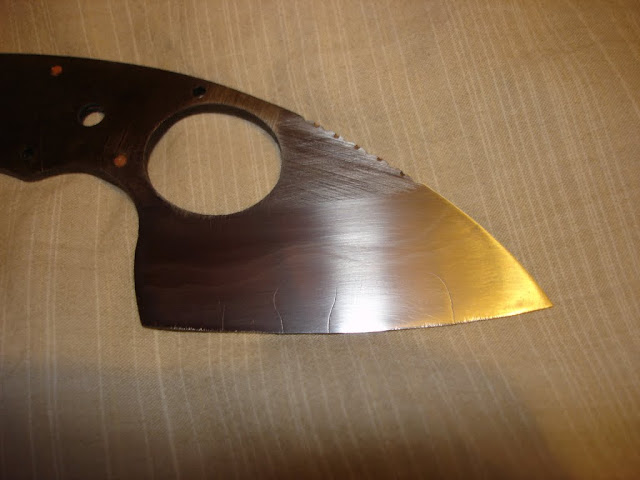
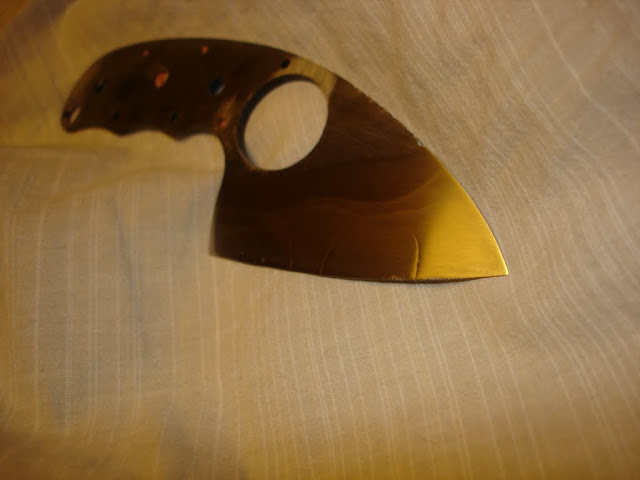
Hi all. I have been working with solely air hardening steels before, I thought I should give carbon steel a chance, so I bought some UHB20C (uddeholm equivalent of 1095) and ground a little necker out of it. Ground to 120 and normalized first at 1550 - then 1475 - then at 1380. Clay coated and austenized at 1475, soak 5 mins... Quenched in water, a little agitation and a couple seconds later interrupt and wait a couple seconds and quench...

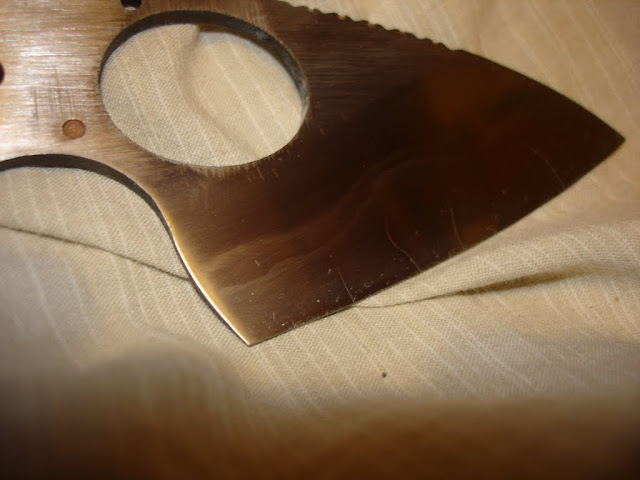
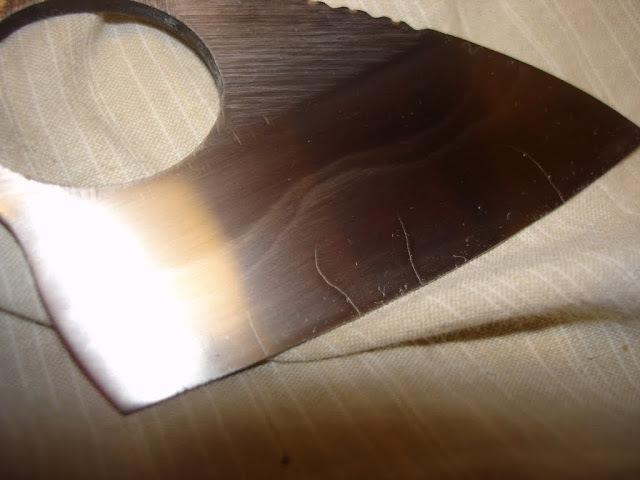
Heard a dreaded "ping" right after it stopped hissling noise, and 4 pings right after. :rolleyes:
I know it is because of water quench but I had to try. I have a good HT oil but I had to experience this...

Anyway I sanded up to 800 and etched in mild nitric acid, then sanded again and repeated the sand + etch cycle until I liked the result. There are two distinct lines and I'm loving it. Time to try that with my fast HT oil, I guess the I will continue to use carbon steel because there are lots of possibilities, easy to shape and sand, but mostly because I'm in love with those hamons :)
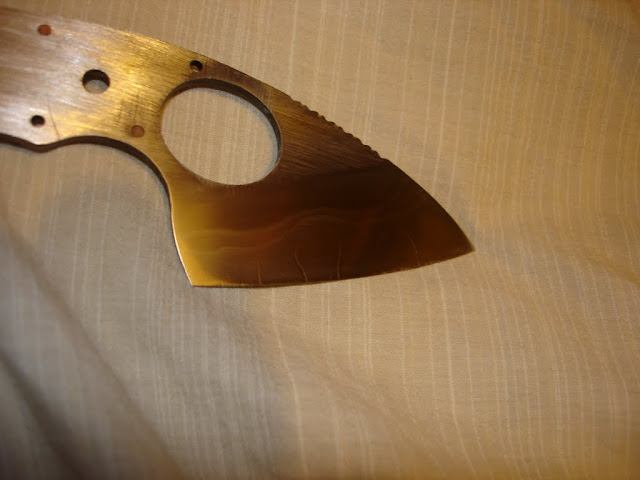
DSC03970.JPG

DSC03974.JPG

DSC03975.JPG

DSC03976.JPG

DSC03977.JPG


Emre
 
Wow! Water quench? You have balls! Can"t you get a hold of a fast oil where you are?
Sorry, didn't catch the part where you were experimenting with the water quench.
 
Last edited:
Here's a thought. Try adding salt to the water and heating the water to 80 deg F. I water quench alot of 1095.
 
Your 120 grit grind could have been the culprit as well. as that low a grit scratches can double as stress risers, which cause cracks. I take mine to 220 and usually even 320 before heat treat. try it again with a higher grit. leave atleast 1.5mm on the edge for a water / brine quench, and 1mm for fast oil. Good Try Though!

Jason
 
Your 120 grit grind could have been the culprit as well. as that low a grit scratches can double as stress risers, which cause cracks. I take mine to 220 and usually even 320 before heat treat. try it again with a higher grit. leave atleast 1.5mm on the edge for a water / brine quench, and 1mm for fast oil. Good Try Though!

Jason

Thats a good point. I learned that the hard way.. The water itself can also be the culprit. I use rainwater I catch beside my shop. Tap water has minerals ect in it that can add variables. The edge thickness needs to be a bit "beffier" when water quenching. Adding salt to make brine(7%-9%) helps because it cools the metal more even by breaking up the vapor jacket.
Dont give up, just get rid of as many variables as possible. Ive cracked one blade in a good while and it was just a "blacksmith" necker made from a file and the water was WAY to cold. My fault there..Just got in a hurry. Howard Clark is a good guy to ask about water quenching. Its about all he uses for 1086M. Using water your gonna lose a bladr sometime or another but it dosnt have to be a 50% of the time or even 10% of the time for that matter. It does take extra care and patience though..Best of all its still the fastest and cheapest there is :D
 
Thanks for the ideas. I'll try with the HT oil now and compare the contrast of hamon. If I don't like the result I'll have to fine tune the water quenching. But these issues are important even for quenching in oil: Sand to fine grit to reduce the stress factors, warm the quenchant to the optimum temp recommended for it. I guess those are important even for quenching in oil...
Emre
 
Your hamon will not be as vibrant in any but the fastest oils. Preheat is good with most oils, but has its limits with water as it lquite understandibly increases the vapor jacket by bringing things that much closer to the boiling point.
 
Yes Mete, the first and loudest one actually. The clay coat was only to there and I accidentally dipped the blade a little bit further. The finish there was at 60 grit. I suppose it is the main reason of that crack...
 
I remember my first attempt at water quenching 1095. I ground a nice knife with a 7 inch blade, brought it up to temp and quenched it in water i had heated to around 150 degrees. I can still see the point coming back out of the water towards me just before it broke in half!!! Actually it didn't bend that much but it definitely bowed way up before breaking. Took me a while to get my nerve back up after that. I spent a lot of time reading about brine quenching and temps to heat both the brine and steel to. Still I will crack one every now and again.
 
Back
Top