
My first and probably last chopper made

BluntCut MetalWorks

Knifemaker / Craftsman / Service Provider
Joined
Apr 28, 2012
Messages
3,476
What do you think of this chopper? It saw a few hrs of actions already.

'Warm' forged from a bar of CruForgeV 0.25x12x1". The constant propane jet and hammering drove my neighbors crazy, thus maybe it's my last chopper in the foreseeable future. 'Warm' because the long duration of high psi propane torch scared the neighbors. I put about 3 hrs of hammering, 2 hrs short of my shaping goal but can't use up too much all my good neighbor credit. Yeah another 30 minutes on the tang, I don't have to see that square-ish handle. Another 30 minutes of hot forged could flatten the blade better (less dents). 1 hr to add better taper from spine-to-edge + add about 5mm to the blade height.

This chopper will go to my mom for chopping small trees & branches, very large vegi plants, and worst of all - into dirt & rocks to remove grass root + some digging. After a month if it doesn't rust & dinged up, I would be disappointed.
chopper20130420.jpg
 
Are you saying you planned on shaping for 5 hrs?
I meant forging into shape. Warm forge take alot of hammer blows. And there are many long wait for the blade the heat up with start/stop propane torch. Also it's sort of tricky to draw metal out on a 6x6 anvil face - half on/off strike usually resulted in sharp crease. And my cross peen hammer sucks. so I drawed the metal out like the way I was doing jewlery, it was a slow process. Afterward, I can't even use my belt sander (cut all noise for a week), so I hand sanded on the disconnected belts and the rest was hand finished.

It was a fun knife. I think, I correctly placed the sweet spot (4" section) just an inch in front of the balance point. This blade easily out-chop my regrinded fallkniven oden.
 
First off, "Warm Forging", as you call it, probably does a lot of damage to the steel. Do not forge CruforgV below 1600F.

Second, at normal forging temps of 1700F to 2000F, that should have taken less than 30 minutes to fully shape from 1/4" stock. An hour should have been enough to forge it and grind it clean.
 
First off, "Warm Forging", as you call it, probably does a lot of damage to the steel. Do not forge CruforgV below 1600F.

Second, at normal forging temps of 1700F to 2000F, that should have taken less than 30 minutes to fully shape from 1/4" stock. An hour should have been enough to forge it and grind it clean.

Stacy - thank you.

I was afraid excess damages had done to this blade from warm forging which could be dangerous to the user (my mom). Under 400x magnications I saw some marks look like damages. So, I put it through 3 hrs of chop/baton/silly-lateral-smack/stand-on... Now, with your warning, I'll keep this chopper and either buy or make another chopper for my mom. There is no way for this newb to make a chopper in an hour even with proper equipments - maybe 2 if without too many mis hits.

I need a workable forge. Is the 'Atlas Mini Forge' good enough for hobby forging? Mostly for forging kitchen or smaller knives. Or please suggest a quiet part time forge.
 
The NC Whisper Lowboy and Whisper Knifemaker are very quiet. An Atlas Mini-forge isn't going to work well on a large blade.

When the steel is properly heated to 2000F, you will be amazed at how easy it pushes around with your hammer.
 
You definitely need a real forge. A solid fuel (coal, charcoal) forge that you could build yourself would work a lot better than that torch if a propane forge is too expensive. A 6x6 anvil should be plenty for blade forging, you just have to work on your hammer control and stock control. Perhaps you could take the edges off your anvil just a bit with a file or angle grinder.

Did you heat treat it? I saw no mention of that... sanding hardened CruForgeV is quite difficult, any real stock removal would be well nigh impossible if the blade was hardened.
 
The NC Whisper Lowboy and Whisper Knifemaker are very quiet. An Atlas Mini-forge isn't going to work well on a large blade.

When the steel is properly heated to 2000F, you will be amazed at how easy it pushes around with your hammer.

NC Low Boy with higher heat capacity & bar stock ports would be a great forge to have. I probably will need some high-temp infrared thermometer too. All is moot for now until I lease another residence, since the current location is severely restricted (neighbors & zone). My other option is to get a Atlas Mini for forging on the back of my F250 :grumpy:
 
You definitely need a real forge. A solid fuel (coal, charcoal) forge that you could build yourself would work a lot better than that torch if a propane forge is too expensive. A 6x6 anvil should be plenty for blade forging, you just have to work on your hammer control and stock control. Perhaps you could take the edges off your anvil just a bit with a file or angle grinder.

Did you heat treat it? I saw no mention of that... sanding hardened CruForgeV is quite difficult, any real stock removal would be well nigh impossible if the blade was hardened.
Thank Salem!

A PID gas forge hot enough to weld would be super fun to build & operate. Realistically, I can't forge at my leased place any more (ok, maybe toad sticker here & there). So it come down to about maximum of stock-removal time between 3&4pm. Elbow grease the rest.

As for this chopper. I warm forged - heated to yellow hammered until way black - repeat. Ceased forge. Make a mistake, didn't re-anneal nor even normalize before sanding use sections cut from a 2x72 blaze belt. Steel was partially harden from warm forged, so it took probably multiple 3hrs sessions to its current shape. Done when I had enough:o

Normalize (heat to non-magnetic for 1 minutes) - slow cool on top my my make shift brick charcoal propane blown forge.
Austenitize (past non-magnetic, hold for 2 minutes) - dip in water (plain h2o) stirred (0.5s) partially pull out but the edge (2s). Tong slipped, tip fully dip and cracked. Take out, redip the spine to water until cool to touch(8-10s). Wraped in aluminum foil, toss in a pre-heated kitchen oven at 425F for 2 hrs.

Lost about ~1 inch tip. The crack was about 0.5" from tip but I removed extra just to safe.

Spent another few hrs sand the final bevel & clean up. Edge sharpened to 600 grit & stropped on white compound.
 
Lotsa elbow grease! interrupted quenching CruV in water is dicey... but you found that out! Should cut like a beast for you, though. Good luck with your equipment and housing situation.
 
A quick update. I exposed this chopper oak handle weathered outside for over a month - no surprised, it cracked and scale partially detached from tang (devcon epoxy). So I put on a new cumaru wood handle with three 3/16 brass hidden pins + g/flex epoxy. Oily wood, hopefully it will survive outdoor abuses. Well, it's going to my mom this weekend - my sister told my mom about this chopper, handing it over ;)

choppercumaruhandle.jpg


Will this handle fare any better than oak? Cumaru sure difficult to work with - dulling alox sand paper quite fast.

Thanks.
 
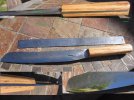
EPIC Failed!!!! My mom wasn't impressed with my chopper. Instead, she asked me to sharpen her real choppers - the middle one is actually custom made from vn. I didn't bring my beater belt sander nor big sharpening stones for these super dull chop at grass base into the dirt choppers. So I use her bench grinder and lawn mower blade boat sharpener.


I've no idea of steel type nor how they were heat treated. Knives are quite hard and tough.

I am thinking about make a 52100 grass chopper in similar shape as pic (18 OAL, 4mm at heel, slight distal 3mm tip, ffg ). ht: triple quench, 1500F harden quench water 1second then oil, 450F double temper, double sub-zero.

Or I could buy a Condor Pack Golok :grumpy:

Your inputs would be greatly appreciated...
 
Back
Top