
-
The BladeForums.com 2024 Traditional Knife is available! Price is $250 ea (shipped within CONUS).
Order here: https://www.bladeforums.com/help/2024-traditional/
You are using an out of date browser. It may not display this or other websites correctly.
You should upgrade or use an alternative browser.
You should upgrade or use an alternative browser.
My first Chef's knife
- Thread starter BOLD1
- Start date


- Joined
- Dec 21, 2006
- Messages
- 3,158
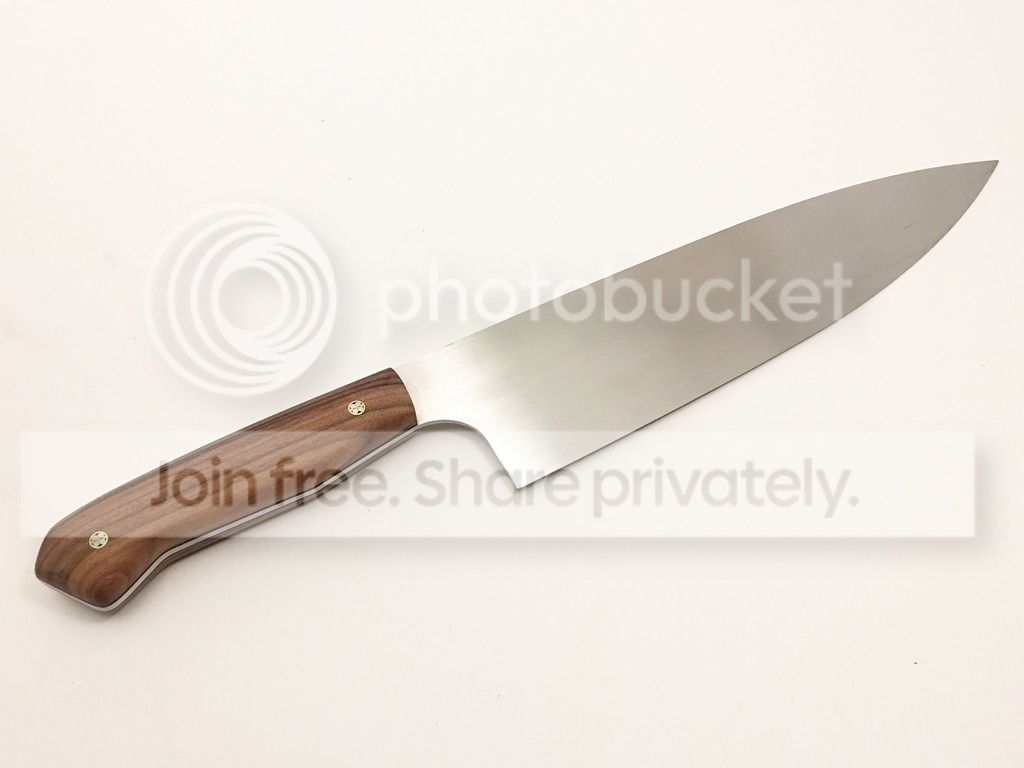
Great job! For a first chef's knife, or your 300th, it looks awesome! I might would have the handle extended a little more further forward, but that's just me. You should give yourself an "atta boy!"
Looks really solid! The best evaluation is using it every day--you will find all of the flaws pretty quickly. There are a lot of features of kitchen knives (like all knives) that come down to individual preference, anatomy and use, but there are a couple of things that come to my mind:
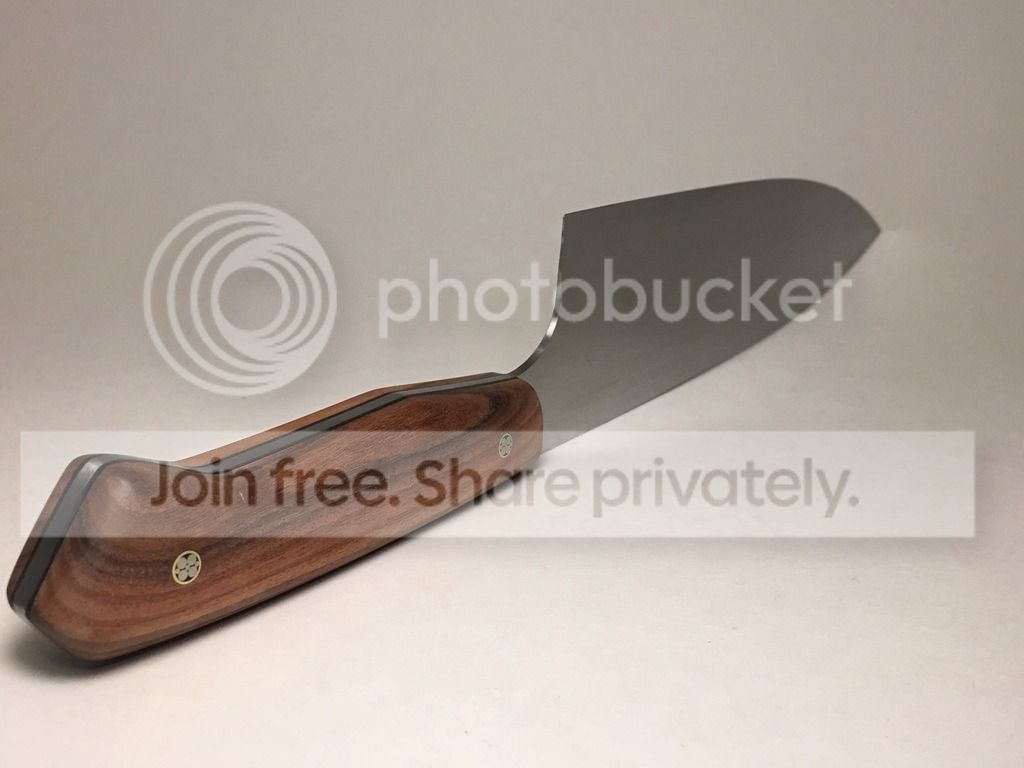
1) The area behind the heel where it curves up to the handle appears to have square corners. If you are holding the knife in a pinch grip, these will dig into your fingers. Try rounding these out.
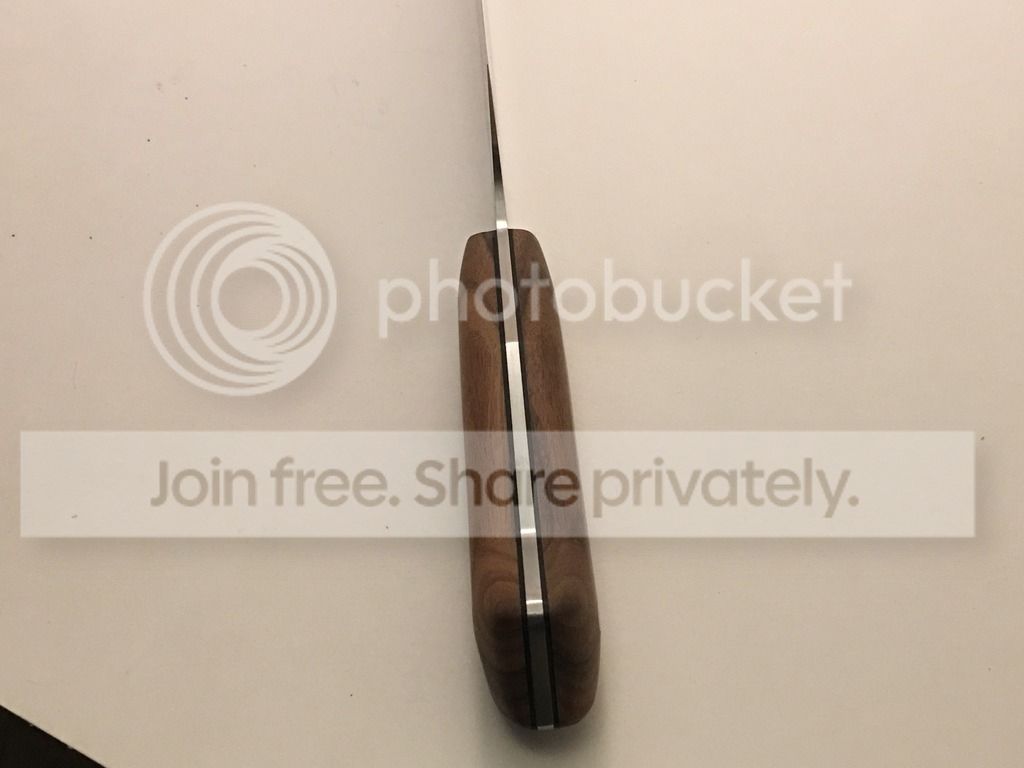
2) The scales end pretty abruptly at the base of the blade. Again, this looks like it would be uncomfortable in a pinch grip. Try rounding this area, and thinning the scales out at this point. I've got my Henckels Chef's Knife in front of me, and the scales themselves thin out to just under 1/4" at the forward end, and the bolster continues to narrow down to only about 3/16" at the base of the blade. I wouldn't recommend emulating very much about this knife, but it is very comfortable to hold in a pinch grip. Even if you are leaving a ricasso between the scales and the blade--in the fashion of Japanese kitchen knives--you may want to make this transition a little bit easier. I angle the forward edge of my kitchen knife scales at about a 45º angle so my thumb can rest on this spot comfortably.
3) Kitchen knives see a lot of water, heat change and stress--even if you are diligent about keeping them out of the dishwasher. I recommend three pins or corby bolts. Bob Kramer uses one bolt on each end and a mosaic pin in the middle.
That said, you have clearly done your research on what makes a good knife. A lot of people's first chef's knives have odd and impractical shapes, and axe-like grinds. This looks like a really classic German pattern with a thin edge--I like to shoot for 0.005-0.008" behind the edge for this style. You also took the edge all the way to the heel, which I think is non-negotiable on a chef's knife.
I think you should make more of these.
Chris
1) The area behind the heel where it curves up to the handle appears to have square corners. If you are holding the knife in a pinch grip, these will dig into your fingers. Try rounding these out.
2) The scales end pretty abruptly at the base of the blade. Again, this looks like it would be uncomfortable in a pinch grip. Try rounding this area, and thinning the scales out at this point. I've got my Henckels Chef's Knife in front of me, and the scales themselves thin out to just under 1/4" at the forward end, and the bolster continues to narrow down to only about 3/16" at the base of the blade. I wouldn't recommend emulating very much about this knife, but it is very comfortable to hold in a pinch grip. Even if you are leaving a ricasso between the scales and the blade--in the fashion of Japanese kitchen knives--you may want to make this transition a little bit easier. I angle the forward edge of my kitchen knife scales at about a 45º angle so my thumb can rest on this spot comfortably.
3) Kitchen knives see a lot of water, heat change and stress--even if you are diligent about keeping them out of the dishwasher. I recommend three pins or corby bolts. Bob Kramer uses one bolt on each end and a mosaic pin in the middle.
That said, you have clearly done your research on what makes a good knife. A lot of people's first chef's knives have odd and impractical shapes, and axe-like grinds. This looks like a really classic German pattern with a thin edge--I like to shoot for 0.005-0.008" behind the edge for this style. You also took the edge all the way to the heel, which I think is non-negotiable on a chef's knife.
I think you should make more of these.
Chris

Stacy E. Apelt - Bladesmith
ilmarinen - MODERATOR
Moderator
Knifemaker / Craftsman / Service Provider
- Joined
- Aug 20, 2004
- Messages
- 38,587
That is a very nice chef's blade. Hesparus' comments are good advice.

- Joined
- Feb 17, 2016
- Messages
- 1,527
You did a very nice job, Great fit and finish.

- Joined
- Dec 6, 2004
- Messages
- 6,212
good job and like said about rounding edges and front of handle angle
Thanks for all the replies. I completely agree with the suggestions with lengthening and tapering the handle. I will be rounding the edge's to be more comfortable also. I started this hobby around a year ago and have you guys to thank for all the suggestions, comments, links and advice you have offered others that I have learned from. Thanks for such a great forum. This knife shows me how much I have learned here.
Thank you
Thank you