
My first Fillet Knife

Joined
Aug 9, 2013
Messages
78
Ok, so I have set forth in creating my very first fillet knife. This is for my cousin who is an Auburn alum, thus the logo on the scale. He is gonna worry about that part, but I have plenty of concerns about the rest of the knife so please give me any and all feed back as well as answers to my questions below.

This project has my nerves going a little bit as I only have 3 completed knives under my belt. Some have told me I'm in too much of a hurry to get to the deeper parts of the pool. Either way, I would love some advice on working the grind for this blade. I am planning on doing a full flat grind but am wondering if it's acceptable to notch into the spine at the ricasso in order to make it thin enough for that "fillet knife flex" - or will I achieve acceptable results as the spine naturally thins towards the point?

Also, about heat treating:

I don't have access to an oven large enough to treat this 12.5" knife so Ill be sending it off. Could I get some suggestions on who to send it to and what to expect pricing-wise? I forsee some challenges with warping such a thin blade during HT and quench so wold it be better to do HT before I do the grinding? Should I just not worry about warping if I'm sending this off to a professional for HT? What if it does warp under their care- are they liable at all?

Here's my progress so far:
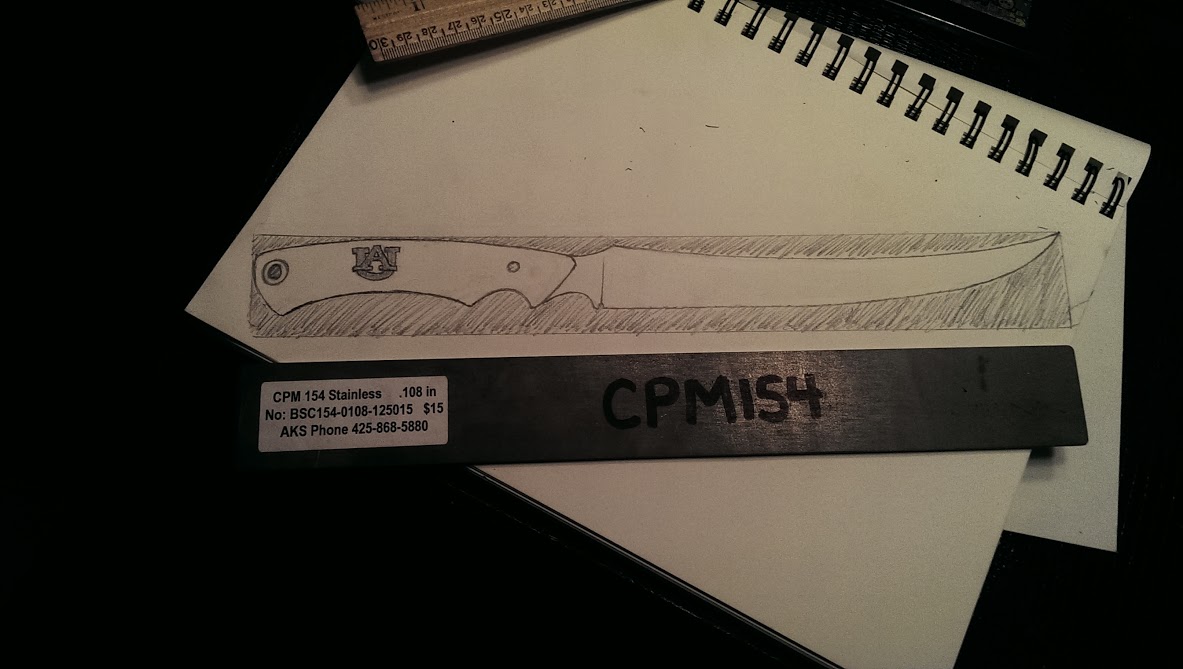
fkeJfov.jpg


This is how she sits now. Profiling 90% done. Just needs some smoothing around the handle area.
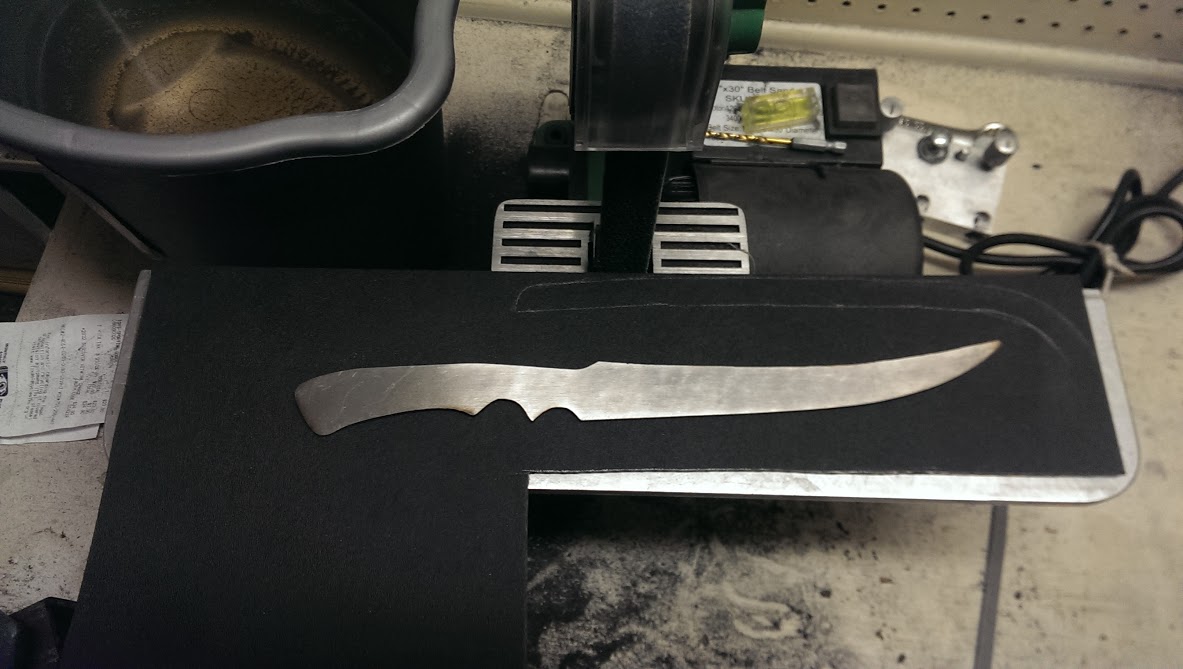
gft2GU9.jpg
 
I like the design. A bit of flare on a fillet knife! They usually tend to look so very pedestrian. How are you planning on doing the college logo just out of curiosity? As much as I fish I might have to get you to do me a copy with my alma mater on the handle! Of course I probably lose 2-3 Wal-Mart fillet knives a year..

I would suggest the same, HT then grind. I know a lot of the kitchen knife guys do that on such thin stock frequently without issue. Just be aware of your heat. Obviously drill holes prior to HT, dur...

Any reputable HT service should be able to do so reliably without warpage, and should offer some sort of coverage in the event it does... I tend to equate warping with either uneven grinds or uneven heat. If you are grinding post HT there shouldn't be much of a risk...
 
Very nice design, and an excellent choice of steel.

Broken spines look amatuerish. By the time you get the mill scale ground off that bar and clean it up you should be down around .100" at most. Full distal taper from there, coupled with the length of the blade should give you a good amount of flex. If you do grind before HT, you can get a very good idea of the blade's flexibilty beforehand... it will not change much if at all after being hardened.

I routinely send thin blades like that to Peter's fully ground, and they come back just fine. They're pretty pricy if you're only sending one or two blades, though. I would at least consider TKS to HT that, and grind the bevels afterward.
 
ok. I was worried this is what I would hear. I get so nervous grinding after heat treat as one can so quickly ruin the tempering... especially around the tip... especially on a little 1x30 1 speed HF grinder. hmmm...

Any suggestions about this other than just go slow and quench often?
 
Good basic shape. I make one very similar to that. I have learned that the "Thumb Ramp" on the spine is of little use, and just curve the blade into the handle top.
You will also find that you need to round off the point between the index and middle finger. As you have it drawn, it will be a bit uncomfortable in use.

Once the handle is finished, any engraving or trophy shop can laser engrave the Aubern logo in the wood.

You really need more than one rivet. Even with a thong tube, I would use three Corby bolts. Two would work, but three is better. Fillet knives get lots of wet use and flexing force, so the handle needs to be well attached and sealed to the tang.

Give the blade a full length distal taper. That meant the whole blade gets thinner progressively from the ricasso to the tip. On a .100" thick knife, I would taper to a .030" tip. Once the taper is established, do the bevels as a full flat grind.

G-10 or Micarta are great handle materials for a fillet knife. If using wood, it must be stabilized or an oily wood. You will be best with G-10 or canvas Micarta on this one until you get a lot more experienced. 3/8" thick scales will give you plenty of room to sculpt a nice fillet handle on a .100" tang. Make it fatter at the butt than at the ricasso.

No need to grind a .100" knife post-H in CPM-154T. Just make the blade as you wish and grind the edge to about .010", or even .005". Sand to at least 400 grit. Peter's will do the HT and it will come back looking almost identical to the way it left. Finish sanding will be short work if you did it all before HT.
 
I like the design. A bit of flare on a fillet knife! They usually tend to look so very pedestrian. How are you planning on doing the college logo just out of curiosity? As much as I fish I might have to get you to do me a copy with my alma mater on the handle! Of course I probably lose 2-3 Wal-Mart fillet knives a year..

Eric, Like i said in my OP, thankfully I'm not worrying about engraving that logo into the spine. Being so neurotically perfectionistic, I cant imagine being able to make that good enough to let it leave my shop. My cousin is pretty handy with a Dremel and plans to take on that challenge himself and then send the scales back to me. BTW, im doing the scales on this with Terotuf. The stuff should make an amazing fillet knife handle. I'm not paying BF enough to talk about selling knives but I would be happy to do you one if this one turns out as good as I'm picturing it in my head!
 
Good basic shape. I make one very similar to that. I have learned that the "Thumb Ramp" on the spine is of little use, and just curve the blade into the handle top.
You will also find that you need to round off the point between the index and middle finger. As you have it drawn, it will be a bit uncomfortable in use.

Once the handle is finished, any engraving or trophy shop can laser engrave the Aubern logo in the wood.

You really need more than one rivet. Even with a thong tube, I would use three Corby bolts. Two would work, but three is better. Fillet knives get lots of wet use and flexing force, so the handle needs to be well attached and sealed to the tang.

Give the blade a full length distal taper. That meant the whole blade gets thinner progressively from the ricasso to the tip. On a .100" thick knife, I would taper to a .030" tip. Once the taper is established, do the bevels as a full flat grind.

G-10 or Micarta are great handle materials for a fillet knife. If using wood, it must be stabilized or an oily wood. You will be best with G-10 or canvas Micarta on this one until you get a lot more experienced. 3/8" thick scales will give you plenty of room to sculpt a nice fillet handle on a .100" tang. Make it fatter at the butt than at the ricasso.

No need to grind a .100" knife post-H in CPM-154T. Just make the blade as you wish and grind the edge to about .010", or even .005". Sand to at least 400 grit. Peter's will do the HT and it will come back looking almost identical to the way it left. Finish sanding will be short work if you did it all before HT.

Bummer you say the thumb ramp is of little use. Not to discount your opinion but I really feel it helps to make the knife handle very well- even it its current state!

I had 3 pins on this handle before I sketched on the logo but I ran into problems as I feel the logo needs to be centered between pins. Maybe I could put 2 small 1/8" pins above each drop between the finger grooves. You think that would be enough with a big mosaic tube pin at the back?

You think I should thin the blade first and then do the grind? I thought the taper occurs naturally as you flat grind a blade this long? No?

I like your answer about grinding before HT. Was getting stressed thinking about all the time I would spend grinding slow on my quirky little grinder on hardened cpm154 while trying not to get it hot... while my wife is hollering at me about our screaming kids bc I've been working on this damn knife for so long! Any idea how much Peter would charge for this one blade?

Seems everyone here is fond of Mr. Peter the Heat Treater. I have heard of another guy here on BF several times and was thinking of using him. Cant remember name now.
 
I have heard of another guy here on BF several times and was thinking of using him. Cant remember name now.

You might be thinking of Darrin Sanders. I'm not sure if he's still doing HT for other folks or not, but it wouldn't hurt to ask.
 
I just noticed that you appear to have two choils. The big one under the ricasso ( good on a fillet knife), and the tiny one at the end of the edge ( I would get rid of that one). The tiny one serves no use with the big one behind it, and eventually the blade will recede back from repeated sharpening , making flat cuts not work for the last three or four inches of the blade.

The thumb ramp is up to you, but I deal with people who fillet fish all year long, and none of them care for it. As you have it drawn, it appears you would have to move your hand off the handle and up onto the choil to get your thumb on it. In a "thumb on spine" power grip, the thumb only projects a small amount past the index finger position.
 
Paul Bos. That's who I was thinking of. What about him?

I have never been disappointed with Bos. Call Paul Varner. He was trained by Bos before he retired. Luckily they are 15 min from my house so that is who I always use.
 
Ah, sorry, missed that you said he was going to worry about that bit. I was looking forward to seeing gow you would do that. Hence wanting one paying homage to my alma mater.

I like the double choil, but agree with Stacy and would suggest adjusting it so that the blade side of that semi-circle come down a bit farther. I hope that makes sense. I don't have my doodling tools ATM. by bringing it down you would increase the lifespan of the knife, like Stacy pointed out, which would get shortened by sharpening. Anything you can do to increase grip the better.

The thumb ramp for looks, I kinda like it. A little less traditional. Everyone has their taste I guess. I keep the knife farther out in my fingers when I fillet, and my thumb does ride the spine at that spot for a lot of my cutting. During straight down type cuts I ride the spine with my index finger and cut down and back towards myself in a dragging motion. So I think I would find it useful...

And the grippier you make it the better. I have dropped more than one fillet knife in the water or at least on the ground due to slipperiness... Rough micarta is good. Textured G10... Not completely polished stabilized wood... etc.
 
You might be thinking of Darrin Sanders. I'm not sure if he's still doing HT for other folks or not, but it wouldn't hurt to ask.

Darrin did the heat treat on my 1095 blades. RC60ish. I'm not sure if he does stainless. Just PM him, that's how I got in touch with him.
 
This is great stuff. Thanks so much, guys! I will definitely eliminate that tiny choil at the end of the blade. I can see what you're saying about it being a hinder to flat cuts.
 
If you like the tiny choil look, just make it a quarter-circle instead of a semi-circle. In that way the curve will go from the edge to above the heel. This makes the entire edge free. Personally, I would not use it at all on this knife, with the main choil already doing the job nicely.
I make a couple hundred fillet knives a year, most of a very similar shape to yours ( sans the tiny choil and thumb rest). They are very popular.

I have noticed that many people like to call the indent in the handle where the finger goes a choil - it is more properly called a finger groove or finger rest. A choil is an indent in the blade at the end of the edge. The large indent under the ricasso and the tiny indent at the end of the sharp edge in his drawing are choils.

Here is how to design a choil in a blade edge that will make a good looking and good cutting blade;
1) Draw the basic knife blade and handle shape. Just the basic lines, no details.
2) Draw a vertical line where the edge will end ( where the plunge line will be if you have one).
3) Place a compass at the junction of the edge and the vertical line (this spot is called the heel), and strike an arc from the edge to the line. This will be a quarter circle. The radius can vary, depending on the look you want, but normally is small.
4) Continue the line back from the upper junction into the handle. This will be the bottom of the ricasso and the bottom line of the handle. The choil now is a rounded rise from the blade edge to the ricasso.

What this does is raise the ricasso a bit from the edge, making the entire blade edge available for cutting, and available for sharpening. The curve in the rise helps prevent the heel from "snagging" when making deep cuts, as in skinning an animal.

Of course this can be varied to fit a specific knife style or look, but the basic drawing method will be the same. If you look at turbo's drawing and carry the tiny choil straight on into the larger one, making a smooth curve, it will look and work better.
 
Dang. I need to get my eyes checked... I didn't even see that little spanish notch/choil there and thought you were referring to the finger choil and finger groove both as choils... which I have heard here nearly all interchangeably. I was all kinds of confused. Tapatalk pics are tiny though and the end of the blade was just a flat line to my eyes.

I usually call the little micro-choil a spanish notch, the finger choil a choil, and finger indent below the handle a finger groove. I don't particularly care for a semi-circular notch there, but like a flat bevel and lightly curved line from the peak of that notch to the edge. With the edge protruding beyond the heel a small amount.

I was trying to get a mental picture of what you were talking about and it wasn't making a lick of sense to me. So I was trying to envision it on the pic when I noticed the tiny notch.
 
Last edited:
Back
Top