
My first freehand Convex grind

Joined
Mar 27, 2015
Messages
247
This Bravo copy I made started as a flat grind but half way through I went to a convex and used water stones like Dr Wako on youtube. Not the greatest job but I will keep at it. I didn't have a selection of water stones so I placed wet sand paper over the finest stone and kept going. Worked pretty good
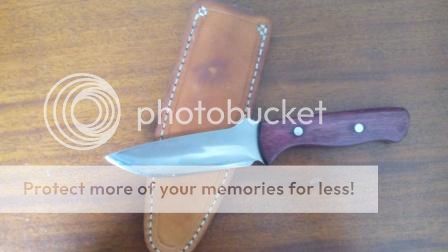
b1s_zpssstppsx4.jpg
 
Fun stuff. IMO, ALL convex grinds should start flat or as a series of flat "facets" Trying to do it from the get go on a slack belt leaves you with a grind that is oft times WAY too convex a sometimes narrower at the spine than say 1/4 of the way down the bevel. Bill Moran arguably popularized the convex grind amongst modern custom makers and on his knives, particularly the later ones, it is a very subtle full height convex.
 
I have found that if you aggressively remove material using a coarse water stone you will get a convex grind weather you like it or not. Just looking at the bow in the stone tells me this
 
Fun stuff. IMO, ALL convex grinds should start flat or as a series of flat "facets" Trying to do it from the get go on a slack belt leaves you with a grind that is oft times WAY too convex a sometimes narrower at the spine than say 1/4 of the way down the bevel. Bill Moran arguably popularized the convex grind amongst modern custom makers and on his knives, particularly the later ones, it is a very subtle full height convex.

^^Yep, I tend to do a full height flat grind and the convex the edge then blend it into the rest of the grind makes for a nice "thin" convex grind works very well and you can control the grind much better on the platen than the slack belt.

DR...
 
I still use the KMG rotary platen to do the convexing of the edge. On the kitchen knives that I have made, I do a initial full height or close to it flat grind down to about 1mm at the edge, a second flat grind from about 60% or so of the way up the bevel down to the edge and get it fairly close to final thickness, convex the edge and the area behind the edge up as much as say 3/8ths of an inch and then go back and blend or modify the transition between those two flats. and the top of the convex section. if I am really feeling frisky, I will do the S grind by putting a slight hollow under that transition between the first and second fat grind and blend and thin. For a pure convex grind, you could make more flats/facets like the Japanese sword polishers and Bill Moran did and then blend. Mr. Moran used to do that on a 12 inch stone grinding wheel and a Wilton Square Wheel grinder.
^^Yep, I tend to do a full height flat grind and the convex the edge then blend it into the rest of the grind makes for a nice "thin" convex grind works very well and you can control the grind much better on the platen than the slack belt.

DR...
 
I went through several changes doing convex grinds starting out on the slack belt. It was too thick of a grind/edge geometry. I got a rotary platen and did the total grind on that and still felt the geometry was too thick. I've settled on flat grinding about 75% of the grind then finish on the rotary platen. A flatter convex grind that is strong and cuts well.
Scott
 
The rotary platen is money well spent if you want to convex an edge or the entire bevel, plus it is great for stuff like handles!!!!!
 
i agree, the convex grind, to be effective shouldn't be seen as such... It should almost look like is a full flat to the edge.
Rolling an axe edge on a knife is just plain ugly and utterly ineffective...as in my first knives ;)
 
I can't see from the picture, but i didn't have the guts to regrind mine first attempts ;) I use them to have fun hacking at rebars!!
Even today mine main focus is to strive going thinner in the first steps of grinding...it seems thin enough, then i go and roll it and discover it wasn't :)
 
I can't see from the picture, but i didn't have the guts to regrind mine first attempts ;) I use them to have fun hacking at rebars!!
Even today mine main focus is to strive going thinner in the first steps of grinding...it seems thin enough, then i go and roll it and discover it wasn't :)
Do you think that I can just use my coarse waterstone and thin it a bit over time or will it just end up with the same profile?
 
That's what i do.
I use the stones for setting the edge, and i curse a lot when i find i left the bevel too thick, because it's doable but it requires much time.
If the edge is very thick i use the grinder sprayed with water to bring down the main bevel closer to what i aim to. I also bought a coarse eze-lap bench diamond stone to hog the material quicker, before switching to the finer whetstones.
Actually the most effective technique is having the main bevel thinner from the pre HT...just thick enough not to have problems in the quench, but you can grind post ht, just stay shy of overheating the edge, and for this reason i just spray the belt and dunk the blade in water every pass.

But i can't see how your edge looks like from the picture....maybe you could try the knife and possibly it is fine for the intended use.
 
Back
Top