If you go on the Abswebmaster channel on YouTube, there are a few videos on grinding.
In particular profiling knives with Jerry Fisk. It's short and doesn't go too much in depth, but he explains how to stand and position yourself at the grinder very well. That's the biggest thing to figure out right there.
Once you know how to stand, it's just practice.
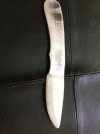
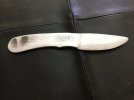
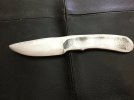
From the looks of your blade, I'd say the belt was dull, and you were rocking it from edge to spine, whether you noticed it or not. Sharp belts, and start at the edge and work your way down. I generally go back and forth from one side of the knife to the other rather than grinding one side at a time. I find it helps me keep things perfectly even, and and also reduces warpage in steels such as aeb-L that'll move on you just from grinding.
I start by scribing a pair of centerlines. I use a surface plate and height gauge, but a $10 pair of calipers works as well. I'll usually scribe the lines 20-30 thou apart.
After figuring out where I want the plunge lines to end up, I'll go about 1/8" in front of that, and use the corner of the wheel or Platten to make a little notch on each side. The blade edge tilted towards the Platten at about a 45 degree angle, and put the notch almost all the way to the scribe lines. This is more of a reference line than anything, and I do it because it's a lot harder to miss than a scribe line or sharpie mark. I'll then grind about a 45 degree bevel from that little notch to the tip on both sides, and grind it up within a few thou of the scribe lines. Until now this has all been done with a dull belt to avoid stripping the grit off a new one.
Then I'll put on a fresh belt and start working the grinds down on each side. I'll go back and forth between the two sides, and gradually work my way towards the spine. It'll start as a really short sabre grind, and gradually work to a full height grind. I find starting at the final bevel angle right away (as a jig would) makes it a lot easier to have ugly grind lines, or hit the flats, even digging into the spine.
The plunges are the last thing I worry about. I usually bring the point end slightly off the Platten or wheel ( to avoid two inch marks) and use either a jflex belt or a 3M gator belt to move the plunges exactly where I want them and even everything out. The gators in particular are my favorite. If you run it flush with the edge of the Platten it'll make for a very sharp transition. If you track it over as you would a jflex it can make as long and smooth a transition as you want. It chews up the edges of the gators some, but they still last long enough to end up being cheaper than using jflex belts. I find it harder to screw up with them as well.