- Joined
- Feb 26, 2002
- Messages
- 618
About one week ago I wrote in the Cantina asking for reviews of khukuris to cease until I received mine (tongue in cheek). I had ordered my first HI khukuri about a week and a half earlier but delivery to rural Australia can be slow. I couldn't stand hearing about how great other people's khukuris were.
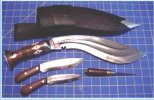
Well, the reviews can start up again - I have received my World War II khukuri. Uncle Bill, you may have to contact me though to arrange to charge me more. No matter which way I measure the length of the khukuri, it always comes out at 18 inches, not the 16 1/2 inch that I ordered - and considering you (Uncle Bill) had already waived the shipping costs during the previous sale, I feel a bit guilty about getting a more expensive knife at a cheaper price. It's an impressive khukuri and no matter which way I look at it I have a great deal and am quite happy to pay the extra.
As I mentioned in a previous post about one month ago, I originally picked up a secondhand 15 inch Sirupati (hope I spelt that correctly) cheaply on the Australian ebay. This is an impressive little khukuri but I wanted something new and a bit bigger for camping/bushwalking. I had started following the HI forum and enjoyed the comraderie and friendly banter that was a feature of the Cantina. I also realised that HI khukuris had no equal when it came to quality. I had to order one. Ash, a fellow Australian on the Cantina, had recommended a BAS for my purposes but being the stubborn *#!! that I am, I went ahead and ordered a World War II because I wanted something a little bigger that 15 inches.
Please excuse any non technical language I have used in my following description - I am still not all that familiar with the terms used in describing a khukuri. My first impression of the World War II was its sheer size compared to the Sirupati. It is a massive knife. At the time, I kept thinking that if this is a 16 1/2 inch World War II, what must be the size of the 18 inch. I also kept thinking that maybe it was a bit heavy for carrying on a belt when bushwalking (and it probably is, but I am sure going to try - as you will read below, I have come to love this khukuri), that was when I measured it and realised that I probably had the 18 inch.
The marking on the blade is of a half rising sun. I think that is the mark of Kesar. The khukuri is beautifully polished and the two smaller knives appeared to also be of good quality. The handle is wood and was stikingly similar to the Sirupati, except in size. All three knives fit the scabbard well. Perhaps compared to the Sirupati, the World War II is not held in as tightly. I have no idea if that is good or bad. The scabbard is well made and is of the modern type ie. no markings on the leather.
My first feeling I had included an element of disappointment that it was a little larger than I had envisaged. But then I took it outside to "prune" a willow tree that my wife disliked on our footpath. Our local council won't let you chop down trees on the footpath but they like people to keep them "pruned". The branches were approximately 4 inches in diameter. I started by cutting branches a little too close to the recurve. Eventually I realised that the belly was the best part of the khukuri for chopping. I also found my downward strokes at first to be very effective but not my upward strokes. But after a bit more use the upward strokes became just as effective. There was a definite feel to using the khukuri the correct way - I can't explain it any better than that. I can understand why the khukuri would be such an effective weapon in the hands of someone who had used them all their lives. I can now understand why the Gurkhas need minimal training in how to use the khukuri. Well I kept pruning, and pruning, and pruning, until my wife came out to see what I was doing. I was ordered to stop! In my enjoyment at using the khukuri and letting it teach me how to cut, I had cut down the whole tree except for 2 branches. My wife believed that I had perhaps gone a little overboard and was in danger of turning the "pruning job" into a tree demolition job. I think she is concerned that the local council will not be too impressed at my work. Despite my inexpert cutting technique, the khukuri was as sharp at the end of the chopping as it was at the beginning.
I am still not sure if this is the bushwalking khukuri that I wanted (but then that gives me an excuse for buying another khukuri at a later time doesn't it). I'll have to try it out and see if the weight becomes too much during a day's walk and outweighs its usefulness in that type of situation. It definitely is the camping tool I wanted though, especially for the times I can drive to a spot and set up a tent. It would have no trouble cutting up timber for the ideal size for cooking purposes. I can also see it's use for future "pruning" jobs - if my wife allows. Interestingly, my sixteen year old daughter's comment was that "YOUR" khukuri was too big and didn't have the fancy engravings on the blade like the other sweet one. I think it was her way of saying the Sirupati was hers now that I had the other brute. The Sirupati now resides in her bedroom - pity, I liked that little khukuri too.
Well, the reviews can start up again - I have received my World War II khukuri. Uncle Bill, you may have to contact me though to arrange to charge me more. No matter which way I measure the length of the khukuri, it always comes out at 18 inches, not the 16 1/2 inch that I ordered - and considering you (Uncle Bill) had already waived the shipping costs during the previous sale, I feel a bit guilty about getting a more expensive knife at a cheaper price. It's an impressive khukuri and no matter which way I look at it I have a great deal and am quite happy to pay the extra.
As I mentioned in a previous post about one month ago, I originally picked up a secondhand 15 inch Sirupati (hope I spelt that correctly) cheaply on the Australian ebay. This is an impressive little khukuri but I wanted something new and a bit bigger for camping/bushwalking. I had started following the HI forum and enjoyed the comraderie and friendly banter that was a feature of the Cantina. I also realised that HI khukuris had no equal when it came to quality. I had to order one. Ash, a fellow Australian on the Cantina, had recommended a BAS for my purposes but being the stubborn *#!! that I am, I went ahead and ordered a World War II because I wanted something a little bigger that 15 inches.
Please excuse any non technical language I have used in my following description - I am still not all that familiar with the terms used in describing a khukuri. My first impression of the World War II was its sheer size compared to the Sirupati. It is a massive knife. At the time, I kept thinking that if this is a 16 1/2 inch World War II, what must be the size of the 18 inch. I also kept thinking that maybe it was a bit heavy for carrying on a belt when bushwalking (and it probably is, but I am sure going to try - as you will read below, I have come to love this khukuri), that was when I measured it and realised that I probably had the 18 inch.
The marking on the blade is of a half rising sun. I think that is the mark of Kesar. The khukuri is beautifully polished and the two smaller knives appeared to also be of good quality. The handle is wood and was stikingly similar to the Sirupati, except in size. All three knives fit the scabbard well. Perhaps compared to the Sirupati, the World War II is not held in as tightly. I have no idea if that is good or bad. The scabbard is well made and is of the modern type ie. no markings on the leather.
My first feeling I had included an element of disappointment that it was a little larger than I had envisaged. But then I took it outside to "prune" a willow tree that my wife disliked on our footpath. Our local council won't let you chop down trees on the footpath but they like people to keep them "pruned". The branches were approximately 4 inches in diameter. I started by cutting branches a little too close to the recurve. Eventually I realised that the belly was the best part of the khukuri for chopping. I also found my downward strokes at first to be very effective but not my upward strokes. But after a bit more use the upward strokes became just as effective. There was a definite feel to using the khukuri the correct way - I can't explain it any better than that. I can understand why the khukuri would be such an effective weapon in the hands of someone who had used them all their lives. I can now understand why the Gurkhas need minimal training in how to use the khukuri. Well I kept pruning, and pruning, and pruning, until my wife came out to see what I was doing. I was ordered to stop! In my enjoyment at using the khukuri and letting it teach me how to cut, I had cut down the whole tree except for 2 branches. My wife believed that I had perhaps gone a little overboard and was in danger of turning the "pruning job" into a tree demolition job. I think she is concerned that the local council will not be too impressed at my work. Despite my inexpert cutting technique, the khukuri was as sharp at the end of the chopping as it was at the beginning.
I am still not sure if this is the bushwalking khukuri that I wanted (but then that gives me an excuse for buying another khukuri at a later time doesn't it). I'll have to try it out and see if the weight becomes too much during a day's walk and outweighs its usefulness in that type of situation. It definitely is the camping tool I wanted though, especially for the times I can drive to a spot and set up a tent. It would have no trouble cutting up timber for the ideal size for cooking purposes. I can also see it's use for future "pruning" jobs - if my wife allows. Interestingly, my sixteen year old daughter's comment was that "YOUR" khukuri was too big and didn't have the fancy engravings on the blade like the other sweet one. I think it was her way of saying the Sirupati was hers now that I had the other brute. The Sirupati now resides in her bedroom - pity, I liked that little khukuri too.


 COngrats on the new Khukuri