
My First Knife - 8" Chef in CruForge V

Joined
May 2, 2017
Messages
12
I've been wanting to make knives for quite some time and I've been lurking here for many months trying to pickup as much knowledge as I could before jumping in. This past weekend I finally made the plunge and made this knife. Since cooking is another passion of mine I started with a general purpose Chef's knife. I've owned many high-end commercial kitchen knifes and none of them match the performance of this one. Hopefully it holds up!
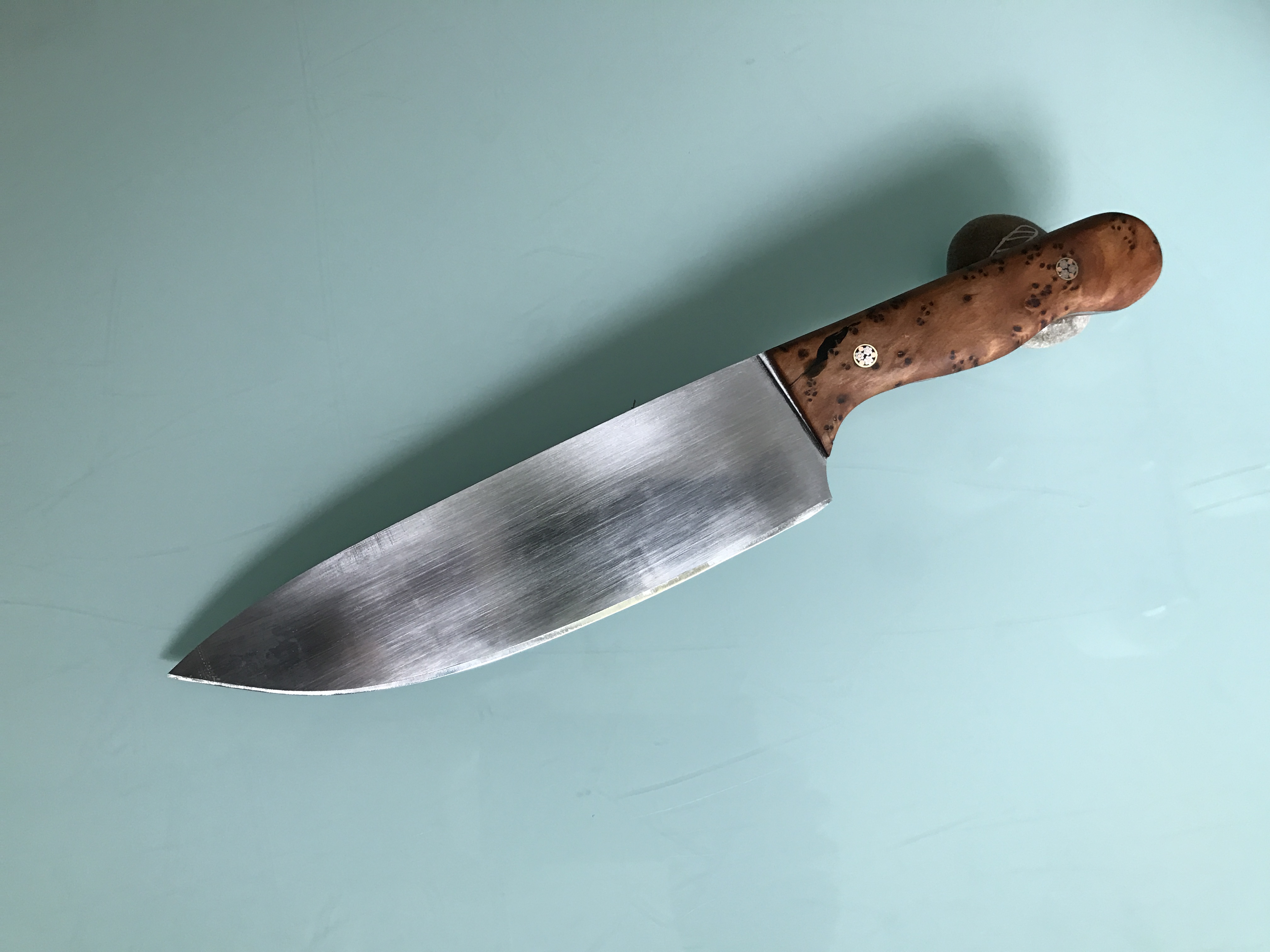
CExkx9I.jpg


As I'm just starting out, this was a stock removal blade and since I don't own a grinder the full flat grind was done with a file. This process was a complete girl dog. I picked this steel because it seems to have good wear resistance and is still something I could heat treat at home. If it stands up to day to day use the way it stood up to the file I think wear resistance will be just fine.

Hardening was done in my two brick homemade forge. I used MAP gas to get it up to temp as quickly as I could. Took it just past magnetic and then quenched in 150 deg canola oil. Two temper cycles in a 400 deg kitchen oven and then finish sanded to 600 grit (I may go finer but I'm not sure).

Handle is Thuya burl with mosaic pins I bought on Ebay.

So areas you guys could help me:

My finish sanding isn't great (the picture makes it look worse than in person) and for the life of me I couldn't figure out how to sand the scale at the plunge line without scratching the blade all to hell.

During quench, the blade warped about midway. I was able to remove the warp after tempering by over-clamping to a flat piece of steel with some pins and putting it back in the 400 deg oven. Came out perfect. What can I do to reduce warp in the future?

Do you think I need to soften the spine? Not sure a kitchen knife needs that.

Thank you to everyone here that's ever given advice. I'm now trying to figure out what organ I can live without to pay for a grinder!
 
Looks pretty nice! About all I would do is even up the curve heading towards the tip of the blade. The curve looks just a little uneven. Other than that, I like the handle and the overall look of the knife. Good work!
 
What thickness did the stock start out as? It looks to be on the thicker side, as the edge is pretty high up the blade. I prefer thinner stock (.098 is what I'm using mostly) for kitchen knives.
 
Finish sand the front of the scales before you put them on the knife,
 
In my opinion, no kitchen knife needs being draw tempered at the spine. Maybe a big bone chopping butcher cleaver but that should be tempered lower overall anyhow.

Nice looking chef's knife!
 
What thickness did the stock start out as? It looks to be on the thicker side, as the edge is pretty high up the blade. I prefer thinner stock (.098 is what I'm using mostly) for kitchen knives.

Yes, it was pretty thick .148 and I was worried about warping so I left the edge geometry a little beefy. I'm going to make a different knife for slicing tasks. This slices ok but at this thickness its more of a chopper which are most of the things I do in the kitchen. It took a chicken apart in no time as well. If I had it do all over again I might go a little thinner but not much. I like the heft and I'll make a much thinner knife for slicing.
 
Finish sand the front of the scales before you put them on the knife,
Yes sir, I did that. The problem I had was on the blade itself right at the plunge line. There is some black scale right there that I just couldn't get off.

Edit: I see where I was unclear in my original post now. When I said scale I meant black forge scale on the blade but I might be using the wrong name.
 
Last edited:
Looks pretty nice! About all I would do is even up the curve heading towards the tip of the blade. The curve looks just a little uneven. Other than that, I like the handle and the overall look of the knife. Good work!

I actually didn't notice that but you are right, it does have a little bit of a hook bill to it there. Thanks!
 
That's a fantastic "first". You will only get better. My advice would be to skip the 2x42 and go right to a 2x72 grinder. A grizzly can be had for under $600 shipped. I've seen some modified to run at slower speeds. No organs need be removed for that price.
 
That's a fantastic "first". You will only get better. My advice would be to skip the 2x42 and go right to a 2x72 grinder. A grizzly can be had for under $600 shipped. I've seen some modified to run at slower speeds. No organs need be removed for that price.

I was thinking about buying the grinder chassis from Oregon Blade Maker (they are local to me). I have been woodworking for 20 years off and on and have a spare 1.5 hp Leeson motor from an old bandsaw. I'm not super mechanical and I don't know how to weld but I think I can figure out how to make that one work.
 
That's a fantastic "first". You will only get better. My advice would be to skip the 2x42 and go right to a 2x72 grinder. A grizzly can be had for under $600 shipped. I've seen some modified to run at slower speeds. No organs need be removed for that price.


LOL, you lucky guys from.the US. The grizzly grinder is $954 Canadian. :confused:
 
OK I see the scale you are talking about, you need to make you a sanding bar with a 90 deg edge and wrap sandpaper around it tight to get into the plunge.
Do all sanding to the blade before putting on the handles, I know it is very tempting to get ahead of your self,we want to see the finished product.
But doing things out of sequence will actually take you longer trying to get it right.
Very nice for a first knife, actually much better than my first.
Now use that one and make another one ,but better this time.
 
OK I see the scale you are talking about, you need to make you a sanding bar with a 90 deg edge and wrap sandpaper around it tight to get into the plunge.
Do all sanding to the blade before putting on the handles, I know it is very tempting to get ahead of your self,we want to see the finished product.
But doing things out of sequence will actually take you longer trying to get it right.
Very nice for a first knife, actually much better than my first.
Now use that one and make another one ,but better this time.

Ah, I see now what I did. I used a brass bar as the sanding bar and I went and looked after I read this and noticed it does have a slight radius to the edge. I'll get a piece of phenolic and use that next time. Very helpful post. And thanks for the kind words. I spent so much time filing this very stubborn steel that I probably did rush a little at the end.
 
Yes, it was pretty thick .148 and I was worried about warping so I left the edge geometry a little beefy. I'm going to make a different knife for slicing tasks. This slices ok but at this thickness its more of a chopper which are most of the things I do in the kitchen. It took a chicken apart in no time as well. If I had it do all over again I might go a little thinner but not much. I like the heft and I'll make a much thinner knife for slicing.
Where did you get .148 CFV stock?
 
Back
Top