
My forge now runs on oil

Joined
Jun 11, 2006
Messages
8,651
well i installed the oil injector in my burner tube tonight and it works great. i did not take a picture of it before i installed it but i did do a drawing. here it is. it runnes off compressed air and it creates a vacuum on the oil line and the mists the oil into the forge. when its is running i can turn almost turn off the forge blower as it creates a ventury affect and draws in air. but i had it up to 2300 deg just running on oil. here is the drawing of what i made. i will be refineing the injector and building another one that does not use as much air. i will then take picture for you.

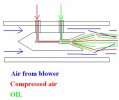
attachment.php
 

Attachments

  • forced oil.jpg
    forced oil.jpg
    19.8 KB · Views: 331
I made one similar to that one, but alot simpler, yours is much nicer. Man I swear those things can get beyond hot!! I mean dang HOT Quick!
 
JT that's pretty sick, venturis are pretty cool.

Another good trick is to pressurize a container 5-10 psi is fine. with the oil in it, and have a needle valve control fuel flow, then just have the oil piping open right at an air nozzle.

That way rather than draw a small vacuum you use less air since no vacuum is required.

Old LPG tanks are great.
 
well after much searching i found something that you can buy that does a better job then what i made. thats why i made mine was because i could not find one but after refining my search i Finley found something that will work. i will let you know how it works out.
 
Any chance that the oil residue could contaminate the welding of damascus?

Leadfoot
 
The way I have mine set up it does leave residue. Mine is a coil of tube wrapped around the burner tube and drops in just behind the flare tube. About every hour or two I have to knock the build up away from the the front of the flare tube and inside the forge. JT's setup may be different in that the oil is being sprayed into the forge.

I've heard copper can be bad for forge welding, there could be potentially copper residue in oil if a vehicle has worn bearings. Not sure if that would be an issue or not.
 
Why I ask, is that a friend burns used oil in a very large wood stove, it's a converted steam engine fire box. They drip the oil down into a large cast truck brake drum, with air blown in at an angle to create a vortex. It made a wonderful clinker in the bottom.

I'm guessing the clinker is the contaminates in the oil, at some point part of that has to be going into the metal being heated up. Mind you I'm occasionally wrong in my thinking.

Leadfoot
 
I accidentally let some of the klinker build up a little too much and managed to get a couple nice sized chunks. I tested them for continuity and they definitely conduct electricity.
 
I know very little about this, but if it is a waste oil forge, could the klinker possibly be metal particles from running the oil through an engine, that combine when all the oil is burned off?
 
I accidentally let some of the klinker build up a little too much and managed to get a couple nice sized chunks. I tested them for continuity and they definitely conduct electricity.

No metal needed for that. Carbon itself is very conductive. Carbon rods are often used in welders to melt metal and combine with an air stream it is a very fast way to remove metal. Wanna see something real bright with real sparks. LOL.
 
Oh, yea, sure there is in used motor oil. I wonder if the metal, being so small and exposed to the induced oxygen, would be burnt off in the flame. I think clinkers are formed by the combining of the trace elements like silica, graphite and trace metals with excess carbon. Some refineries make a type of calcite coke using carbon. I is almost impossible to ignite and much of it is used in the aluminum smelter industry, I believe as a type of flux. I think clinkers are of a similar composition.
 
Back
Top