
My knifemaking seems to be cursed- Updated

Joined
Jan 10, 2012
Messages
741
As the title says, I have experienced a number of dramatic setbacks in my knifemaking.
I will start this post with a "formal" introduction.

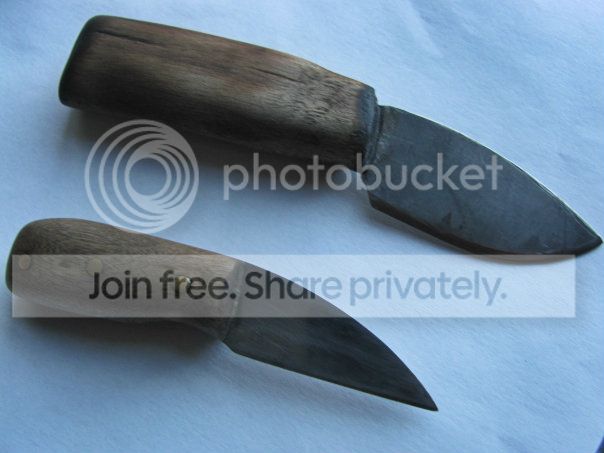
Hello, Forumites. I am a young "knifemaker" living in east Tennessee. Although an earlier thread I made claimed this as my second knife, I have made several "knife like objects" from 0.036" spring tempered 1095.
IMG_1318.jpg


Those are the first (the drop point) and the last (wharnie). There were a few in between these two but I can't find them;).
Anyway, back to the original point of my thread. I have had several problems with my knifemaking but this stands out to me the most: broken file guide, and then this

IMG_1311.jpg


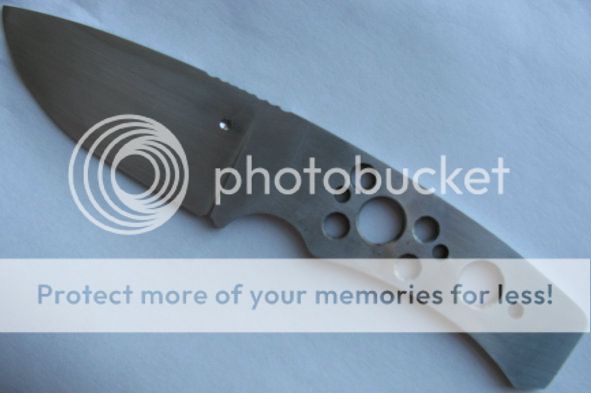
There are two major problems I had with this knife. Firstly, I screwed up the jimping. :mad:Then, it CRACKED :mad: :mad: :mad:
I have no clue how this happened. In an attempt to delay any troubles I might have with the knife, I spine tempered the knife and then I started to drill a hole at the end of the crack. I say "started to" because I could not get the drill bit more than 1/32" in. :mad: :(

Do you folks think this design is worth re-making?
IMG_1314.jpg


Sorry for my crappy writing. :(

Thanks for looking!
 
Last edited:
Do you think the file guide could have created the crack?
Did it crack before heat treat?
What was the heat treat?

You are doing a nice job but I have a feeling something is out of order with your process...

Nice lines and that is worth re doing for sure.
 
Do you think the file guide could have created the crack?
Did it crack before heat treat?
What was the heat treat?

You are doing a nice job but I have a feeling something is out of order with your process...

Nice lines and that is worth re doing for sure.
I don't think so...
No sir
Heat treat was done with a Oxy-Acetylene gas torch and Mcmaster 11 second oil.

Thank you very much! :thumbup: I appreciate it. :D

Now that I have created this thread and looked over it, I think I was over-reacting. :eek:;)
 
Last edited:
FleshWound:

Out of curiosity, what did you quench your blade in? The crack looks suspiciously like you used brine. Your thumb serrations are an easy fix - buy yourself a checkering file from Sheffield's Knifemaker's Supply. I use 20 lpi on tacticals like yours.....30 lpi on the hunters. Finish the spine before you heat treat, then fie in your serrations. Be careful when you final finish the blade as to not grind away your serrations.

You have a nice design there - keep at it. Check out the saying under my signature.
 
FleshWound:

Out of curiosity, what did you quench your blade in? The crack looks suspiciously like you used brine. Your thumb serrations are an easy fix - buy yourself a checkering file from Sheffield's Knifemaker's Supply. I use 20 lpi on tacticals like yours.....30 lpi on the hunters. Finish the spine before you heat treat, then fie in your serrations. Be careful when you final finish the blade as to not grind away your serrations.

You have a nice design there - keep at it. Check out the saying under my signature.
I used Mcmaster 11 second oil. I want to get a checkering file, but I am practically broke. :(
I have been finishing my spines, but it is nice to get confirmation that what I have been doing is correct. :)
Thank you! :) I like that quote, I must remember it.
 
I would look at what you did/didn't do during the time between quench and temper.

1) How long between Q and T?
2) Was anything done to the blade between Q and T? Clean up, straighten a warp, sand a little to see the shiny metal, put an edge on, drop on floor/bench.?

INFO:
1 hour at temper is probably OK, but two hours is preferred. If you attempted to straighten a warp after only one hour, you can expect it to break/crack.
Drawing to blue with the edge in water won't anneal the spine enough to drill it. That will spring temper the spine, which is still reasonably hard.
 
Also H/T with a torch is iffy at best,you more than likely overheated the steel causing the crack.11 second MC oil is fine for 1084,I use it,but I use a kiln for my heat source.My advise,make another but first put an edge on that one ant test it,then break it and look at the grain inside.Also post pic's of the grain and we will better be able to help.

Stan
 
One tip is that as a general rule do your hardening and tempering in a constant cycle. After quenching as soon as the steel has cooled to ambient it should go right into the temper oven.

This is just a guideline and does not apply to all steels. I thought I would mention it to help.

I find data sheets online for each steel I use direct from the manufacturer, they are immensely helpful. You will learn their perspective on heat treating the particular alloy, machinability, industrial applications, tempering and much more. I like to cross reference as many I can find while paying particular attention to the manufacturers notes on the exact steel I am using. This mostly applies to tool steels and the information is harder to find for simpler steels.

Great information here ---> http://www.cashenblades.com/steel/1084.html

Great choice going with 1084.

Keep up the good work!
 
Last edited:
I would look at what you did/didn't do during the time between quench and temper.

1) How long between Q and T? About four hours. My torch sucks so I use a torch at a friends machine shop. I also had to wait an hour or two because I had a meeting.
2) Was anything done to the blade between Q and T? Clean up, straighten a warp, sand a little to see the shiny metal, put an edge on, drop on floor/bench.?The only thing I did was sand it, while being very, very careful not to drop it.

INFO:
1 hour at temper is probably OK, but two hours is preferred. If you attempted to straighten a warp after only one hour, you can expect it to break/crack. It came out of the quench straight as an arrow, but cracked
Drawing to blue with the edge in water won't anneal the spine enough to drill it. That will spring temper the spine, which is still reasonably hard.
I tried to answer everything.

Thank you for helping everybody, I really appreciate it.
 
One tip is that as a general rule do your hardening and tempering in a constant cycle. After quenching as soon as the steel has cooled to ambient it should go right into the temper oven.

This is just a guideline and does not apply to all steels. I thought I would mention it to help.

I find data sheets online for each steel I use direct from the manufacturer, they are immensely helpful. You will learn their perspective on heat treating the particular alloy, machinability, industrial applications, tempering and much more. I like to cross reference as many I can find while paying particular attention to the manufacturers notes on the exact steel I am using. This mostly applies to tool steels and the information is harder to find for simpler steels.

Great information here ---> http://www.cashenblades.com/steel/1084.html

Great choice going with 1084.

Keep up the good work!
Thank you! That was a very helpful link!:thumbup:
 
For what it's worth, I asked a very similar question, because I had cracks starting from the top of a finger choil, but basically the same darn thing.

I think that the biggest difference in that batch of knives, was that I didn't anneal them before grinding. I ground them from a normalized state, and hardened them. No thermal cycle between grinding and hardening either.

I think I screwed up both those things.

Now I anneal from 1250* for two hours, cool in oven to 800* and quench in Houghton 11 second.

Then I grind and full normalize, and stress release with LN, before I harden the blade.

Another precaution I take is to smooth the inner raceway and buff the sharp corners off the... rims, I guess.

The cracking is obviously starting at a microscopic level. If the choil isn't smooth and completely burr free, it seems like it's inviting a microscopic crack, which has the propensity to grow.

Even if a blade doesn't crack, it's pretty easy to see what a stress riser any choil can be, so now I'm doubly careful.

I have no idea whether we did something the same, but thanks for showing me that even a sharpening choil can have the same effect.
 
Scotchrite belts are nice for rounding everything just slightly before heat treat.

As a note I have only had one blade in about 200 crack this year and it was a very aggressive brine quench on a thinly ground (but thick at the spine) clay coated blade. I had heat treated it once already and the upward curve was dramatic, probably 1/2" over the 9" blade!

But I have a kiln and do not forge so my circumstances are much different...
 
For what it's worth, I asked a very similar question, because I had cracks starting from the top of a finger choil, but basically the same darn thing.

I think that the biggest difference in that batch of knives, was that I didn't anneal them before grinding. I ground them from a normalized state, and hardened them. No thermal cycle between grinding and hardening either.

I think I screwed up both those things.

Now I anneal from 1250* for two hours, cool in oven to 800* and quench in Houghton 11 second.

Then I grind and full normalize, and stress release with LN, before I harden the blade.

Another precaution I take is to smooth the inner raceway and buff the sharp corners off the... rims, I guess.

The cracking is obviously starting at a microscopic level. If the choil isn't smooth and completely burr free, it seems like it's inviting a microscopic crack, which has the propensity to grow.

Even if a blade doesn't crack, it's pretty easy to see what a stress riser any choil can be, so now I'm doubly careful.

I have no idea whether we did something the same, but thanks for showing me that even a sharpening choil can have the same effect.
I use files and sandpaper. So I have no chance of introducing stresses into the steel. But the thing about removing the burrs and sharp edges makes a lot of sense and I will round and deburr all my corner's now. Thank you :thumbup:

Scotchrite belts are nice for rounding everything just slightly before heat treat.

As a note I have only had one blade in about 200 crack this year and it was a very aggressive brine quench on a thinly ground (but thick at the spine) clay coated blade. I had heat treated it once already and the upward curve was dramatic, probably 1/2" over the 9" blade!

But I have a kiln and do not forge so my circumstances are much different...
I do not have a belt sander, would a scotch-brite belt used by hand help me? I don't forge either. :( I wish I could. I need to get a kiln. ;) Thank you for all your help so far. :thumbup:
 
Last edited:
I use files and sandpaper. So I have no chance of introducing stresses into the steel. But the thing about removing the burrs and sharp edges makes a lot of sense and I will round and deburr all my corner's now. Thank you :thumbup:

I do not have a belt sander, would a scotch-brite belt used by hand help me? I don't forge either. :( I wish I could. I need to get a kiln. ;) Thank you for all your help so far. :thumbup:

You can go over it by hand with 400 grit paper. I usually keep some paper around the grinder to knock of the occasional burr when grinding so I don't have to do a belt change. By hand is just as fast.

Equipment is nice in knifemaking but not critical at all, in fact I feel if I wanted to make knives as a hobby I might do most of it on my porch with files just like I did when I started.
 
I am not experienced enough to give any advice and have only completed a few knives that I have even show anyone.

That said, I can only encourage you to keep at it and listen to the wondeful info and advice you'll get here.
 
Back
Top