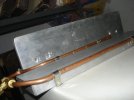
My new air quench plate

Joined
Dec 25, 2004
Messages
1,363
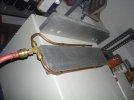
I was blowing air by hand using compressor but it was not satisfactory, first air was not uniform second it took a while to but the blade between plates and then grab the blower. Why not to put the air between the plates constantly blowing I thought (Ok not a good grammar I guess), I built this...

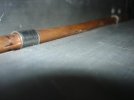
I cut some copper tubes and placed in between the plates. The holes cut just a bit above the plate, so they will directly blow the air to the blade. Holes are tapered so the air flow is spreading. Plates then will be placed on vise jaws (the vise I got from neighbor traded with a knife: Here is the story :) http://www.bladeforums.com/forums/showthread.php?t=591459)

Not so fancy but it will help to cool faster I hope...
 

Attachments

  • DSC01874 (Medium).JPG
    DSC01874 (Medium).JPG
    46.4 KB · Views: 239
  • DSC01877 (Medium).JPG
    DSC01877 (Medium).JPG
    45.3 KB · Views: 206
  • DSC01876 (Medium).JPG
    DSC01876 (Medium).JPG
    27.7 KB · Views: 134
Setting here thinking about it I believe you are on to something worth pursuing it sound like a good idea. Great photographs of your set up and thanks for showing them to us all. :)
 
Fantastic! I would only make a few of suggestions (if you have the means):

1. Drill holes on one side offset from the holes on the other side to create a more uniform flow.

2. Use an actual pipe bender for the bends to maximize air flow. The light crimping you have in the bends might cause more back pressure on one side or the other.

3. Use fittings with plugs on the ends of your tubing to prevent any possible air flow out. Or solder / braze the crimps.

4. You might also extend the tubing around the end of the plates so the air flow encircles the entire blade.

Really cool (no pun intended!) idea.
 
Fantastic! I would only make a few of suggestions (if you have the means):

1. Drill holes on one side offset from the holes on the other side to create a more uniform flow.

2. Use an actual pipe bender for the bends to maximize air flow. The light crimping you have in the bends might cause more back pressure on one side or the other.

3. Use fittings with plugs on the ends of your tubing to prevent any possible air flow out. Or solder / braze the crimps.

4. You might also extend the tubing around the end of the plates so the air flow encircles the entire blade.

Really cool (no pun intended!) idea.

Thanks guys. It was came from necessity. I've done with what I had in shop. But sure it can be improved. TekSec, you are right but I tried the first option, and it was not good. The drill hole project the air so some gaps in the air flow occurs in between. I tested it with a piece of plastic at the center line, this setup keeps the plastic piece around the center when air pumped. But I have also built a rectangle with small drill holes, there were some gaps and irregularities, to avoid these gaps I drilled more but then the pressure dropped too low. I guess the most appropriate design would be a powerful compressor and full rectangle pipe, each edge connected individually to the compressor and a continuous hair thick cut with dremel. But it requires real powerful compressor...

Regards, Emre
 
I'm not sure I undrestand the rationale. You could cool them really fast in liquid nitrogen. (But of course, they'd shatter when you put them in).

Why do you want faster? Simple plate quenching works great.

Your idea is interesting - but sometimes, too much of a good thing..... :(

Rob!
 
I'm not sure I undrestand the rationale. You could cool them really fast in liquid nitrogen. (But of course, they'd shatter when you put them in).

Why do you want faster? Simple plate quenching works great.

Your idea is interesting - but sometimes, too much of a good thing..... :(

Rob!

Thanks for the sarcasm, I didn't thought of that, I guess I will give it a try...

First it is suggested for D2 I use by the producer (BOHLER). It is possible also to quench it with oil, which would be my first choice but deformation risk is bigger...

Second, the quench rate is discussed here. I was thinking just like you but as Nathan and Mete explained, the corrosion resistance defined by the quench rate. For D2 this is very important as some knives I made tend to produce a patina in time but some doesn't. I was not sure why it was like this.

Lastly; I shared my idea with you. I might not to, I'm not forced to share, and you are not forced to apply. For years people in this forum shared ideas and experience with me without any expectations. I only wanted to give something in return...

Thats all.

Emre
 
Emre,

I don't think Rob meant any harm with the statement, I think he was just saying that he's found that straight quench plates work well. To each his own. For what it's worth, I think you have a great idea and I know many people have had issues obtaining the cooling rates they need with just plates. Your idea may be the solution they are looking for!
 
I think that most of the problem people have with plates only is that the plates are really effective alone only where they are in contact with the blade.
The adding the air injection will help cool those parts oof the blade no in cntact with the plates.
As for running the air in from all four sides of the plates... no gain there, as you then have no avenue for the air to flow.
in on the sides and out the ends is where the airflow is in your setup. Looks good.
 
Thanks for the sarcasm, I didn't thought of that, I guess I will give it a try...

First it is suggested for D2 I use by the producer (BOHLER). It is possible also to quench it with oil, which would be my first choice but deformation risk is bigger...

Second, the quench rate is discussed here. I was thinking just like you but as Nathan and Mete explained, the corrosion resistance defined by the quench rate. For D2 this is very important as some knives I made tend to produce a patina in time but some doesn't. I was not sure why it was like this.

Lastly; I shared my idea with you. I might not to, I'm not forced to share, and you are not forced to apply. For years people in this forum shared ideas and experience with me without any expectations. I only wanted to give something in return...

Thats all.

Emre

And you have done a good job in passing on information.
Thank You
Richard
 
Thanks for the sarcasm, I didn't thought of that, I guess I will give it a try...

Emre

Sorry Emre

No sarcasm intended. I was serious that I didn't understand the rationale. I used the liquid nitrogen as something I thought would clearly illustrate the concept of 'too much of a good thing'. It wasn't intended as an insult.

Thanks for the links in your response. I'll follow them and seen if they explain it for me. Just wanted to get the apology in first.

Rob!
 
jsut a little FYI
i jsut plate quenched some O1 3/32 sheet stock kitchen knives
there was no bevel set on them sept for the 45degree grind to get them started (keeps em from stripping all the grit right off a belt )

guess what

hardness was checked to within .5 of a point compared to a parks 50 blade in the same heat treat after tempering (next test will be with cryo before temper to see if i can get back that .5 point)

if your doing air cool blades unless you are doing some kind of wild deep grind i don't thing you need to worry
 
Thanks guys,
Rob, I was in a hurry and tired, 5 hours of hand sanding and polishing. Really I was not in a good mood and did find your post somewhat rude, but now I read it again after relaxing a bit, sorry I surely offended easily. It was a sincere question....

You dont need to apologize, it was my fault to misunderstand your simple question. Sorry...
 
jsut a little FYI
i jsut plate quenched some O1 3/32 sheet stock kitchen knives
there was no bevel set on them sept for the 45degree grind to get them started (keeps em from stripping all the grit right off a belt )

guess what

hardness was checked to within .5 of a point compared to a parks 50 blade in the same heat treat after tempering (next test will be with cryo before temper to see if i can get back that .5 point)

if your doing air cool blades unless you are doing some kind of wild deep grind i don't thing you need to worry

Butch, it is really interesting, I was thinking of copper plates for oil hardening steels plus air blow, your input is a very good info, I'm glad someone tested the idea. The thickness of the blade is very important I guess...

I'm making almost all my blades tapered from head to toe. The problem is not only some parts of blades are not contacting the plates because of taper but also if I don't blow pressure air the parts not contacting the plate tend to bend some. The alternative way would be to quench it in still air but this result some reduction in corrosion resistance for thick blades. This above solution is the only reliable way to quench my D2 blades I could come with. Most of my customs sold are kitchen knives and many reed knives and most users look for stainless steels, I have only D2 stock to work with (search for good SS steel in Turkey continues for years for me)..

Thanks for replies...
Emre
 
do you just lay the blade on the plate flat and put the other plate on top?
I have mine in a vice and slide the blade in between the plates and tighten the vice.
 
do you just lay the blade on the plate flat and put the other plate on top?
I have mine in a vice and slide the blade in between the plates and tighten the vice.

I use vise also, but it is not vertical vise, so it is somewhat challenging to put it in between. This is the only vise I have for the time so I cannot modify it. But hopefully tomorrow I'll have my plate vise tomorrow because my trade hunter is finished here... :cool::D

Emre
 
Back
Top