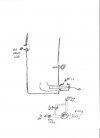
Play with it and see what happens, but the placement of the thermometer will probably give erroneous readings.
Here is how I would have configured that tank for agitation, heating, and temperature readout.
The side diverted port ( where the thermometer is now) location should be for the oil return line of the agitation pump. The oil agitation pump incoming line should be where you have the heater. There should be an inside "J" tube on that port to cause the agitation to be directed straight up the middle of the tank.On the outside of that port, install a "Tee" fitting, with the through part ( top of the "Tee") straight into the tank. The heater will go on the other end of the "Tee" top sticking in toward the tank, and the pump incoming line will be on the "Tee" side port. You may need to add nipples and fittings as needed.
The thermometer should be in the middle hole of the tank.
You can use any sort of low to medium volume oil transfer or a circulation pump for this task. A by-pass line and valve (by-pass loop at the pump) will allow regulation of the amount of agitation.
By using this setup:
1) The oil is heated as it enters the tank bottom, assuring evenness of heating (no reliance on convection).
2) The oil creates a vertical agitation vector which is beneficial to the evenness of the quench. The use of the diverted side port for the return creates a lesser circular vortex, thus further assuring evenness of heat distribution, without adversely affecting the vertical direction of the agitation flow.
3) The temperature probe is reading the oil temperature directly at a point approximate to the quenching area.
4) The possibility of striking the heater element with a long blade during a quench is eliminated. ( not a big issue, but one to consider and avoid if possible)
5) With a circulation pump, future use of an oil cooler in the circulation line will be an easy add-on.
Draw this out on paper and see if it isn't a more appealing arrangement for your "Super Quench Tank"
Stacy