My Newly Built Knife Forge

Rick Marchand

Donkey on the Edge
Moderator
Joined
Jan 6, 2005
Messages
9,680
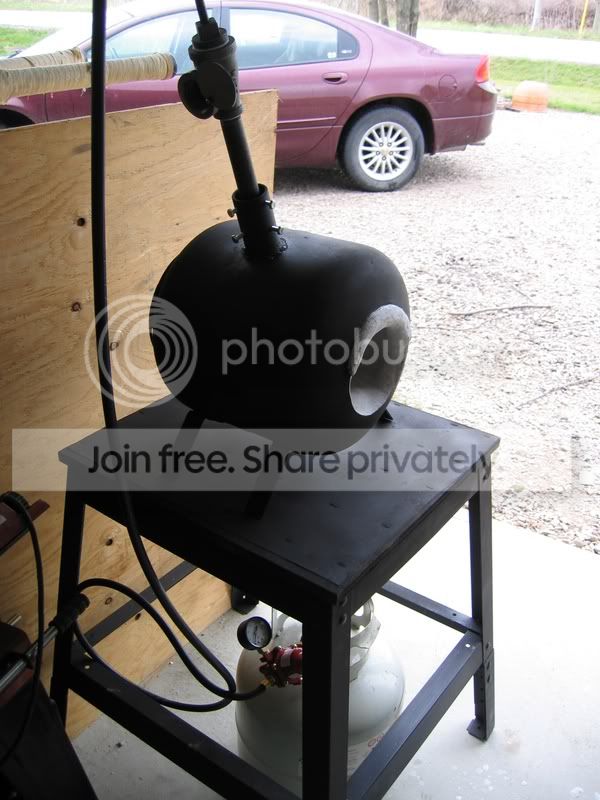
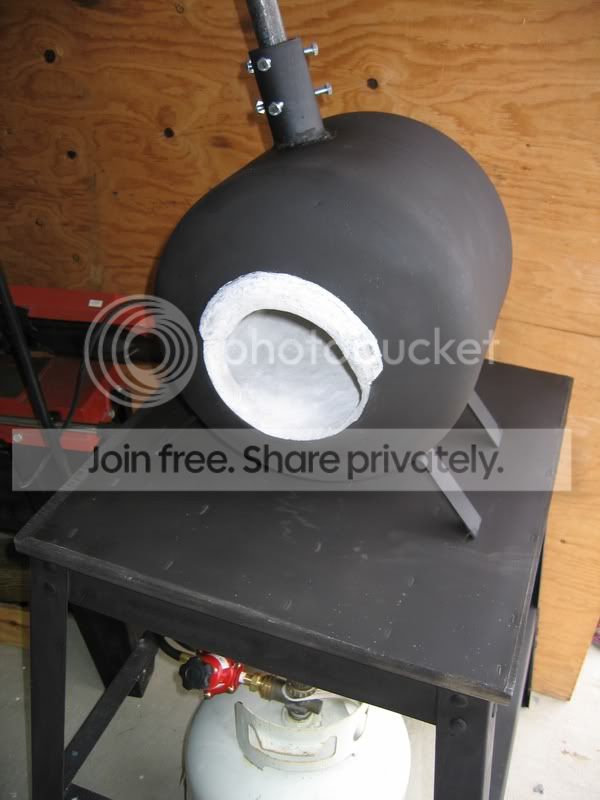
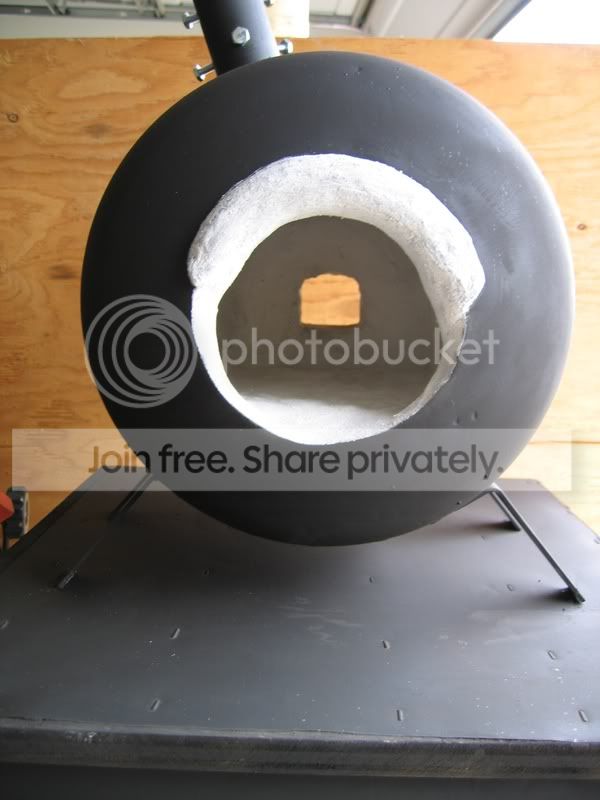
I made this last Friday. No plans... just a "vision" of how I wanted it to look and from seeing others on the web. The burner is a Larry Zoeller Side Arm Burner and the body is an old propane tank. Wally Hayes (Master Bladesmith) made an identical one that day, too. There are slight differences between the two but essentially they are twins. The one in the pics is mine. Very efficient.... Whatchathink?

Rick

ForgewithZoellerSideArmBurner.jpg

PropaneTankForge.jpg

PropaneTankForgeInside.jpg
 
That is a very professional looking job. I would be pleased to have it.
An attached work rest mab be usefull

On mine I have welded a 1/2 inch internal diamiter pipe down the side. I made an L shaped 1/2 inch rod that I slide in. I have a 3/8 nut welded to the front side of the 1/2 inch pipe with a bold through it to clamp onto the L shape.

A slide in rest is easier than a stand. I also have a hinged door to fold in to stop the heat loss. Both items are not needed but I like to have them.

If you have any problems with that burner MUNGO PK from Winerpeg has a easy version to make with less complications.

I can't post photos here if you want to see how rough mine is and the stand
rellery@iinet.net.au
 
Not a bad start!

What is the inner line made of? Also, I would very much like to see some photos of the forge in action.

The reason I mention these two bits is to ascertain the use and expectations of the unit in question. It appears that the burner enters the forge at a fairly steep angle (across the forge body). This kinda defeats the purpose of the cylindrical, horizontal design.

The horizontal cylindrical forge has really only one advantage over square bosy or vertical designs, that being the ability to keep the workpiece out of the flame front, where oxygen levels are high enough to cause large amounts of scaling and decarb. With a flame that points across the chamber, this advantage is almost completely defeated.

Also, this advantage is almost completely nullified in a ceramic wool only forge, even with a floor of hard firebrick. In order to take full advantage of the cylindrical / horizontal design, the inner liner should be a refractory with a higher thermal mass than ceramic wool, which is used to insulate the refractory. Being more durable than the wool insulators is a major plus to long term use as well, otherwise, you would be as well off using a coffe can and a propane torch.

I don't mean to seem overly critical, and I'm not trying to be a dick about it. You did a MUCH better job than my first three forges, and I'm quite sure it'll work beautifully for everything you want it to do and more. However, there is a lot of information about forges and forge construction floating around, and I would like to see the level of expectation in general raised a notch. There are some square body forges originally presented as competition farrier's units being ponned off as knifemakers forges at two to three time the price one could build a forge for, and if someone didn't know there was a difference, they could easily be taken over a barrel.

You, on the other hand, have taken it on yourself to build your own. Thus showing both the inginuity and, frankly, the wisdom to understand your tools and make what you want the way you want it. Not to mention the patience to learn the principals involved and the frugality / intelligence to save not insignificant amounts of money when you could have spent twice as much and just purchased an inferior product.


I do have a question, though. If you have the patience to humor an idiot ike me, who had had more to drink tonight than I should have. I have wondered from time to time on the chimney effect that having an upswept burner might or might not have on the flame in a setup like yours. I read somewhere ( I cannot recall quite where) that a burner should come in from the side or underneath to avoid having pressure and / or flame problems that might arise if the burner were to come in from the top. I have not seen any confirmation nor denial of this effect from any other source, and wonder from time to time at the validity of the argument. If you've any input on that front, please do share.

 
The inside has been coated in refractory material.... 2" of 8lb Kaowool and finished with 2 coats of Plistex 900F. A friend suggested I put that bit of refractory above the front opening to keep the flames from licking the shell and disorting it over time. I have heard that you can fire it up before plistix dries completely but I'm gonna wait a bit so I don't mess it up.

I still need to make a door for the 2.5" through hole in the back.

You can purchase the 8lb Kaowool on Larry Zoeller's site at $7/ft. (2ft width).... We are making a few forges so I found another source that sells a 2ft x 25ft roll @ roughly $4/ft.... sorry none to spare!

I had it running before I coated the Kaowool and (from a cold start) it heated a 1/4" thk piece of mild steel to bright yellow in under 2 minutes. With the cavity/burner ratio I estimate it gets to about 23-2500F at 7lbs running pressure. (welding temeratures) and forging temps at 3lbs. Larry Zoeller (as well as many other forge makers) suggests a 10-20 deg angle toward the center of the cavity for a working forge. This allows you to focus the flame on certain areas of the piece for a quicker heat. Also there is less of a swirling effect in the cavity which according to most Mastersmiths is undesirable for heat treat. Having said that, I will also be making a heat treat forge with a slightly different design to allow for a more even heat with little to no swirling.

This is the 3rd forge I have made and I tried to do as much research as I could to make the best one for its intended use. there is so much info out there that is difficult to come to one decision... so I went with what I felt would work best for me.

Thanks for the comliments and critical input.... both are appreciated.
Rick


Here is a pic of the burner set up along with a link to where I got it from...


http://www.zoellerforge.com/sidearm.html

nate-forge-3.jpg
 
Very cool indeed. I'm making my "mark 4" coffee can forge. Verticle fired using hybrid fuels (charchoal, waste oil, paraphine, etc.)

The refractory is on the outside of the can to insulate the works. Speaking of "works" I'll let you know if it does.

When the current can goes away, I'll either slide a new can in it's place or not. We'll see.

Jim L.
 
Back
Top