My (short) 1095 hand forged santoku

Joined
Feb 7, 2013
Messages
204
I forged it out of a small piece of 1/4"x1-1/4"x 4" 1095. Lots of deep pitting that I couldnt seem to avoid even with water forging towards the end.

took a long time to get it roughly to shape but the labor was worth it. When I tried to forge in the drop point it simply wouldnt move so i used the bandsaw and cheated a little bit and then forged it in nicely.

ouus93.jpg


After i had it forged to shape i wanted to make the hamon. I did some research on how to do it and I didnt really have the equipment for the exact science so I winged it.

I used APG 36 refractory cement and coated the blade. I coated the VERY tip of the edge extra , so the edge wouldnt break or crack on my first quench. (you really cannot tell from the picture)

20uqqom.jpg


I had a problem with the refractory clay cracking both outside and inside the forge and decided nothing could be done right this minute to remedy that so i moved on.

I got some water and I read somewhere to get it to around 100 degrees when you quench in it , so i heated up water on the stove to right before boiling and poured it into the quench bucked and brought it outside.

I put the knife in the forge and waited until the clay was a good orange color and kept it there for a few minutes (no timer) and took it out of the forge before i quenched it to let the blade cool to a more cherry color.

When all was ready i vertically dipped the blade for about 1 1/2 to 2 seconds in water (So i dont break the edge that is ground quite thin) and immediately quenched FULLY into room tempature oil.

This is what i got (after i polished and everything)

1zm36l2.jpg


a pretty incomeplete hamon but its there I guess. I think what happened is either my water quench was too short by around a second , or the clay did not hold up and the water got into cracks in the clay.

But other than that it was arrow straight after the quench and I had already heated up the oven to around 400 so I threw the blade in there and flipped it every 30 minutes for an hour.

Waiting on custom cut peices of leapordwood to get finished tomorrow for the handles.
 
I think maybe the angle of the pic makes it difficult to see the temper line.
Eddie
 
I think maybe the angle of the pic makes it difficult to see the temper line.
Eddie
its very very subtle , i wouldnt even call it a "line" as its more of a cloud.

It looks more like skin oil or leftover polish than it does a hamon.
 
JZ, I'll give you props for going ahead and trying it out. I had actually typed out some thoughts, but I hesitated to post them for the sake of being nice. If you're looking for feedback, I'll be glad to oblige, but don't take it the wrong way. It is not intended to be insulting or offending, but rather, it is intended to be critical in an attempt to provide constructive feedback.

I'll start with the shape. This is highly subjective, but my first thought is that the overall shape is unrefined. When I look at a santoku, I see an elegant, purposeful shape. I can't put my finger on it, but where your blade profile transitions down toword the poing, it just seems too abrupt of a change or too flat just prior to the spine meeting the tip. It looks like a fat clip-point more than it does a santoku.

Next is finish. You mentioned your forgeing pits. I don't think that these are from scale being pounded in, but they may be more a result of poor hammer control. When working with thin steel, it takes finess to make sure to not pound in deep marks that cannot be ground out. Most start with a bit thicker steel to have some sacrificial material to clean things up. Also, what is your finishing method? If it is a grinder, you've left many deep scratches in place that affect the overall quality of the finish and are still evident in the final product.

I'm not sure what method you used to get to your final edge, but it appears that the bevel only extends about 1/2" up from the edge? Extending the bevel up to meet the spine will help.

For your heat treatment, my gut tells me your clay was too close to the edge and likely resulted in less than adequate hardening. This is hard to say as a lot depends on time and temperature and temperature control. The clay wash you used appears fairly thick as well which may have slowed down the cooling of your edge. I'm not a water quencher, but using water heated to nearly 200F seems too hot. As far as that goes, most people heat the oil to decrease viscocity, which is mute with water. Maybe someone with more water experience can add to that point.

I think the reason we cannot see your hamon is the angle of photograph as well as the finish of the blade if there is even a hamon present. For a hamon to show, you really want a uniform finish which you do not appear to have. A clean 400 grit finish will help it show a great deal more.

Anyway, these are just some thoughts. It's great that you're trying things out, but you want to work on your overall finish quality. Also, do some more fine tuning in your processes. Creating hamon is fun, but it's not a science and takes a bit of practice and finess. I think you should spend your time focussing on other areas of your process (forging, finishing, etc) before worrying about hamon. Hope that helps and doesn't discourage too much. That knife doesn't look too far off of my first 1-2 attempts. Just make each progressive one better than the last. If something about it bothers you, you're not done.

--nathan
 
Like Nathan, I clicked on and then clicked the back-button without comment. Please take this as constructive, and use it on the next one. I will just be brief on the problems:
Shape - It looks about half way done and certainly not anything like a santoku. It is twice or more the thickness it should be, for one thing.
Forging - I will be willing to bet you forge way too cool, and are using a poor hammer. A smooth anvil top and a smooth hammer used on 2100F steel will make a smooth and flat surface. Things will move like it was clay.
Finish - There isn't much of any. Why would you have a food prep knife that would be a health hazard in the pitted surface.
Bevel - See above first sentence.
Hamon - I would suggest you read a good tutorial on yaki-ire. I have posted on that subject a good bit, and that should be available by search. The procedures you used are not complete or exactly right. The quenchant should be 3 pounds of salt to five gallons of water.

What are you using to heat the blade when forging and for HT.
 
JZ, I'll give you props for going ahead and trying it out. I had actually typed out some thoughts, but I hesitated to post them for the sake of being nice. If you're looking for feedback, I'll be glad to oblige, but don't take it the wrong way. It is not intended to be insulting or offending, but rather, it is intended to be critical in an attempt to provide constructive feedback.

I'll start with the shape. This is highly subjective, but my first thought is that the overall shape is unrefined. When I look at a santoku, I see an elegant, purposeful shape. I can't put my finger on it, but where your blade profile transitions down toword the poing, it just seems too abrupt of a change or too flat just prior to the spine meeting the tip. It looks like a fat clip-point more than it does a santoku.

Next is finish. You mentioned your forgeing pits. I don't think that these are from scale being pounded in, but they may be more a result of poor hammer control. When working with thin steel, it takes finess to make sure to not pound in deep marks that cannot be ground out. Most start with a bit thicker steel to have some sacrificial material to clean things up. Also, what is your finishing method? If it is a grinder, you've left many deep scratches in place that affect the overall quality of the finish and are still evident in the final product.

I'm not sure what method you used to get to your final edge, but it appears that the bevel only extends about 1/2" up from the edge? Extending the bevel up to meet the spine will help.

For your heat treatment, my gut tells me your clay was too close to the edge and likely resulted in less than adequate hardening. This is hard to say as a lot depends on time and temperature and temperature control. The clay wash you used appears fairly thick as well which may have slowed down the cooling of your edge. I'm not a water quencher, but using water heated to nearly 200F seems too hot. As far as that goes, most people heat the oil to decrease viscocity, which is mute with water. Maybe someone with more water experience can add to that point.

I think the reason we cannot see your hamon is the angle of photograph as well as the finish of the blade if there is even a hamon present. For a hamon to show, you really want a uniform finish which you do not appear to have. A clean 400 grit finish will help it show a great deal more.

Anyway, these are just some thoughts. It's great that you're trying things out, but you want to work on your overall finish quality. Also, do some more fine tuning in your processes. Creating hamon is fun, but it's not a science and takes a bit of practice and finess. I think you should spend your time focussing on other areas of your process (forging, finishing, etc) before worrying about hamon. Hope that helps and doesn't discourage too much. That knife doesn't look too far off of my first 1-2 attempts. Just make each progressive one better than the last. If something about it bothers you, you're not done.

--nathan

Thank you for the feedback , its alright you can be as blunt as you want as long as its purposeful.

As for the shape , like I said I tried forging in the clip point but the steel was too thin already and was folding over when i tried , so I used the band saw and cut a flat clip on there and ground it abit.

The pitting is more than likely a mixture of both , I got MOST of the scale off but im pretty sure during forging i made a "dish" where the center of the blade is thinner than the rest and those are hammer gouges or peen marks from trying to spread out the metal.

Also the "grinder" im using is a flipped upside down belt sander. Its not very powerful and requires lots of time to use. Its nowhere efficiant enough for knife work but its all I have. The scratches are more than likely from me trying to remove the scale with a small knife , It was lack of judgement and patience.

As for the clay , the part on the edge was not thick at all , it just looks that way , it was a slurry coat. The water was more along the line of 150 degrees as It was cold outside and it cooled for like 15-20 minutes.

The finish is up to 2000 , I thought the higher the finish the more visible the hamon?
 
Like Nathan, I clicked on and then clicked the back-button without comment. Please take this as constructive, and use it on the next one. I will just be brief on the problems:
Shape - It looks about half way done and certainly not anything like a santoku. It is twice or more the thickness it should be, for one thing.
Forging - I will be willing to bet you forge way too cool, and are using a poor hammer. A smooth anvil top and a smooth hammer used on 2100F steel will make a smooth and flat surface. Things will move like it was clay.
Finish - There isn't much of any. Why would you have a food prep knife that would be a health hazard in the pitted surface.
Bevel - See above first sentence.
Hamon - I would suggest you read a good tutorial on yaki-ire. I have posted on that subject a good bit, and that should be available by search. The procedures you used are not complete or exactly right. The quenchant should be 3 pounds of salt to five gallons of water.

What are you using to heat the blade when forging and for HT.
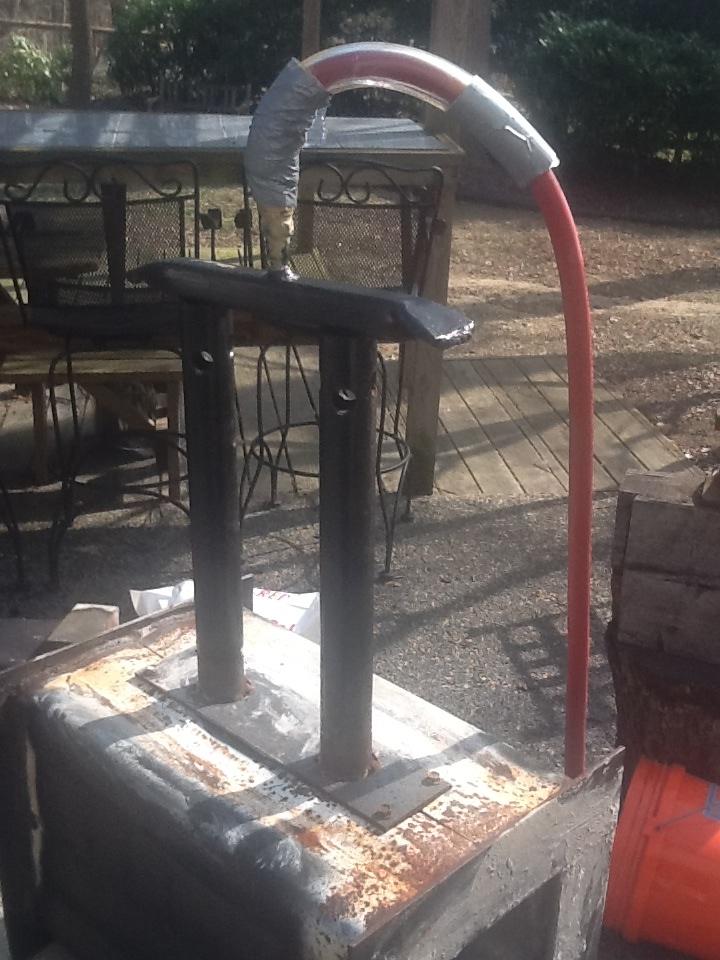
Im using a ebay 2 burner gas forge and forging in the orange range (when inside the forge) im forging in sunlight so its very difficult to tell where I am as it will go to orange to dull cherry once it hits the light.

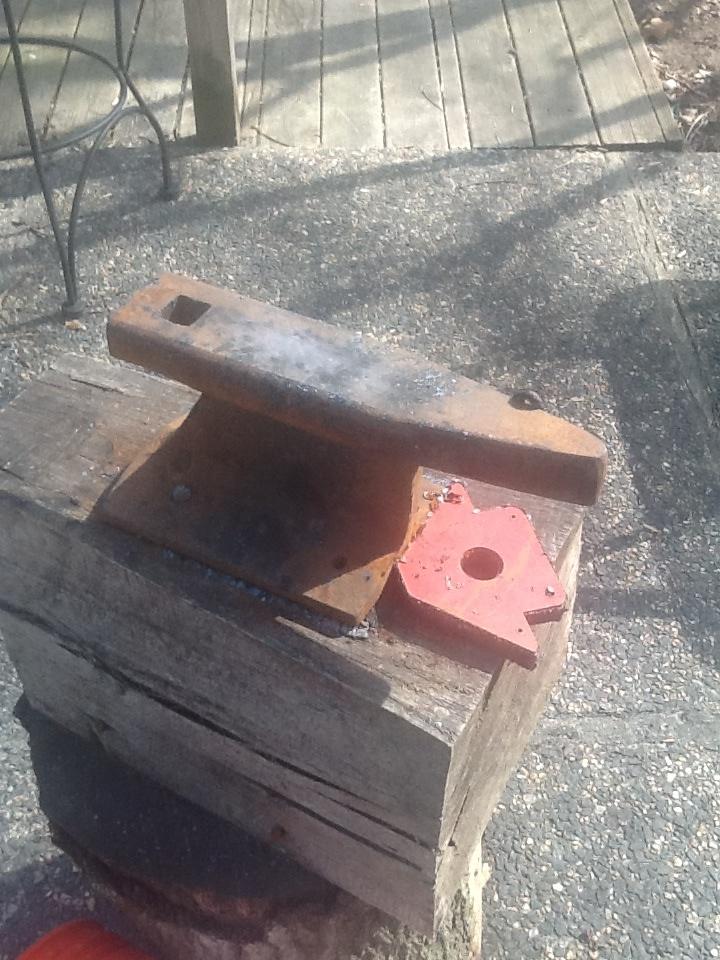
Im also using a poorly setup raiload anvil that im more than sure is not level and it might have lost its HT. I know what its like to work on a real anvil (i am part of my local blacksmith guild) and its much better but i dont have the money for a real anvil.

I have also been reading books on japanese bladesmithing and paying attention to the hamon parts of it. Lots of information to remember.
 
Before you take a blade to 2000 grit, you'll need to spend time establishing a clean 320 or 400 grit finish. At your finished grit, you still have scratch marks visible from your grinding procedures. You are right that a higher grit finish will bring a bit more detail out of the hamon as will etching with something like lemon juice or dilute ferric chloride.
 
If the belt sander is taking too long, you'd be just as well off busting out the files and sandpaper. You'll have more control, and files can hog material surprisingly quickly. Obviously this has been hardened, but it's something to ponder for future blades.

A+ for effort.
 
Orange is too low. You should be forging in the yellow range and stop at red-orange. 2100F down to 1600F. A few Templi-stix would be a good investment. They are only a few bucks each. 1200, 1400, 1600, 2000 will do a lot toward keeping steel in the ranges you want. It will also teach you to know what that temp looks like colorwise.

A RR anvil will work OK, but lacks in mass a bit. Make sure it is firmly attached to a large base.

What type of hammer are you using?
 
Orange is too low. You should be forging in the yellow range and stop at red-orange. 2100F down to 1600F. A few Templi-stix would be a good investment. They are only a few bucks each. 1200, 1400, 1600, 2000 will do a lot toward keeping steel in the ranges you want. It will also teach you to know what that temp looks like colorwise.

A RR anvil will work OK, but lacks in mass a bit. Make sure it is firmly attached to a large base.

What type of hammer are you using?
A weird ballpeen type hammer from home depot , i have a big cross peen but i had to stop using it because the head is coming loose.

also the forge i have wont get much hotter than orange , i applied itc 100 and everything but it still wont get that high. Have no idea how to fix it.
 
Post some photos of the forge, the regulator and valves, and the tank you use. If you have an ebay link to the forge maker, that will help, too. Lets see if we can tweak it to run right. I have a lot of parts that may help.

If you are using a BBQ regulator and hose, I know what the problem is.

The hammer can be snugged up by driving a new wedge in it ( hardware store). Tap the handle in tight, and drive in a metal wedge or two. If it is just a tad loose, running thin CA down the hole, or just soaking in a bucket of water for a day will usually work.

A ball peen hammer isn't balanced for forging. It will work, but a forging hammer is much better. 1 kilo (2 pound) standard blacksmiths hammer is a good general use size. If it is old and dinged up, sand the faces smooth to 400 grit.
Most hardware stores have a basic blacksmiths cross peen hammer, as does HF. Just because it came from China, and it isn't a Hofi, doesn't mean it won't move metal. Try and avoid getting a drilling or machinist's hammer. They are close, but not quite the same.
 
Can you clamp the belt sander in a vice? Its a trick we used in shop class a lot of years ago. (For orbital sanders, put them on a phone book to keep them from jumping too much- useless for steel, but for wood, its a good tip.) Check this site out for anvil tips: http://www.anvilfire.com/index.htm If you have an arc welder, you can hard face the anvil you have, assuming metal compatibilities. PM me your address. Since you are forging, I will send you a couple pieces of hex 4140 you can make some better hammers from. I have a hex axle from a combine saved just for this purpose, and I can spare a few pieces.
 
Post some photos of the forge, the regulator and valves, and the tank you use. If you have an ebay link to the forge maker, that will help, too. Lets see if we can tweak it to run right. I have a lot of parts that may help.

If you are using a BBQ regulator and hose, I know what the problem is.

The hammer can be snugged up by driving a new wedge in it ( hardware store). Tap the handle in tight, and drive in a metal wedge or two. If it is just a tad loose, running thin CA down the hole, or just soaking in a bucket of water for a day will usually work.

A ball peen hammer isn't balanced for forging. It will work, but a forging hammer is much better. 1 kilo (2 pound) standard blacksmiths hammer is a good general use size. If it is old and dinged up, sand the faces smooth to 400 grit.
Most hardware stores have a basic blacksmiths cross peen hammer, as does HF. Just because it came from China, and it isn't a Hofi, doesn't mean it won't move metal. Try and avoid getting a drilling or machinist's hammer. They are close, but not quite the same.
Here is my setup

2cxdtms.jpg


b5nwj5.jpg


30qjfba.jpg


4dyAr0V.jpg
 
Can you clamp the belt sander in a vice? Its a trick we used in shop class a lot of years ago. (For orbital sanders, put them on a phone book to keep them from jumping too much- useless for steel, but for wood, its a good tip.) Check this site out for anvil tips: http://www.anvilfire.com/index.htm If you have an arc welder, you can hard face the anvil you have, assuming metal compatibilities. PM me your address. Since you are forging, I will send you a couple pieces of hex 4140 you can make some better hammers from. I have a hex axle from a combine saved just for this purpose, and I can spare a few pieces.
I would love that but I don't know how to drift the hammers :x
 
5 minute rough edit in GIMP with your original image, removing material only. To me it would look more attractive with some material removed to make it like this. I would also probably acid etch the top half black to hide the imperfections and then sand the bevel till it was nice and clean.

14vhi6o.jpg
 
While those types are not the best forge design, the forge should run plenty hot enough. It should run at pressures from 3-5PSI where it will got around 1500-1600, to 15PSI, where you can get near welding heat. Crank up the pressure and see what it does.
If it won't run any hotter, something is wrong with the manifold.
 
i had that ebay forge for a while and it will get hot enough if you crank it up and cover the front or back openings with ceramic wool or I even used fire brick. I eventually got rid of it and got a better designed forge.
 
i had that ebay forge for a while and it will get hot enough if you crank it up and cover the front or back openings with ceramic wool or I even used fire brick. I eventually got rid of it and got a better designed forge.

Do you think its the forge thats bad or the burners? because the burners screw on and i can make my own , would that be a better option?

arent venturi burners adjustable ?
 
Back
Top