My sword heat treat kiln coming together....

Joined
Jan 10, 2010
Messages
1,818
I started a thread a couple of weeks ago about using a big top loading kiln for heat treating swords. Well... Y'all were right. Heat rises. :-) So I decided to take it apart to re-use the soft bricks, the elements and the power. I then took a smaller Aim pottery kiln and removed the back and stripped the elements and then welded up an angle iron frame. The idea was to use the smaller kiln as the door and then stack the fire bricks from the other kiln to elongate it. So here it is now with all the bricks cemented and framed up. I next need to come up with a top that will be easy to remove in case of a future element failure... and then tackle wiring. I have a PID/SSR set-up built from the sticky on this forum so I just need to convert it to 220. I'd love some advice on that.

Anyway... so far I'm happy with how it's coming together!


IMG_3175.jpg


IMG_3176.jpg
 
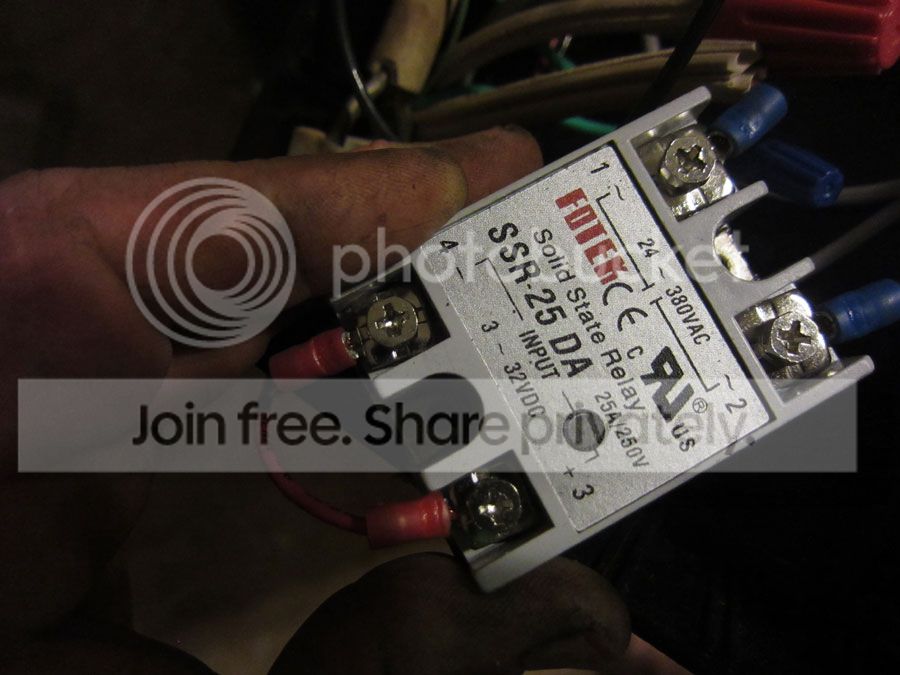
By the way... I had originally built my PID/SSR set-up to run a controlled forge so I intended it to be a 110 set-up. But I just opened my box and noticed that the SSR indicates 240V. I never noticed that before. Am I interpreting this correctly?

IMG_3179.jpg


If that is indeed correct then all I have to do is put on the heat sink, build a bigger metal box and install computer cooling fan??
 
Thanks Mark..

Okay I just saw the other thread that was just posted which had a wiring diagram for 220. So... It looks like I could run my kiln with the SSR pictured above... but two would provide the safety feature of making sure no power is going to the coils.

But.. my kiln will have the original power controls that were on the original kiln. These controls include a power switch... basically the hi/low knobs that ran the kiln. So ... would I still want the second SSR then?
 
Hey Scott... It's probably too far along but I thought this was a cool idea for an easy access vertical HT oven.

Go to 15:11 in this video.

[youtube]kTGYwiMgzUU[/youtube]

PS.. for anyone wondering about grain refinement, at 15:57 is a great example showing the same steel before and after thermocycling.
 
Here is how I have my Oven wired. 2 SSRs shut down both sides of the 220. With just one side shut down the other side of the 220 is still hot to ground and your oven frame should be ground.
Notice that I have a door switch, it is a push button mounted so it is off when the door is not closed, the second switch is a toggle on the control box that shuts the elements down while I mess with the PID. Check the terminal numbers on your PID as mine is one that I can program the ramp soak. Jim

HTovensch.jpg
 
Thanks a bunch... I had just found that right before you posted it. Very helpful.

Another question... What methods have people found to be best for holding a blade in the kiln?? I was considering running horizontal rods of stainless across for a 'rack'... but am concerned about arcing of the elements?
 
Scott, get yourself a couple soft fire bricks and drill some holes in them. Put ceramic rods in the holes to keep your sword on edge.
Place them far apart as necessary to have one at each end of the blade.


Thanks a bunch... I had just found that right before you posted it. Very helpful.

Another question... What methods have people found to be best for holding a blade in the kiln?? I was considering running horizontal rods of stainless across for a 'rack'... but am concerned about arcing of the elements?
 
okay.. I was thinking of something like that but wasn't sure if having the edge in contact with the firebrick would be an issue. But I suppose if they are spaced out as you suggest it won't be a big deal. I'd rather have the blade on edge so I don't have to pick up a blade and have it droop into a wet noodle.
 
I use two of those same ssr's in both kiln I have built. They will work well.

I have always wondered how you would pull a sword from a front load kiln and not bend the tang due to the eight of the blade:)
 
That is looking good, Scott.

I just can't get my head around how one could attain even heat in a vertical kiln without a conductive liquid media of some sort... the physics just don't support it. I am glad to decided on the horizontal build, bud.
 
Well I thought with an even pattern of elements from the top to the bottom that you would at least get some balance.. but no. I had two thermocouples running top and bottom and there was almost a 50 degree difference. The sword came out of the quench okay... but came out helter skelter after the first temper cycle... using the same kiln.

Anyway.. life will be good now.

Jake... with the sword held on edge and my wide tangs.. I don't see an issue with that. But held horizontally at critical temperature it would certainly droop mid-blade.
 
Scott,

On your vertical kiln, was there a top opening? Closed lid, with or without hole?

I notice on the French kiln in the video there was a front opening. There must still have been some temperature gradient due to convection. Has anyone any data on how much?

(Thinking of a build, myself...)

John
 
John... Yes there was a top opening in which my tang was sticking out. But in fear of too much heat loss through radiation I built a temporary 'home' for it to avoid this. But in retrospect it may have been better to let it radiate. And yes... I could see using another front opening towards the top to let out heat to even things up. But it just made better sense to go ahead and just get this horizontal one done. Like I said above.. I really don't see any reason to fear the blade drooping if you hold it on edge... so no need for a vertical anyway (although.. it is nice to draw it out and put straight into quench tube).

Still waiting for your sword John!
 
Even venting the top of a vertical forge won't do it. It will just make the entire forge cooler... still having a temperature gradient.
 
Rick,

Do you know of anyone who has measured the gradient in a vertical forge like the one shown in the above video, which has no visible vent opening.

Hot air is probably escaping around the door opening rapidly enough to disrupt the convection circulation, hot air rising along the walls by the elements, and falling down the middle, but by how much?

John
 
I highly doubt there is any convection "circulation" happening in a vertical forge... perhaps at the start but not once it is at heat. I have made mention before about Kevin Cashen's stacked forge and the temperature gradient between 12inches being almost 20Degs. Hot air rises, whether in a sealed forge or not.
 
Back
Top