Mystery Divots... Surface Grinder?

Joined
Dec 7, 2008
Messages
2,936
Mystery Divots... Surface Grinder?
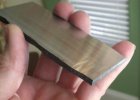
Got the surface grinder wired and the wheel faced. Just tried my first real shot at surface grinding a piece of Random Damascus.
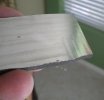
Came out within .001 all the way around but had three Divots that seemed to just appear :confused:

I have three wheels and am using the White course all purpose one to start with. Have two other Blue Nortons one fine and one extra fine.

Have not ground the surface of the chuck,,, Could that be the issue?
When it gets ground should it be Magnetic or Disengaged?
Any help is appreciated!
 

Attachments

  • Divots002.jpg
    Divots002.jpg
    24.7 KB · Views: 176
  • Divots003.jpg
    Divots003.jpg
    37.8 KB · Views: 136
Looks like you may have paused the wheel over those spots. When I 1st started out on a surface grinder I had similar marks. I was trying to bit off too much in 1 pass and where I slowed down the wheel would dig in. I took smaller "bites" and learned to move completely off the work piece before stopping or switching direction.
 
I grind in the surface of my chuck with the magnet engaged. Why? beacause a very knowledgeable machinists told me too, that's all I got. I've done it without the magnets engaged and didn't notice a difference. My tolerances are not what his were. The divots on the bar look like hesitations in the grinding. DO NOT STOP at any time while the wheel is crossing the surface, make sure you are all the way off the steel before advancing the Y axis.
 
Assuming you didn't pause in the middle of a pass, I would suspect gunk in the ways or (if this is a bearing mounted table) gunk in the table bearings. ...you didn't pause in the middle of a pass eh?

I don't think the condition of the grind of the magnetic chuck is going to do that.

It is also possible the spindle bearings or wheel are loose. While it seems very unlikely these would cause that, any play or vibration in a surface grinder can cause some weird artifacts.

... I actually hate surface grinders... tool post grinders too. Damn fickle things...

Try running the table all the way over and look at it from the bottom and see if there is anything stuck on it.
 
Did not stop and change directions until the steel was past the wheel, so that was not it. The Gunk or Crud on the bottom seems more likely. Will look at the bottom and see. Not the smoothest table but also not loose, there was a lot of oil build up all over the machine when I got it.
It was a piece of School equipment at some point, so who knows what abuse it suffered in it's past life.

What are the differences in using the Norton gel wheels XS the White wheel?
How difficult is it to change out Bearings on these pups? Just in case;)
Thanks for helping a machinist Newb out
 
Last edited:
My Sanford used to do this a little. I turned out that the ways were worn enough that at the ends of the table travel the "rack" was bottoming out in the pinon on the table drive. in the middle the rack was worn down enough that things didn't touch.
 
One thing I noticed about your photo the billet seems to be uneven and not contacting the chuck under the divots. If it is not flat and being held firmly by the mag chuck the lack of rigidity can cause some weird problems. If this is an illusion then never mind. Some things to try are move the part over away from the area you ad the problem in. Turn the part over and try the other side to see if it happens again. The magnet needs to be engaged while grinding. I have used double sided tape before but it is easier to use the chuck.
 
How difficult is it to change out Bearings on these pups? Just in case;)


There are probably no bearings on a surface grinder that you are going to want to replace. They are abec 7 or abec 9, so they are quite expensive and everything is assembled to assure balance and concentricity. Even the bearing and pulley on the motor are special. Even the windings in the motor are special. Surface grinders are a PITA.
 
I am a machinist as well and had similar caused by wheel chatter when i was learning to surface grind...were you using auto-feed or hand feed? did you notice a change in sound or vibration on that end? what sought of increments were you making between each pass?

can be hard to tell without being there but looks A LOT like wheel chatter caused by the cut increment and speed you fed across the material.
 
I cannot help you with those divots, but you do NEED to grind in your chuck or your pieces will never get parallel. they will get flat, but never parallel. My chuck was cupped a hair in the middle and when I ground mine in I took more off the edges than the middle.
 
The more I Play:D with this machine the more I like it!
Has made me Re-Think my whole approach to making knives and a lot of the mistakes/frustrations are becoming clearer now...
Bearings on this are very tight with no wobble Etc, so looks like feed/speed/bite may be it.
I will grind the chuck tomorrow, just wanted to get some practice first.

??? When grinding a piece should it be started in the middle and then worked to the edges? Start from one side and work across to the other?
Talking about bar stock here...

Have noticed that after each pass am still getting sparks for 2-3 passes in the same spot... Is this normal?
 
Start from one end and work towards the other. Measure the thickest end and start there. Take off only enough to get you going and take your time. These are only meant to take off .001-.002 with each pass. Finish passes are .0005 or less. Yes the spark will continue for a few more passes. This is called spark out and is done for the final finish pass.
 
...

??? When grinding a piece should it be started in the middle and then worked to the edges? Start from one side and work across to the other?
Talking about bar stock here...

Have noticed that after each pass am still getting sparks for 2-3 passes in the same spot... Is this normal?

Think of a surface grinder wheel as an end mill. You don't want to use the whole mill surface to cut the material, you only want to use the edge. If you apply that to a surface grinder wheel you use one edge to remove the material and the rest of the wheel will spark out the steel as you continue grinding. If you do it this way the wheel will form an angled edge that will progress towards the back of the wheel until you determine its time to dress the wheel.

Start on one side and work towards the other moving .005" to .020" per pass depending on the depth of the cut (.0001"-.040"). Typically I take off .015" at a time with a .020" feed when I'm surface grinding damascus.

Try reading this thread: http://www.practicalmachinist.com/v...-grinding-deeper-cuts-better-finishes-110659/ They explain the method better than I can.

Nate is right.Some of these machines are rated at .002mm (.000078") running accuracy new, replacement parts cost more than a used machine.:foot:
 
Back
Top