Hey I had a really interesting idea for testing your heat treatment, and thought I would share. Here's the idea. When profiling the knife leave a little tab of steel on the handle, then after you heat treat it you could break it off to check your grain size. That way instead of a destruction test on 1 out of 50 knives, you could check every one.

-
The BladeForums.com 2024 Traditional Knife is available! Price is $250 ea (shipped within CONUS).
Order here: https://www.bladeforums.com/help/2024-traditional/
You are using an out of date browser. It may not display this or other websites correctly.
You should upgrade or use an alternative browser.
You should upgrade or use an alternative browser.
Neat Idea
- Thread starter Nebulae
- Start date
- Joined
- Jan 15, 2012
- Messages
- 74
thats a good idea
- Joined
- Oct 4, 2011
- Messages
- 1,043
Hmm, interesting! It would only show you if the grain size was abnormally large, or else youd have to take each knife to the microscope, right? I'd like to hear what the more experienced makers think.

- Joined
- Dec 25, 2004
- Messages
- 1,363
That's a really good idea actually, The problem is the tab should be left on the edge on carbon blades, especially if you are dipping it up to ricasso or doing only edge quenching. This test would be much more useful for forged blades but leaving a piece to break maybe a bit difficult than it seems.

- Joined
- Jan 6, 2005
- Messages
- 9,680
I don't think it is practical or necessary. As someone who heat treats their own work and does a lot of testing, I can confidently say that the largest obstacle to overcome is consistency. If you need to run tests on every piece you make, it is only because you lack consistency(or the proof that you ARE consistant). I am a firm believer that you need to set aside time to work on heat treat without the worry of ruining a blade that you've invested time into. Make simple blanks and test until you gain confidence.
I just made that up... heh-heh."Being a good knifemaker is nothing more than a con game... Consistency, Confidence and Constant improvement."
Last edited:

- Joined
- Dec 13, 2006
- Messages
- 2,415
I do something similar but I cut some extra pieces from the steel I am using for a blade, I will typically do 5-6 at one time. Typically they are rectangles of left over steel and I run them through the same HT with the blades, I break one prior to temper to see what kind of grain I have and the break some after temper to see how tough it is, I also put and edge on one and do some rope cutting. Lots of good info to be collected here without breaking a good blade. I do destructive testing on some blades when something gets messed up, I will finish the blade without a handle and then mess with it until there is nothing left, lots of fun.

james terrio
Sharpest Knife in the Light Socket
- Joined
- Apr 15, 2010
- Messages
- 22,618
I just made that up... heh-heh.
I like it :thumbup:

- Joined
- Oct 27, 2010
- Messages
- 8,721
Rick, you are right, and I also think Neb is right. Without periodic test samples, how can you be so sure your equipment is still functioning at 100% of expected efficiency. Stange things happen, maybe taking small 1x3 pieces of the same steel and running them through the same routine as your blades every so often, maybe quarterly, or after XX blades, or when you have reason to believe it is needed would be a good idea. I don't like the idea of a tab that will be broken off of a blade because all sorts of other possibilities for damage to the blade arise, like bending, cracking, or worse.
Production facilities rely heavily on continual test samples to maintain a perceived quality of final product, why shouldn't we? We test edge geometry, edge holding, toughness, cutting/shaving and all sorts of other things. Rick, I know you are a very methodical, thorough person and if you feel or have proven (I don't own one of your blades - yet, so I personally don't know) that your process is as consistant as you expect, 100% of the time, then that is awesome.
I say to test, and retest as often as one feels is needed.
-Xander
Production facilities rely heavily on continual test samples to maintain a perceived quality of final product, why shouldn't we? We test edge geometry, edge holding, toughness, cutting/shaving and all sorts of other things. Rick, I know you are a very methodical, thorough person and if you feel or have proven (I don't own one of your blades - yet, so I personally don't know) that your process is as consistant as you expect, 100% of the time, then that is awesome.
I say to test, and retest as often as one feels is needed.
-Xander
- Joined
- Jan 6, 2005
- Messages
- 9,680
I apologize for not expalining myself, fully. I whole heartedly believe in testing, even a proven method, periodically. I just wanted to stress the importance of setting aside time and resources to hone your heat treating skills. Many new makers fall into the trap of making "knives" right off the bat. If every blade you "test" is one you've poured yourself into making, I argue that you either will not test to the level it should be done or you won't test enough blades to form a consistant method and result. If you are heat treating in a forge, once a week, and thinking that you are achieving the consistancy needed to come to a conclusion, I don't think you are being honest with yourself.Rick, I know you are a very methodical, thorough person and if you feel or have proven (I don't own one of your blades - yet, so I personally don't know) that your process is as consistant as you expect, 100% of the time, then that is awesome.
I say to test, and retest as often as one feels is needed.
My suggestion is to make a couple dozen blanks, heat treat 2-3 blades at night, test the next day and repeat. Do this for 20+ blanks, consecutively, for a few weeks, so you get into the "zone". Repetition is the key. Try to find a way to get your blades Rockwell tested. Obviously, it will be easier with a controlled kiln but you can take the same approach with an open forge.
I still test every blade I make for common perfomance attributes but you should have to check grain size on a knife by knife basis.
Last edited:
What magnification is needed to check grain size? Couldn't you just polish a small section of blade, stain it, then check for grain size. Actually, I think Ed Fowler mentions something like this on his website. In that case you don't need any test pieces to check for grain size because you would be checking every knife. Now, stainless might be a little harder to check.
I think Rick is correct, for what he does. Since he HTs so many knives, and does good testing he doesn't need to check every single one, as he stated consistency is key, and he does enough to get consistent. But honestly I am pretty new at all this and I have only HTed a very few blades, and for the foreseeable future will be doing less than a dozen or so in a year, so I will never really reach a steady state. I make so few that it really hurts to do a destruction test, and I am not at all consistant.
P.S. gonna be trying a water quench hammon soon wish me luck!
P.S. gonna be trying a water quench hammon soon wish me luck!

- Joined
- Jan 6, 2005
- Messages
- 9,680
Nebulae... you make a valid point that I feel foolish for not addressing. It has been a while since I did anything as a hobby. If you are making a knife every now and then, when time and work permits, then spending weeks on heat treat might not be an option. And if you managed to pull it off, the time inbetween knives would probably leave you rusty.
In this case, I would make a small blank in addition to your knife, for a practice run prior to final heat treat. With this piece you can check grain size, Rockwell test or whatever you had in mind. Then you can adjust accordingly before HT'g the knife your spent time on.
Bo T... Checking grain size can be done with the naked eye or a low magnification jeweler's loupe(10-40X) You simply break the steel and check the face of the fracture. There is no polishing necessary. Infact, it is easier to see if nothing contaminates the break. Here is a pretty good thread where a member asked advice about HT, which eventually drifted to grain size. Once he realized that he could further refine his grain, he went back and improved his normalizing/austenizing methods, resulting in a major improvement.
He went from this(which isn't the worst I've seen)...
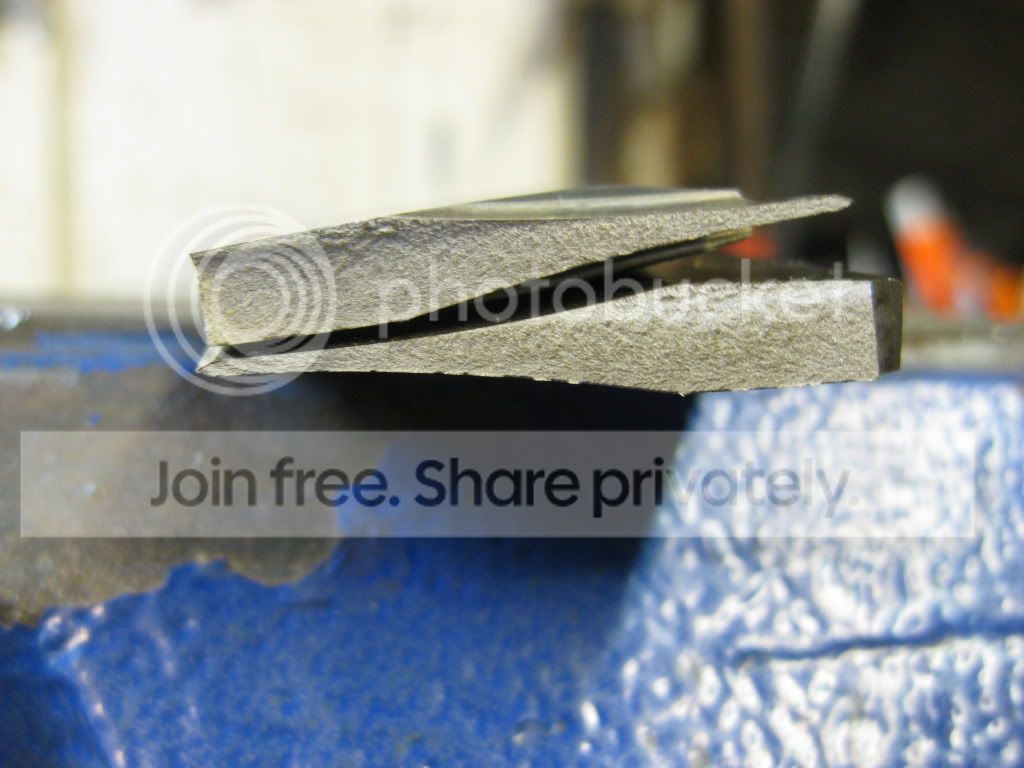
to this...

In this case, I would make a small blank in addition to your knife, for a practice run prior to final heat treat. With this piece you can check grain size, Rockwell test or whatever you had in mind. Then you can adjust accordingly before HT'g the knife your spent time on.
Bo T... Checking grain size can be done with the naked eye or a low magnification jeweler's loupe(10-40X) You simply break the steel and check the face of the fracture. There is no polishing necessary. Infact, it is easier to see if nothing contaminates the break. Here is a pretty good thread where a member asked advice about HT, which eventually drifted to grain size. Once he realized that he could further refine his grain, he went back and improved his normalizing/austenizing methods, resulting in a major improvement.
He went from this(which isn't the worst I've seen)...
to this...
Nebulae... you make a valid point that I feel foolish for not addressing. It has been a while since I did anything as a hobby. If you are making a knife every now and then, when time and work permits, then spending weeks on heat treat might not be an option. And if you managed to pull it off, the time inbetween knives would probably leave you rusty.
In this case, I would make a small blank in addition to your knife, for a practice run prior to final heat treat. With this piece you can check grain size, Rockwell test or whatever you had in mind. Then you can adjust accordingly before HT'g the knife your spent time on.
Bo T... Checking grain size can be done with the naked eye or a low magnification jeweler's loupe(10-40X) You simply break the steel and check the face of the fracture. There is no polishing necessary. Infact, it is easier to see if nothing contaminates the break. Here is a pretty good thread where a member asked advice about HT, which eventually drifted to grain size. Once he realized that he could further refine his grain, he went back and improved his normalizing/austenizing methods, resulting in a major improvement.
He went from this(which isn't the worst I've seen)...
to this...
You would need to break the steel to check for homogeneity through the thickness of the blade. And the 2 pieces you show seem to be uniform except for the area on one side that I am assuming to be from compression from breaking the blade. If we assume uniform grain structure throughout then wouldn't a surface polish to expose clean metal allow one to check the grain size without destroying the blade? I just really hate to see a good piece of metal destroyed. Also, if this is possible, then couldn't one easily check every blade and multiple areas of the blade?
- Joined
- Oct 27, 2010
- Messages
- 8,721
Surface polishing will not show you if through hardening was accomplished. Immature soak times and or hot spots in a forge can cause only a "skin" to harden leaving improper grain in the interior of the steel.
-Xander
-Xander
- Joined
- Dec 25, 2004
- Messages
- 1,363
I run "brass rod" test to every knife I make. In normal conditions, with normal edge angles this test, if done right, does tell you if a grain size problem occurred or not. The edge has tendency to overheat and open to gain size problems (both for normal grain size or carbide sizes). So to check the edge functioning well, usually tells you if you have a good HT run or not...
For micro cracks, I run flex tests to each knife, it is better if the knife broke on my hands rather than the customer.
To break the steel and inspect the grain size is fun but I believe it is not necessary at all..
For micro cracks, I run flex tests to each knife, it is better if the knife broke on my hands rather than the customer.
To break the steel and inspect the grain size is fun but I believe it is not necessary at all..
- Joined
- Jan 6, 2005
- Messages
- 9,680
I somewhat disagree, Galadduin. Perhaps, once you've established consistant geometry and heat treat, you have somewhere to work from with the brass rod test. Unless we are speaking of major grain growth, you would be hard pressed to assess and fine tune grain size in that way. What constitutes "normal edge angles" or "normal geometry"? A knife with a 30deg inclusive edge with a shoulder of .030" is going to behave quite differently from a knife with the same 30deg inclusive edge and .010" shoulder. Add to that, convex, hollow, full flat, etc... and you have too many variables for the "occasional maker" to draw a clear conclusion with a brass rod test. I believe it is in your best interest to know what is happening with everything behind the edge as well. Observing grain size from a break isn't just for fun and games... especially for those who heat treat in and uncontrolled forge, only a dozen times a year. I rarely check the grain these days because I am confident in my method and routinely calibrate my equipment. I don't need to "experiment" with normalization cycles because I already put the time into that(through making and breaking). I am always looking for better ways but I am doing the best I can with what I know, now.
- Joined
- Dec 25, 2004
- Messages
- 1,363
Sorry if I couldn't explain, I was talking about my routine, the geometry is really thin on my knives generally, I have run break tests numerous times, I studied all the steel types within my reach, I have calibrated all my thermocouples, ovens, regularly maintain the equipment I have, for the new steel I do destruction tests until I'm satisfied with the results. I have been experimenting and polishing my HT technique for about 6 years. I am confident that unless a new variable is introduced to my process, to break some knives in order to check the grain size is somewhat redundant, again I emphasize: for me !