
Hey all! This is my first post and I thought I'd start it with a bang.
I tinkered with forging about 10yrs ago and had to get away from it due to life intervening. But, now that I've got some free time I decided to reignite an old hobby.
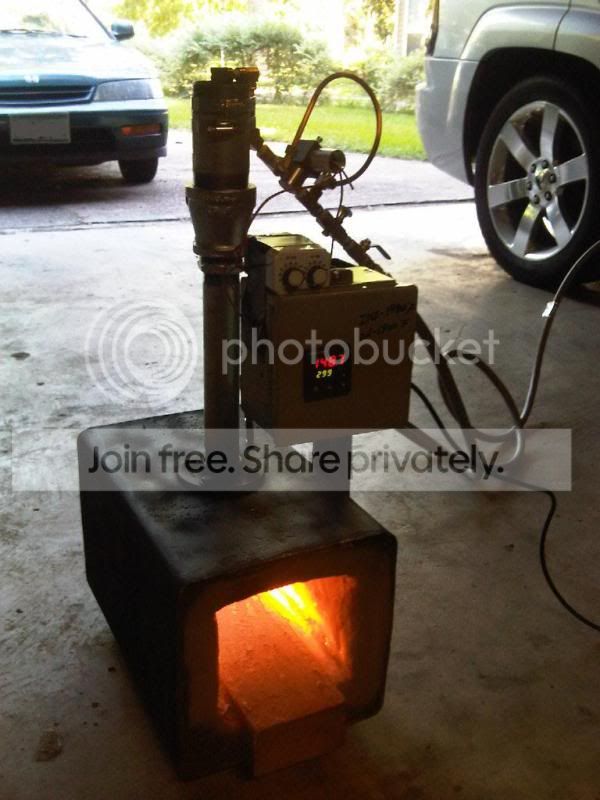
So I built a forge and got to work on some stock removal 1095 knives. Forge is made from a 16"L section of 9"x9" square structural tube, 2" of ceramic wool coated with furnace cement, firebrick floor, 1" pipe burner w/ brass NPT nozzle, electronic solenoid valve controlled by PID controller which uses a K-type thermocouple to regulate the temperature. I added a second controller (not shown in picture below) to just monitor the interior temperature of a section of 3" exhaust pipe I'm using for heat-treating.
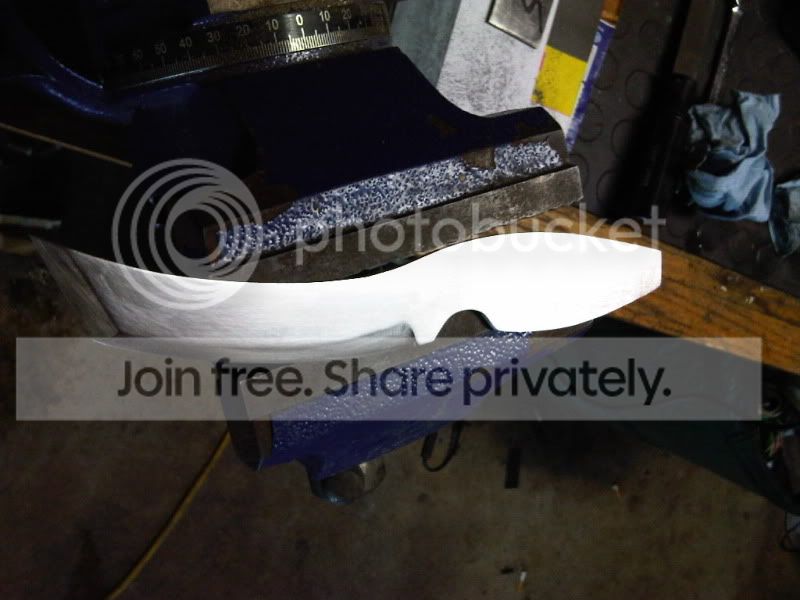
Here's the first blank I ground out of a section of 1.5"W x 12"L x 0.125"t 1095 steel.
My first heat treat with this blade was clay coat and quench in ATF. After polishing and etching the surface a bit the hamon wasn't very descipt and only went up the blade about 1/4". So I decided to quench a second time (no re-anneal I might add) but in brine. Blade was heated to 1,500 and quenched in 75deg brine. Blade was left in the brine until cool to touch. A little warping to one side was noted and decided to try an fix it (cold) in my vise and some "gently coercion". You can probably figure out what came next - SNAP! i went ahead and polished/etched the blade fragment but results were same as before - non-descript hazy hamon. I'm thinking that I didn't let it soak long enough, coupled with the 1/4" layer of furnace cement I used on the blade caused a lot of probems. I also noted some significant stress cracking on the surface of the blade probably caused by me bending it in it's hardened state and not bothering with a temper.
SO, I've learned my lesson. I've ground out a another blade to heat-treat:


...and here's the process I'm going to follow to complete this blade and hopefully get a hamon:
1) Anneal steel @ 1,475degF & cover with ceramic blanket. Let cool with forge. (DONE)
2) Profile grind & hand sand to 320 grit. Leave edge @ 0.020 to 0.040 (DONE)
3) Normalize @ 1,570degF 3 times allowing to air-cool between, reducing temperature for each consecutive step.
4) Apply thin was of furnace clay to whole blade. Cover hamon spine with clay to depth of 0.0625 to 0.125. Form clay to desired hamon form.
5) Insert Exhaust tube into forge and heat forge to 1,475degF. (PID Controller setting: 1,430degF). Insert remote T/C into inlet of HT Tube. Int. HT Tube temp needs to be 1,475degF.
8) Insert blade into HT Tube and let come to 1,475degF. Soak for 5mins.
9) Quench in 75degF brine. Count to 5, pull blade out while still warm (500 to 400degF) and check for warpage. Fix immediately. Place back in quench.
10) Temper @ 400degF IMMEDIATELY! Temper for 2hrs, let cool 30mins, temper again for 2hrs, cool for 30mins.
11) Hand sand/polish to 2,000 grit.
12) Etch with one of the following:
a. Ferric Chloride (1 part FC, 4 parts H20)
b. Warm Apple Cider Vinegar
c. Warm lemon juice (heat blade to 212 degF)
13) Polish w/ red rouge
14) Etch again & repeat step 8 & 9 until hamon is acceptable.
Can anyone else who's had a lot of experiece heat treating for a hamon chime in and double-check my procedure above. I'd appreciate any input you could give since I would hate to break another blade that I just spent 4 hours sanding on in preparation of the heat-treat. I've done a fair bit of research since my first try and figured out a number of things I did wrong - Didn't anneal before second heat-treat, didn't keep the metal at the proper temperature to fix warpage (>400degF), didn't temper @ 400degF right after the quench.
School of hard knocks I guess.
Thanks much!
- Jesse
I tinkered with forging about 10yrs ago and had to get away from it due to life intervening. But, now that I've got some free time I decided to reignite an old hobby.
So I built a forge and got to work on some stock removal 1095 knives. Forge is made from a 16"L section of 9"x9" square structural tube, 2" of ceramic wool coated with furnace cement, firebrick floor, 1" pipe burner w/ brass NPT nozzle, electronic solenoid valve controlled by PID controller which uses a K-type thermocouple to regulate the temperature. I added a second controller (not shown in picture below) to just monitor the interior temperature of a section of 3" exhaust pipe I'm using for heat-treating.
Here's the first blank I ground out of a section of 1.5"W x 12"L x 0.125"t 1095 steel.
My first heat treat with this blade was clay coat and quench in ATF. After polishing and etching the surface a bit the hamon wasn't very descipt and only went up the blade about 1/4". So I decided to quench a second time (no re-anneal I might add) but in brine. Blade was heated to 1,500 and quenched in 75deg brine. Blade was left in the brine until cool to touch. A little warping to one side was noted and decided to try an fix it (cold) in my vise and some "gently coercion". You can probably figure out what came next - SNAP! i went ahead and polished/etched the blade fragment but results were same as before - non-descript hazy hamon. I'm thinking that I didn't let it soak long enough, coupled with the 1/4" layer of furnace cement I used on the blade caused a lot of probems. I also noted some significant stress cracking on the surface of the blade probably caused by me bending it in it's hardened state and not bothering with a temper.
SO, I've learned my lesson. I've ground out a another blade to heat-treat:
...and here's the process I'm going to follow to complete this blade and hopefully get a hamon:
1) Anneal steel @ 1,475degF & cover with ceramic blanket. Let cool with forge. (DONE)
2) Profile grind & hand sand to 320 grit. Leave edge @ 0.020 to 0.040 (DONE)
3) Normalize @ 1,570degF 3 times allowing to air-cool between, reducing temperature for each consecutive step.
4) Apply thin was of furnace clay to whole blade. Cover hamon spine with clay to depth of 0.0625 to 0.125. Form clay to desired hamon form.
5) Insert Exhaust tube into forge and heat forge to 1,475degF. (PID Controller setting: 1,430degF). Insert remote T/C into inlet of HT Tube. Int. HT Tube temp needs to be 1,475degF.
8) Insert blade into HT Tube and let come to 1,475degF. Soak for 5mins.
9) Quench in 75degF brine. Count to 5, pull blade out while still warm (500 to 400degF) and check for warpage. Fix immediately. Place back in quench.
10) Temper @ 400degF IMMEDIATELY! Temper for 2hrs, let cool 30mins, temper again for 2hrs, cool for 30mins.
11) Hand sand/polish to 2,000 grit.
12) Etch with one of the following:
a. Ferric Chloride (1 part FC, 4 parts H20)
b. Warm Apple Cider Vinegar
c. Warm lemon juice (heat blade to 212 degF)
13) Polish w/ red rouge
14) Etch again & repeat step 8 & 9 until hamon is acceptable.
Can anyone else who's had a lot of experiece heat treating for a hamon chime in and double-check my procedure above. I'd appreciate any input you could give since I would hate to break another blade that I just spent 4 hours sanding on in preparation of the heat-treat. I've done a fair bit of research since my first try and figured out a number of things I did wrong - Didn't anneal before second heat-treat, didn't keep the metal at the proper temperature to fix warpage (>400degF), didn't temper @ 400degF right after the quench.
School of hard knocks I guess.
Thanks much!
- Jesse


