Need help identifying a knot...

Tough to tell from the low-res picture, but it could be a double fisherman's knot. Used in mountaineering to join two ropes. In this case it is used to form a big loop. Because the loop is twisted to tension the saw, the knot has an asymmetric appearance--kinda popped off to one side. That's my thinking. :)
 
Looks like a blood knot, or a surgeons knot. Both used to put 2 lines together. In the case of that saw, it forms a continuos loop for the back side of the saw.
 
Way too difficult :D

Until someone who knows this type of saw well comes, my conjecture is tautline.

I'm thinking a tautline might slip with the kind of tension a windlass would put on it??

Tough to tell from the low-res picture, but it could be a double fisherman's knot. Used in mountaineering to join two ropes. In this case it is used to form a big loop. Because the loop is twisted to tension the saw, the knot has an asymmetric appearance--kinda popped off to one side. That's my thinking. :)

I go with Rotte - a double fisherman's knot, or at least that's probably what I would use because of the tension that would be on it.

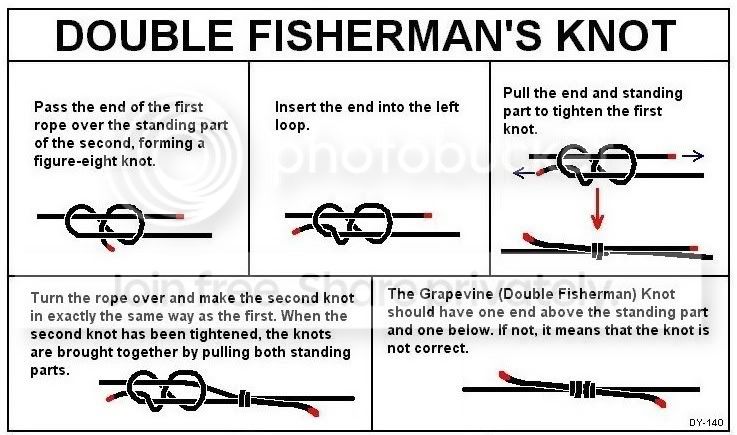
DoubleFishermansKnot.jpg


Doc
 
I'm with the previous guys. Looks like a double fishermen's bend to me.

Any type of solid bend would work to make the tension loop... zeppelin, carrick, double sheet, fishermen's, double fishermen's, etc.
 
The double fisherman's knot would be a good one for this application, and the knot in the photo could actually be one because there appear to be four 'wraps' of cord in the knot.

Dang, Doc.... I looked at your diagram and thought 'that doesn't look like a double fishermans knot'. But I followed it and got a result that did look like the knot that I know and love. I must play with your method some more. Thanks for that. I actually may have seen your diagram in the past, but because I was familiar with the knot I didn't look closely. Perhaps your method might become more automatic than mine... I have to look carefully at what I'm doing to make sure the wraps stay crossed if you know what I mean.

I picture it a different way when tying it, with the loops held quite high so that the tail end can just be passed through the knot in a straight line from one end....as the black cord indicates in the diagram below.

DoubleFishermansKnot.jpg


The double fishermans bend/knot is relatively difficult to undo, or adjust...not that it probably matters in this application. For many joining situations now I prefer the zeppelin bend.

ZeppelinBend.jpg
 
Last edited:
Hey coote, good to see you here.

Something you might want to try, since I know how much you like the Zeppelin knot - run the ends through the centre a second time and see what you think.

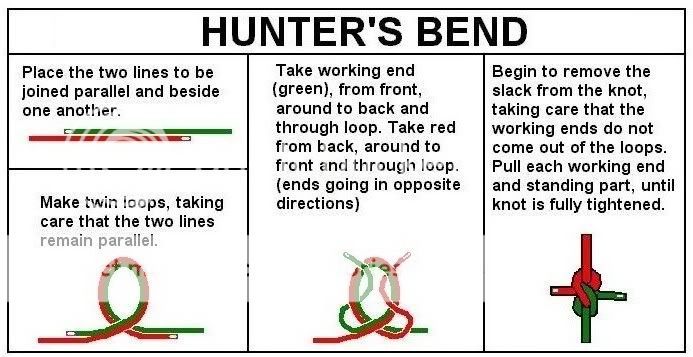
The other knot that is almost identical is the Hunter's Bend.

HuntersBend.jpg


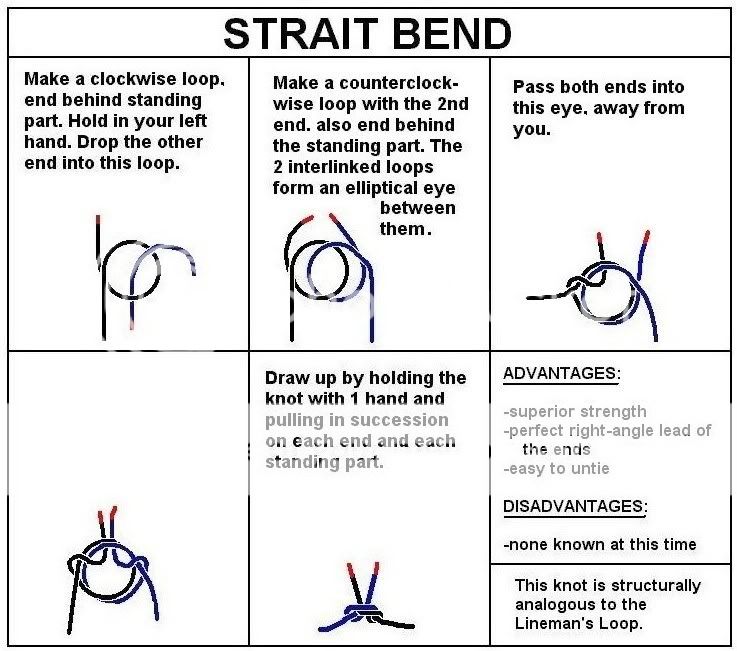
My most used bend, though, is the Strait Bend (which I usually make 'slippery'):

StraitBend.jpg


Doc
 
Last edited:
Funny you should mention running the ends through the loop of the zeppelin bend a second time Doc. I tried doing that a couple of days ago when experimenting trying to find the best monofilament fishing line joining knot. I even ran the ends through three times. This 'improved' zeppelin bend actually performed quite well in tests compared to my old favorite mono joining knot - the blood (or barrel) knot, but twin uni knots or a surgeon's knot (water knot) generally seem to be the strongest knots for this job.

That Hunter's bend looks like it would be easier to teach than the Zeppelin bend.

The straight bend should be good. Joining a rope that way would have a similar effect to when a lineman's loop (alpine butterfly) is tied at a damaged point on a rope to isolate the damaged part.

I wonder if there is an appreciable difference in strength between any of the bends we've been discussing.
 
This is what I love this board for. You ask one question - you get an answer - then you learn more stuff because people are willing to teach.

Thanks yall,

TF
 
I can't really tell from the picture but you want a knot that will not slip and creates a loop, I would use a figure 8 or a simple overhand knot. There may be some kind of special bow string knot that would serve the same function but the amount of pressure on this knot is only enough to tension the blade I think the overhand or figure 8 would suffice.
 
Last edited:
Talfuchre. I should have said earlier that I reckon you made a great job of those saws.

This is a bit of a change of subject, but it may be interesting......

I visited the home of some (Cambodian?) refugees in our city. One of the young guys had been making some fantastic model ships by cutting some very thin 'concentric' ship hull shapes in a plank, then pulling the individually cut out bits from the plank. The biggest (outer) shape would be at the top of the hull, then the next smaller one would be fitted below, then the next smaller and so on. If you can't picture this, it doesn't really matter for the point of this tale.

Anyway, cutting out these shapes required a very fine cut. And it also required that the cut could follow a series of curves. I asked how he made the cuts. Turns out he'd made his own blades by getting a bit of bicycle brake cable.... one strand.... and then he carefully cut 'teeth' all around this thin steel strand with a sharp chisel. The blade was then fixed into a frame, but I can't recall what the frame was like now.
 
Back
Top