Need Help ID'ing Old Sword

Joined
Aug 10, 2011
Messages
7
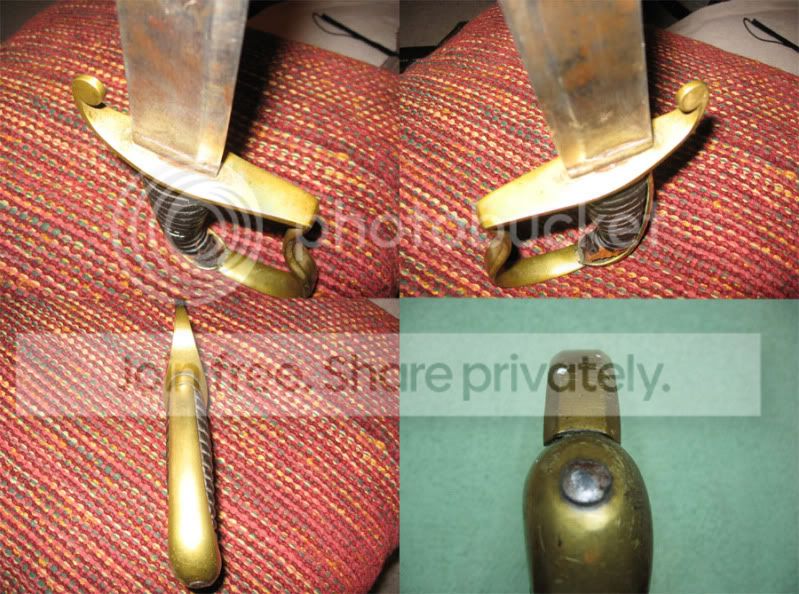
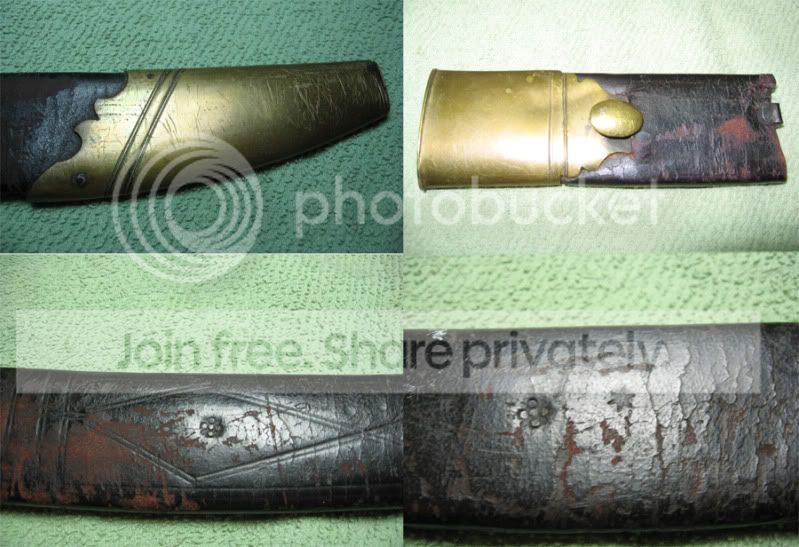
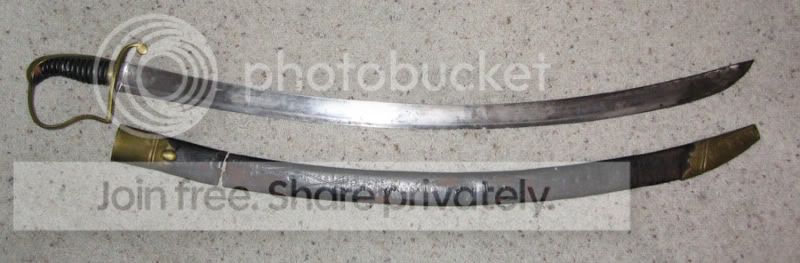
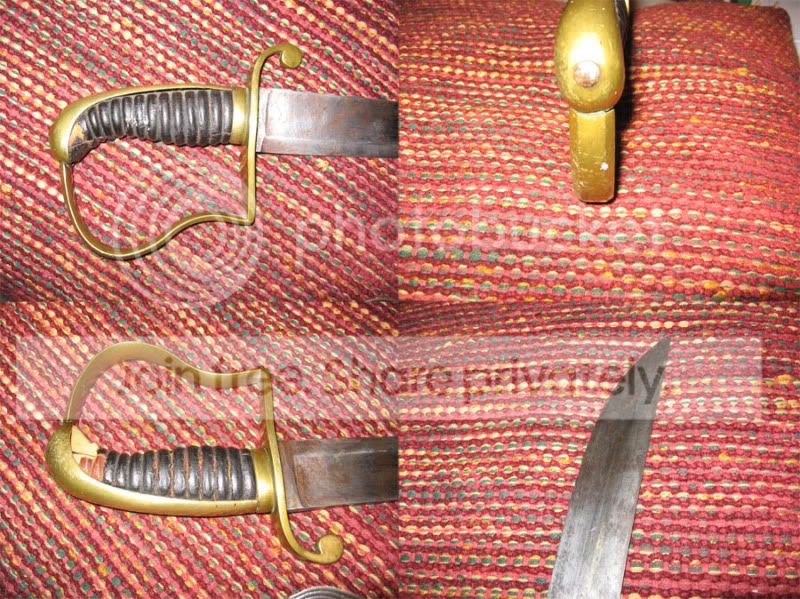
My Mother-in-law gave me this sword this past weekend. It used to hang in her fathers house on a farm in Freehold NJ. As far as she knows, he always had the sword, and it may have come from his maternal grandmother. He was born in 1885, and it predated his birth. The sword resembles an N. Starr sword, but is unmarked. From what I can determine this type of sword was used by the Militia around the War of 1812, basically from 1800 to 1830. It has its original leather scabbard, and it appears to be a cavalry sword meant to hang from a sling/belt/frog. The scabbard has some lines and other markings, basically little circles in groups of 7 and 5 looking a bit like petals on a flower. There is a small six pointed star towards the bottom. The blade measures 32 ½ inches long (direct from the hilt, not along the curve). It has a very wide fuller that ends approximately 6 inches from the point, which is not clipped. The blade is 1 ½ inch wide and ¼ inch thick at the hilt, the guard is brass, the handle is wood wrapped with leather, and no wire is left. The tang is peened to the guard. It is a very substantial sword and very strong.
If anyone can identify this sword, I would greatly appreciate knowing when and who may have made it.
OldSword1.jpg


OldSword2.jpg


OldSword3.jpg


OldSword4.jpg
 
It can be difficult to discern exactly when these were made and who made them. Mounted artillery or militia cavalry. The scabbard markings probably unrelated to and inconsequential in determining who made the sword and where.. The blade and hilt to me speaks of English origin but there were several Philadelphia producers of similar swords (Nippes, Henry, others). The thing is the are less to have not marked a blade at all while many imports were not marked at all. The earlier timeline makes sense to me as by and after the War of 1812, more militia cavalry types are coming from Prussia and the hilts have langets. There wer several agents of importyers in New York such as Spies, Wells and Wolfe but they frequently marked their wares even on nco and trooper level arms. is there any trace of lettering on the spine of the blade?

This very possibly never had wire on the grip. I am not sure why this one looks like one I have just seen on the market but I see a great many that are similar. The width of the blade also makes me think of that war period or earlier. I had recently picked up a later militia cavalry/artillery type with a blade a bit more slender, langets and also never had wire to begin with. This one probably of Solingen origin but unmarked as well. In that case I also have to compare to other swords coming out of Solingen and Alsace vs the English cutlers. Those are not absolute traits but can be good indicators.
%24(KGrHqF%2C!iEE3OkSSp)eBOKHQZ27%2BQ~~0_3.JPG

%24(KGrHqN%2C!hME3vRMqSjuBOKHQSPORg~~0_3.JPG

%24(KGrHqYOKnUE4LE9rp%2BBBOKHQMfTcQ~~0_3.JPG

%24(KGrHqV%2C!g0E3uUIs1jVBOKHQR%2Cowg~~0_3.JPG


Dick Bezdek has a pay for appraisal option and has authored several books. One particularly pertinent to this sword s of the 1812 type. In his book on the 1812 swords, there is indication that there was fairly free exchange going on in Philadelphia, so it may well have had a blade from one source, a hilt from another and the scabbard by yet another.
http://www.theswordman.com/

A mark as simple as just a script JS or a little scrolling squiggle on the spine can lend clues (the squiggle Solingen and the JS Salter). The characteristics I see on your example that point to England (aside from just the blade) are things like the grip contour (American grips of the time quite bumpy/balled, Prussian grips? look Above) The knuckle bows themselves (mine has the knot slot and buttress at the corner, as well as the langets). Little things that add up. Starr and Rose tended to use steel/iron a great deal more for their contract pieces.

Nice piece and enjoy it. One way to patch the scabbard is to lay cards inside with cement. Do this with the blade inserted. The inner cards will tack the pieces together. That is much better than tape, which we see as an expedient for these. There are also folk actually remaking these with the old fittings. I do not have a site for them though. others may be able to take a shot at that as well but this scabbard has some more unique facets to it.

Cheers

GC
 
Last edited:
GC,
Thanks for your comments. It well may be that the blade came from elsewhere and the hilt and scabbard from America. While reading "Man at Arms" magazine, I saw a couple of swords that were profiled as being from the 1812 period. They had a wide fuller that is similar to the one on my sword, and the article noted that the blade was imported from Germany. I'll look closely at the spine of the blade, but in previous examinations I've not seen any discernable marks.
Also, at the recommendation of another member, I'm posting this on the Bernard Levine forum in hopes someone there might be able to identify the maker and vintage.
 
Well,

Good luck with the ID elsewhere at BF. You might also consider sword specific forums such as

http://www.swordforum.com/forums/forum.php

and

http://www.myarmoury.com/talk/

and

http://www.vikingsword.com/vb/

and

*new*

http://www.napoleonicwarsforum.com/index.php

There is yet another. If "Don" Furr is still posting, he may expound on it a bit more than just another generic mounted artillery sword.

http://www.antiqueguns.com/phorum/list.php?8

Keep in mind that England was importing a lot of blades from Solingen as well. For the American market is likely but my hunch is still English cutlery work for the entire piece.

Cheers

GC
 
Back
Top